Family-based treatment was associated with faster weight gain than enhanced cognitive-behavioral therapy in adolescents
Enhanced cognitive-behavior therapy and family-based treatment for adolescents with an eating disorder: a non-randomized effectiveness trial
non-randomized effectiveness trialMixed results
Is family-based treatment or enhanced cognitive-behavioral therapy more effective for adolescents with eating disorders?
Who
97
adolescents aged 12-18 years with a DSM-5 eating disorder diagnosis
Compared
Family-based treatment: significantly higher slope of weight gain at end-of-treatment
Enhanced cognitive-behavioral therapy: lower slope of weight gain at end-of-treatment
Main outcome
slope of weight gain and Eating Disorder Examination Global Score
Bottom line: Family-based treatment facilitates faster weight gain, but both treatments achieve similar outcomes in other domains.
Psychol Med · 2020-12-03Download image
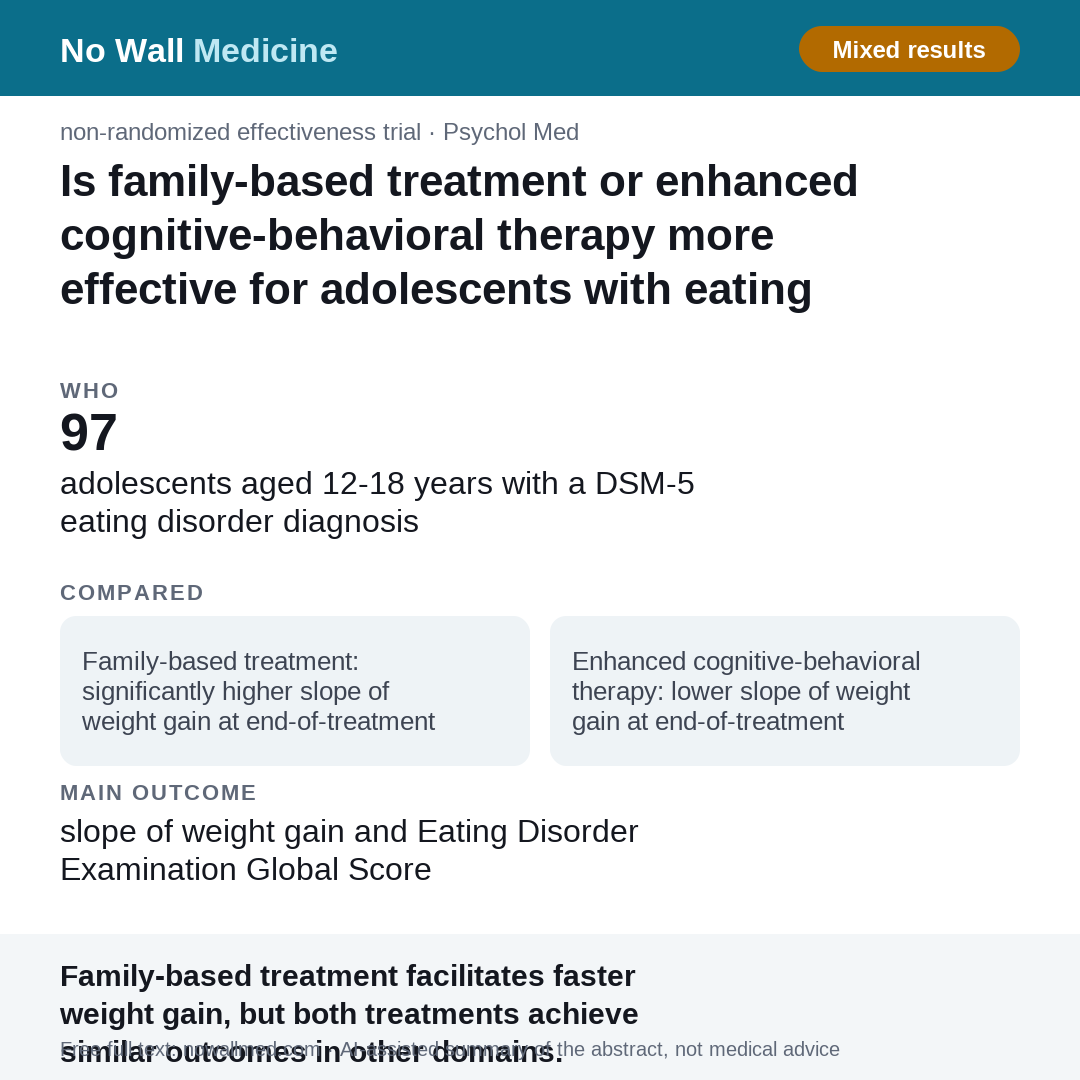
Clinical question: Is family-based treatment or enhanced cognitive-behavioral therapy more effective for adolescents with eating disorders?
Why it matters: It was unknown how family-based treatment compared to enhanced cognitive-behavioral therapy regarding weight gain and symptom severity in adolescents with eating disorders.
Key points
- The study looked at 97 adolescents aged 12-18 years with an eating disorder who chose between family-based treatment or enhanced cognitive-behavioral therapy.
- At the end of treatment, the rate of weight gain was significantly higher for family-based treatment than for enhanced cognitive-behavioral therapy in both lower and higher weight groups.
- There were no differences between the two treatments regarding the Eating Disorder Examination Global Score, which measures eating disorder symptom severity, at any time-point.
Headline and key points written with AI from the paper’s abstract, with every number checked against it. Read the paper before relying on them.
Was this summary helpful?
Cite this article
Le Grange D, Eckhardt S, Dalle Grave R, Crosby RD, Peterson CB, Keery H. Enhanced cognitive-behavior therapy and family-based treatment for adolescents with an eating disorder: a non-randomized effectiveness trial. Psychol Med. 2020. doi:10.1017/S0033291720004407
Spotted a mistake? Suggest a correction
Top studies every Monday
The week’s key trials and guidelines in your specialties, plus any topics you follow. By email, free.
Get the weekly digest