Inspiratory muscle training after pulmonary rehabilitation increases diaphragm movement and exercise tolerance in COPD patients
Enhanced diaphragm excursion and exercise tolerance in COPD patients through inspiratory muscle training after standardised pulmonary rehabilitation: randomised controlled trial
Randomised, prospective, parallel-group, unblinded controlled trialBenefit found
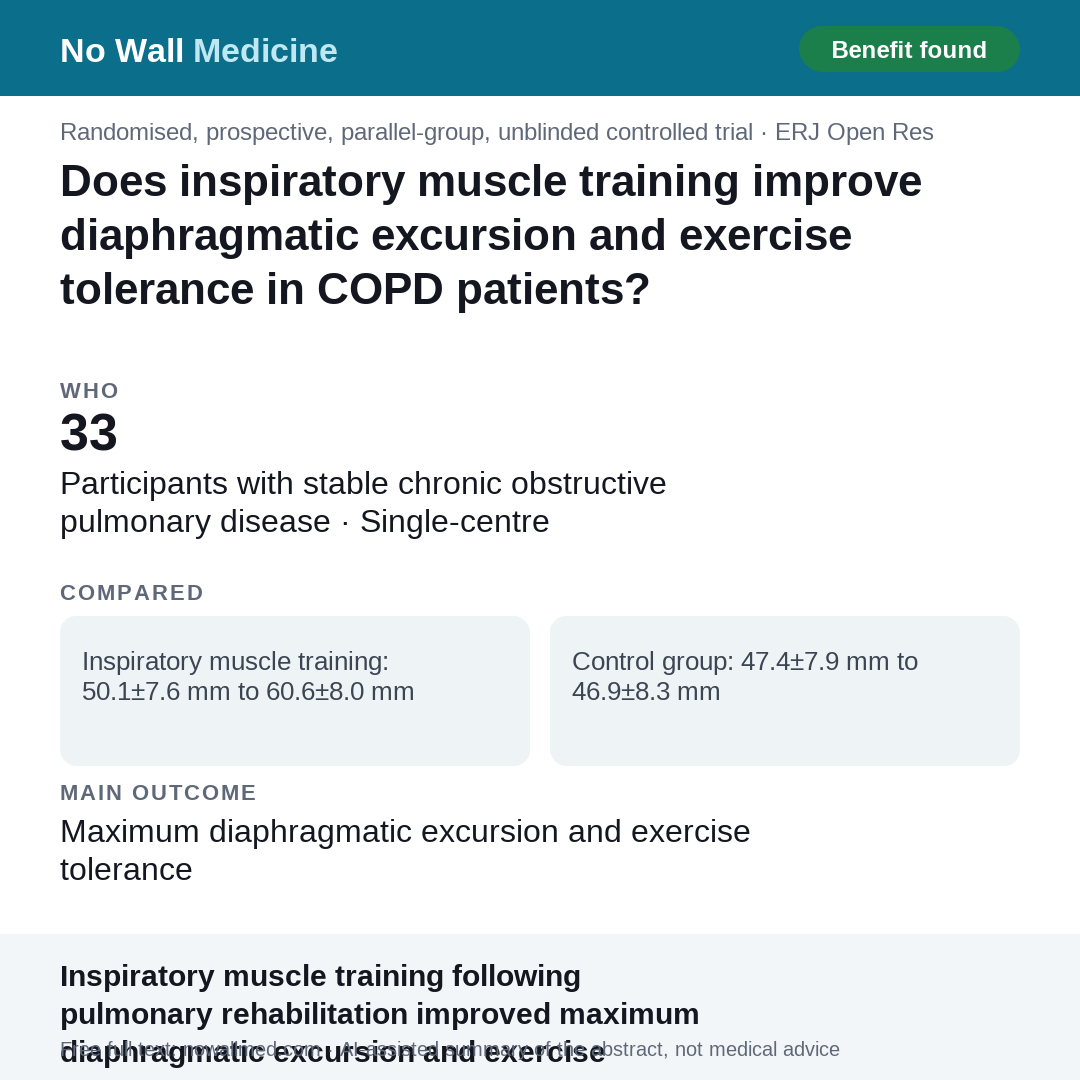
Does inspiratory muscle training improve diaphragmatic excursion and exercise tolerance in COPD patients?
Who
33
Participants with stable chronic obstructive pulmonary disease · Single-centre
Compared
Inspiratory muscle training: 50.1±7.6 mm to 60.6±8.0 mm
Control group: 47.4±7.9 mm to 46.9±8.3 mm
Main outcome
Maximum diaphragmatic excursion and exercise tolerance
Bottom line: Inspiratory muscle training following pulmonary rehabilitation improved maximum diaphragmatic excursion and exercise tolerance in patients with COPD.
ERJ Open Res · 2024-11-25Download image
Clinical question: Does inspiratory muscle training improve diaphragmatic excursion and exercise tolerance in COPD patients?
Why it matters: The effect of inspiratory muscle training on diaphragmatic function has not yet been thoroughly evaluated in patients with COPD.
Key points
- Researchers studied 33 participants with stable chronic obstructive pulmonary disease (COPD) who were randomized into an inspiratory muscle training group or a control group.
- The inspiratory muscle training group showed an increase in maximum diaphragmatic excursion, which is the distance the diaphragm moves during breathing, from 50.1±7.6 mm to 60.6±8.0 mm.
- The inspiratory muscle training group also showed greater changes in exercise tolerance, measured by peak oxygen uptake, compared to the control group.
Limitation the authors note: This was a single-centre, unblinded controlled trial.
Headline and key points written with AI from the paper’s abstract, with every number checked against it. Read the paper before relying on them.
Cite this article
Shiraishi M, Higashimoto Y, Sugiya R, Mizusawa H, Takeda Y, Noguchi M. Enhanced diaphragm excursion and exercise tolerance in COPD patients through inspiratory muscle training after standardised pulmonary rehabilitation: randomised controlled trial. ERJ Open Res. 2024. doi:10.1183/23120541.00035-2024
Spotted a mistake? Suggest a correction