Enhanced support from community health workers increased antibiotic adherence for rheumatic heart disease in Uganda
Enhanced support for adherence to rheumatic heart disease prophylaxis for children in the public health system in Uganda (CAMPS): a pragmatic randomised trial
Pragmatic randomised trialBenefit found
Does enhanced support via community health workers improve rheumatic heart disease prophylaxis adherence?
Who
208
Children and adolescents aged 5-17 years with rheumatic heart disease · Eastern Uganda
Compared
80·0%Usual care (SD 19·0)
98·2%Enhanced support (7·1)
Main outcome
Prophylaxis adherence measured as days covered
Result: estimated mean difference in adherence of 18·2%, 95% CI 14·4-22·1
Bottom line: Enhanced support using community health workers significantly improved antibiotic prophylaxis adherence in children with rheumatic heart disease.
Funded by: Thrasher Research Fund and Edwards LifeSciences Foundation
Lancet Glob Health · 2025-03-29Download image
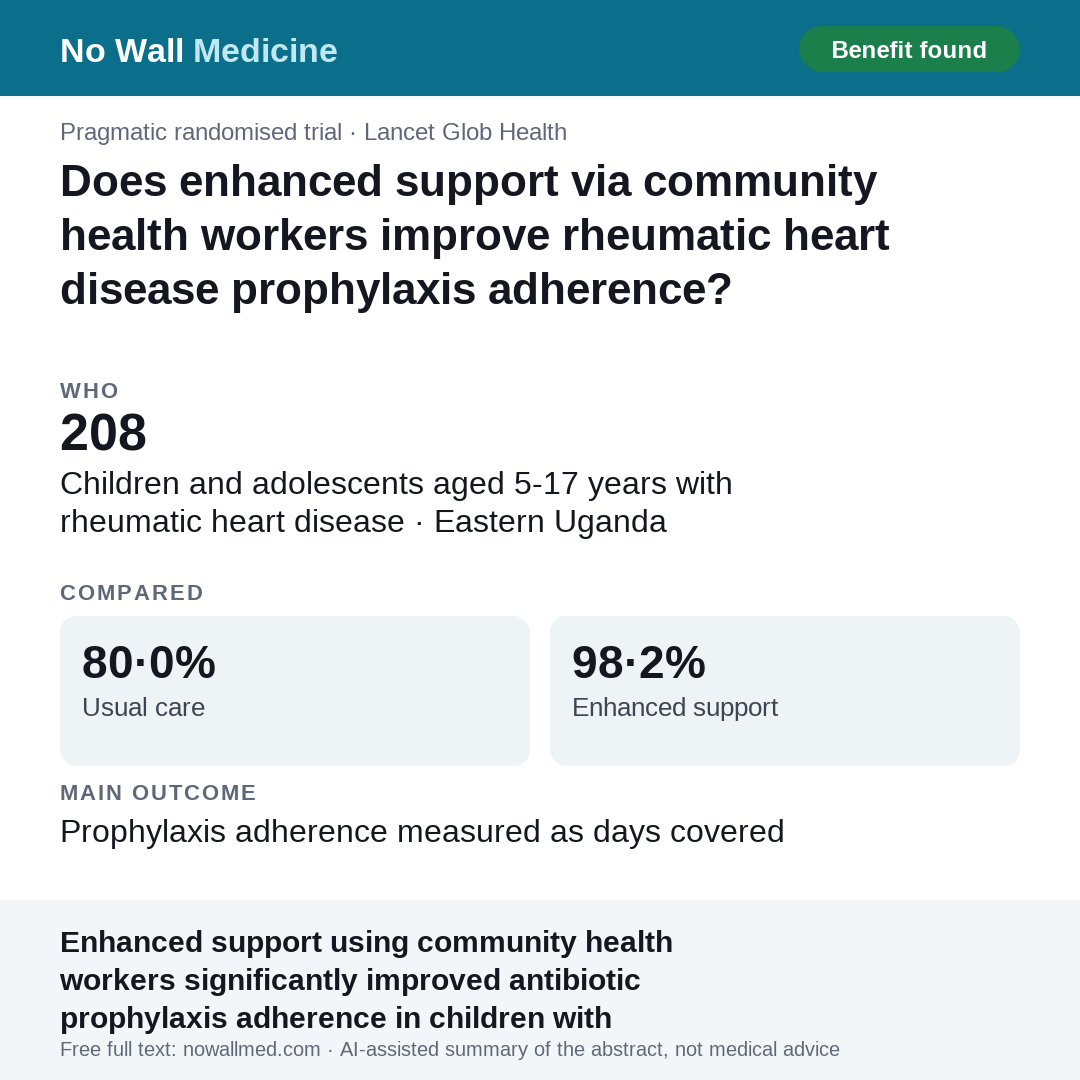
Clinical question: Does enhanced support via community health workers improve rheumatic heart disease prophylaxis adherence?
Why it matters: Delivering antibiotic prophylaxis to prevent rheumatic heart disease progression is challenging to achieve at scale in low-resource settings.
Key points
- Researchers studied 208 children and adolescents aged 5-17 years in Eastern Uganda, comparing usual care to enhanced support involving case managers and peer groups.
- After 12 months, mean antibiotic adherence was 98.2% (SD 7.1) for the enhanced support group compared to 80.0% (SD 19.0) for the usual care group.
- There were no significant differences between the two groups regarding treatment satisfaction or patient and caregiver health-related quality of life scores.
Headline and key points written with AI from the paper’s abstract, with every number checked against it. Read the paper before relying on them.
Abstract
Background
Secondary antibiotic prophylaxis is the only intervention known to prevent rheumatic heart disease progression, yet delivery of prophylaxis at scale in low-resource settings has proven challenging, undermining many global programmes. We sought to assess whether enhanced prophylaxis support for rheumatic heart disease, administered through community health workers in the public health system, was feasible and a scalable model. Methods
The CAMPS trial was a pragmatic randomised trial of prophylaxis supports integrated into routine care in Eastern Uganda. Children and adolescents with rheumatic heart disease who were aged 5-17 years were randomly assigned (1:1) using permuted block randomisation to either usual care or enhanced support. Enhanced support consisted of case managers and peer groups. Participants and providers were not masked to treatment assignment due to the study design. Children were followed up for 12 months to compare the primary outcome of prophylaxis adherence, measured as a continuous variable of days covered, using a modified intention-to-treat analysis principle. Secondary outcomes were treatment satisfaction, and patient and caregiver health-related quality of life scores. This trial is registered at ClinicalTrials.gov, NCT05502042, and has been completed. Findings
Between Aug 9, 2022, and Aug 9, 2023, 208 individuals were enrolled in the study and included in the analysis. 104 (50%) individuals were randomly assigned to the usual care group and 105 (50%) to the enhanced support group; one participant in the usual care group was excluded from the primary analysis as they died before the first injection, meaning that 103 participants were analysed in the usual care group. 121 (58%) participants were female and 87 (42%) were male. After 12 months, mean adherence was 80·0% (SD 19·0) for those receiving usual care, compared with 98·2% (7·1) for those receiving enhanced support (estimated mean difference in adherence of 18·2%, 95% CI 14·4-22·1; p<0·0001). No significant differences were found between groups in treatment satisfaction (mean between-group difference of 0·1 points [95% CI -1·9 to 2·1] at 12 months) or quality of life (2·3 [-1·1 to 5·8] for patient score; 1·3 [-1·6 to 4·1] for caregiver score). Interpretation
The integration of community health workers into rheumatic heart disease supports within the public health system provides an effective and likely scalable model to improve outcomes for children with rheumatic heart disease in low-resource settings. Further research should examine scale-up and scale-out of these strategies, formally explore cost, and rigorously partner with diverse groups of patients to shape adaptations to this design and ensure appropriateness for all groups affected by rheumatic heart disease. Funding
Thrasher Research Fund Early Career Award and Edwards LifeSciences Foundation.
Abstract reproduced under the article’s CC BY NC ND licence.
Topics
Cite this article
de Loizaga S, Pulle J, Atanas O, Alepere J, Nambogo JL, Ndagire E. Enhanced support for adherence to rheumatic heart disease prophylaxis for children in the public health system in Uganda (CAMPS): a pragmatic randomised trial. Lancet Glob Health. 2025. doi:10.1016/S2214-109X(24)00527-8
Spotted a mistake? Suggest a correction
Top studies every Monday
The week’s key trials and guidelines in your specialties, plus any topics you follow. By email, free.
Get the weekly digest