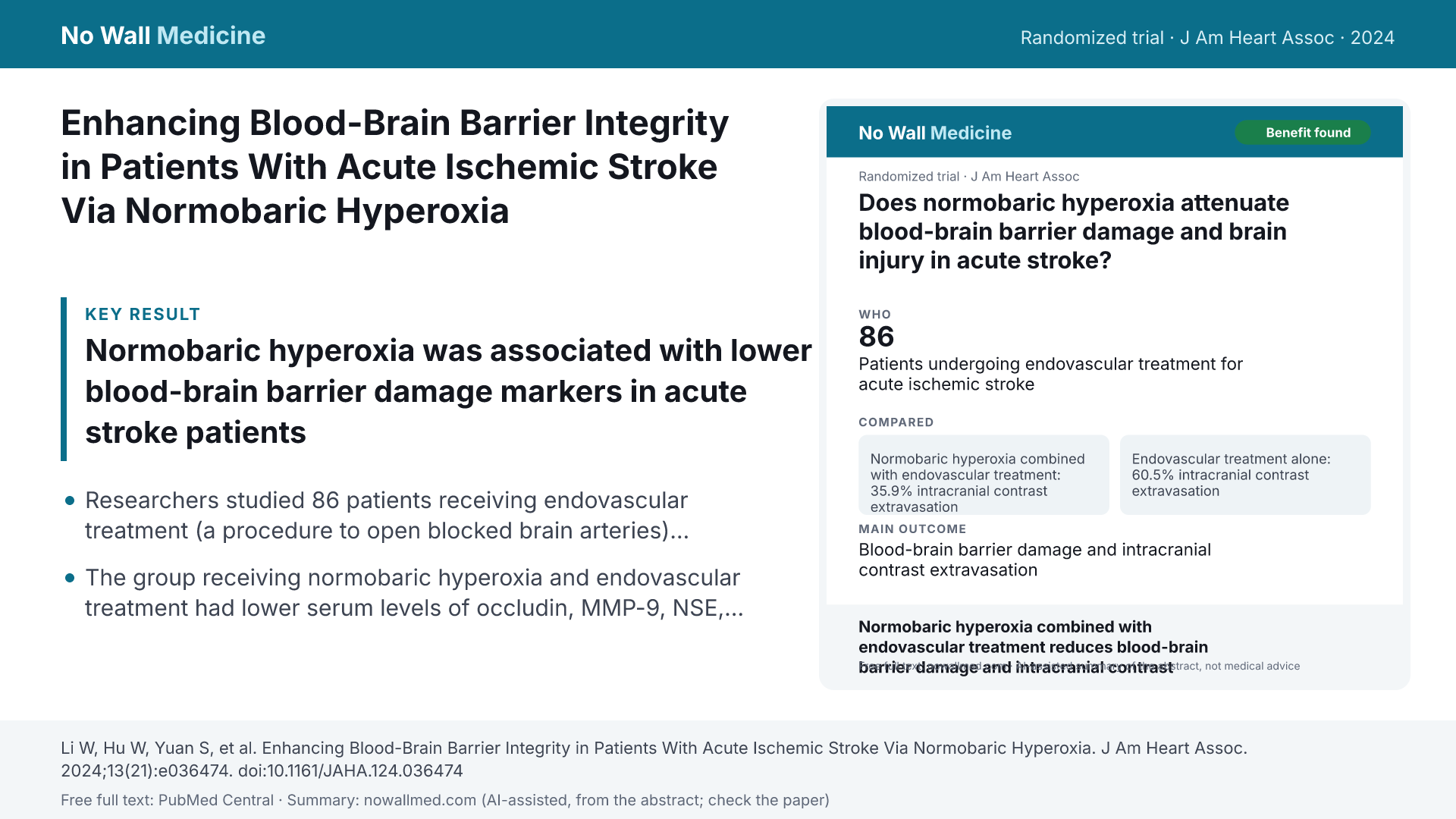
Normobaric hyperoxia was associated with lower blood-brain barrier damage markers in acute stroke patients
Enhancing Blood-Brain Barrier Integrity in Patients With Acute Ischemic Stroke Via Normobaric Hyperoxia
Randomized trialBenefit found
Does normobaric hyperoxia attenuate blood-brain barrier damage and brain injury in acute stroke?
Who
86
Patients undergoing endovascular treatment for acute ischemic stroke
Compared
Normobaric hyperoxia combined with endovascular treatment: 35.9% intracranial contrast extravasation
Endovascular treatment alone: 60.5% intracranial contrast extravasation
Main outcome
Blood-brain barrier damage and intracranial contrast extravasation
Result: 35.9% versus 60.5% (P=0.031)
Bottom line: Normobaric hyperoxia combined with endovascular treatment reduces blood-brain barrier damage and intracranial contrast extravasation in acute stroke.
J Am Heart Assoc · 2024-10-18Download image
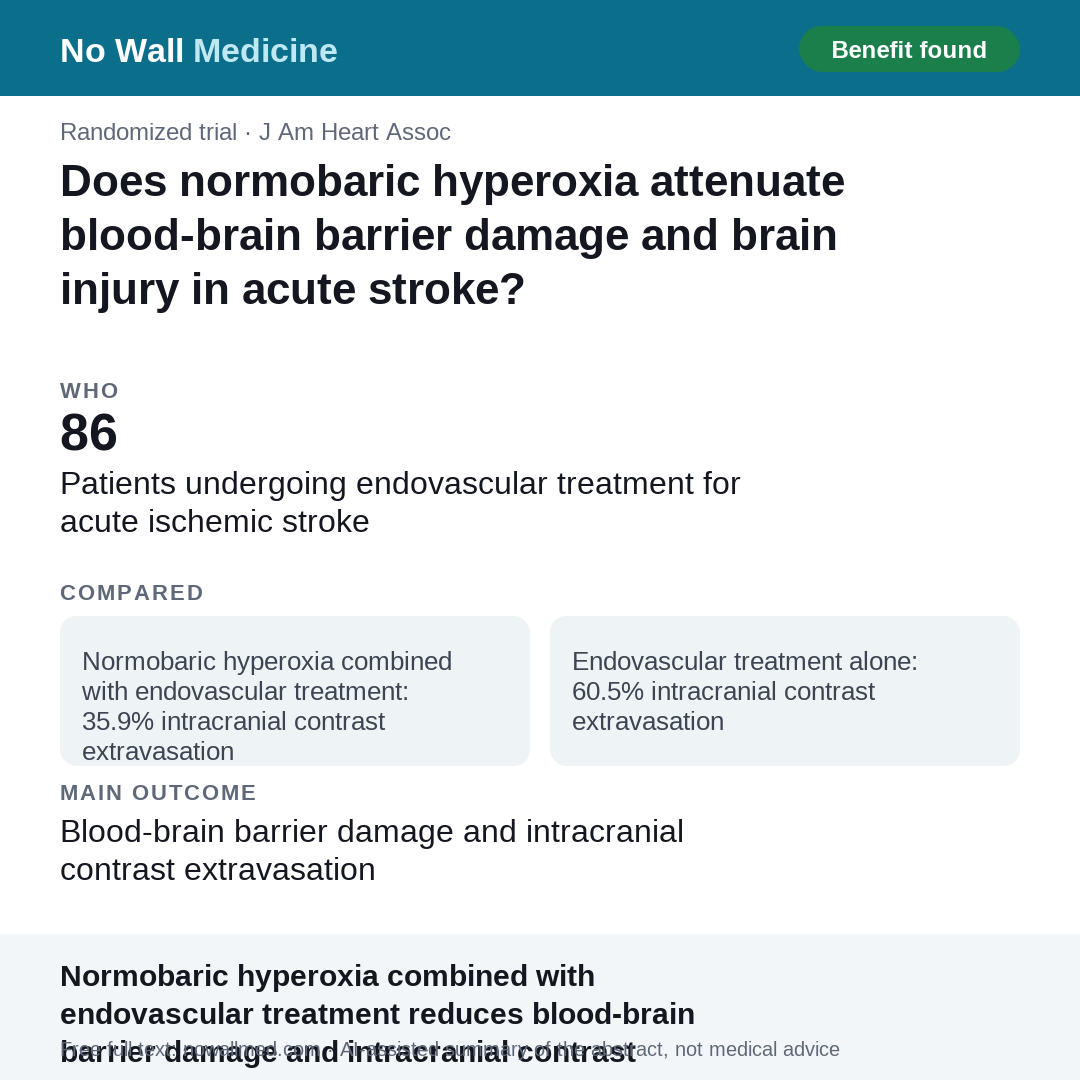
Clinical question: Does normobaric hyperoxia attenuate blood-brain barrier damage and brain injury in acute stroke?
Key points
- Researchers studied 86 patients receiving endovascular treatment (a procedure to open blocked brain arteries) to compare normobaric hyperoxia (breathing high concentrations of oxygen at normal pressure) with endovascular treatment alone.
- The group receiving normobaric hyperoxia and endovascular treatment had lower serum levels of occludin, MMP-9, NSE, and S100b at 24 hours and lower levels of occludin, MMP-9, and NSE at 7 days.
- The incidence of intracranial contrast extravasation (leakage of contrast dye into brain tissue) was 35.9% in the normobaric hyperoxia group compared to 60.5% in the group receiving endovascular treatment alone.
Headline and key points written with AI from the paper’s abstract, with every number checked against it. Read the paper before relying on them.
Was this summary helpful?
Subject terms
Cite this article
Li W, Hu W, Yuan S, et al. Enhancing Blood-Brain Barrier Integrity in Patients With Acute Ischemic Stroke Via Normobaric Hyperoxia. J Am Heart Assoc. 2024. doi:10.1161/JAHA.124.036474
Spotted a mistake? Suggest a correction