Virtual reality and imaginal exposure showed similar clinical improvements for combat-related posttraumatic stress disorder
Enhancing exposure therapy for posttraumatic stress disorder (PTSD): a randomized clinical trial of virtual reality and imaginal exposure with a cognitive enhancer
Multisite double-blind randomized controlled trialNo clear difference
Does virtual reality exposure or prolonged imaginal exposure with D-cycloserine improve PTSD symptoms?
Who
192
Military personnel with posttraumatic stress disorder · Multisite
Compared
Virtual reality exposure: similar meaningful clinical improvement
Prolonged imaginal exposure: similar meaningful clinical improvement
Main outcome
Improvement in symptom severity
Bottom line: Virtual reality exposure and prolonged imaginal exposure showed similar clinical improvement for combat-related posttraumatic stress disorder.
Transl Psychiatry · 2022-07-27Download image
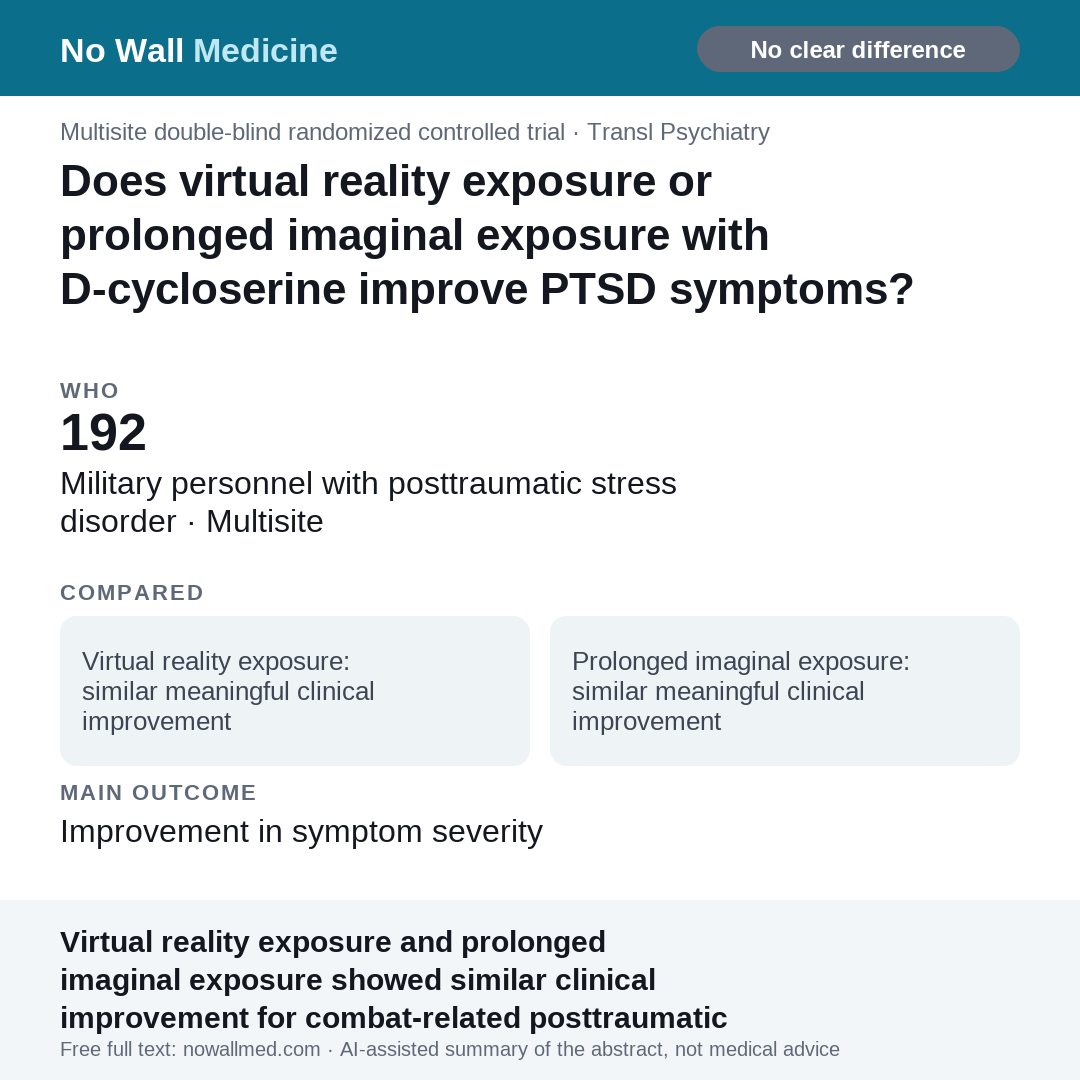
Clinical question: Does virtual reality exposure or prolonged imaginal exposure with D-cycloserine improve PTSD symptoms?
Why it matters: It is unknown which specific treatments work best for different types of patients with combat-related posttraumatic stress disorder.
Key points
- Researchers studied 192 military personnel with posttraumatic stress disorder receiving either virtual reality exposure, prolonged imaginal exposure, or a combination with the cognitive enhancer D-cycloserine or a placebo.
- Both virtual reality and imaginal exposure showed similar meaningful clinical improvement, and the main effect of D-cycloserine compared to placebo was not significant.
- Virtual reality exposure was associated with more effectiveness for participants with comorbid major depressive disorder, while imaginal exposure was associated with more effectiveness for nondepressed participants.
Headline and key points written with AI from the paper’s abstract, with every number checked against it. Read the paper before relying on them.
Was this summary helpful?
Subject terms
Cite this article
Difede J, Rothbaum BO, Rizzo AA, Wyka K, Spielman L, Reist C. Enhancing exposure therapy for posttraumatic stress disorder (PTSD): a randomized clinical trial of virtual reality and imaginal exposure with a cognitive enhancer. Transl Psychiatry. 2022. doi:10.1038/s41398-022-02066-x
Spotted a mistake? Suggest a correction
Top studies every Monday
The week’s key trials and guidelines in your specialties, plus any topics you follow. By email, free.
Get the weekly digest