Enhancing Interoperability for a Sustainable, Patient-Centric Health Care Value Chain: Systematic Review for Taxonomy Development
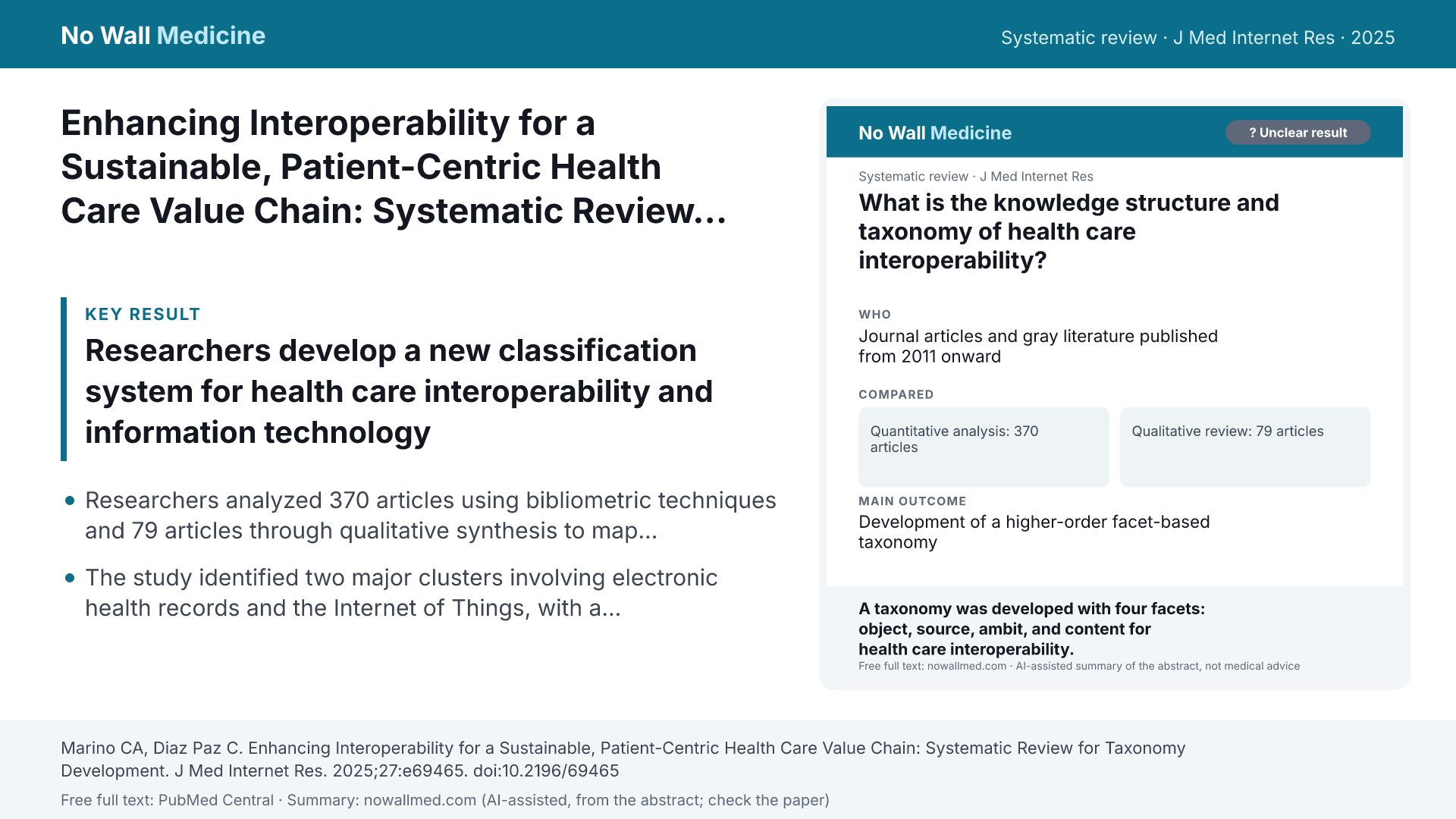
Key result: Researchers develop a new classification system for health care interoperability and information technology
Systematic reviewUnclear result
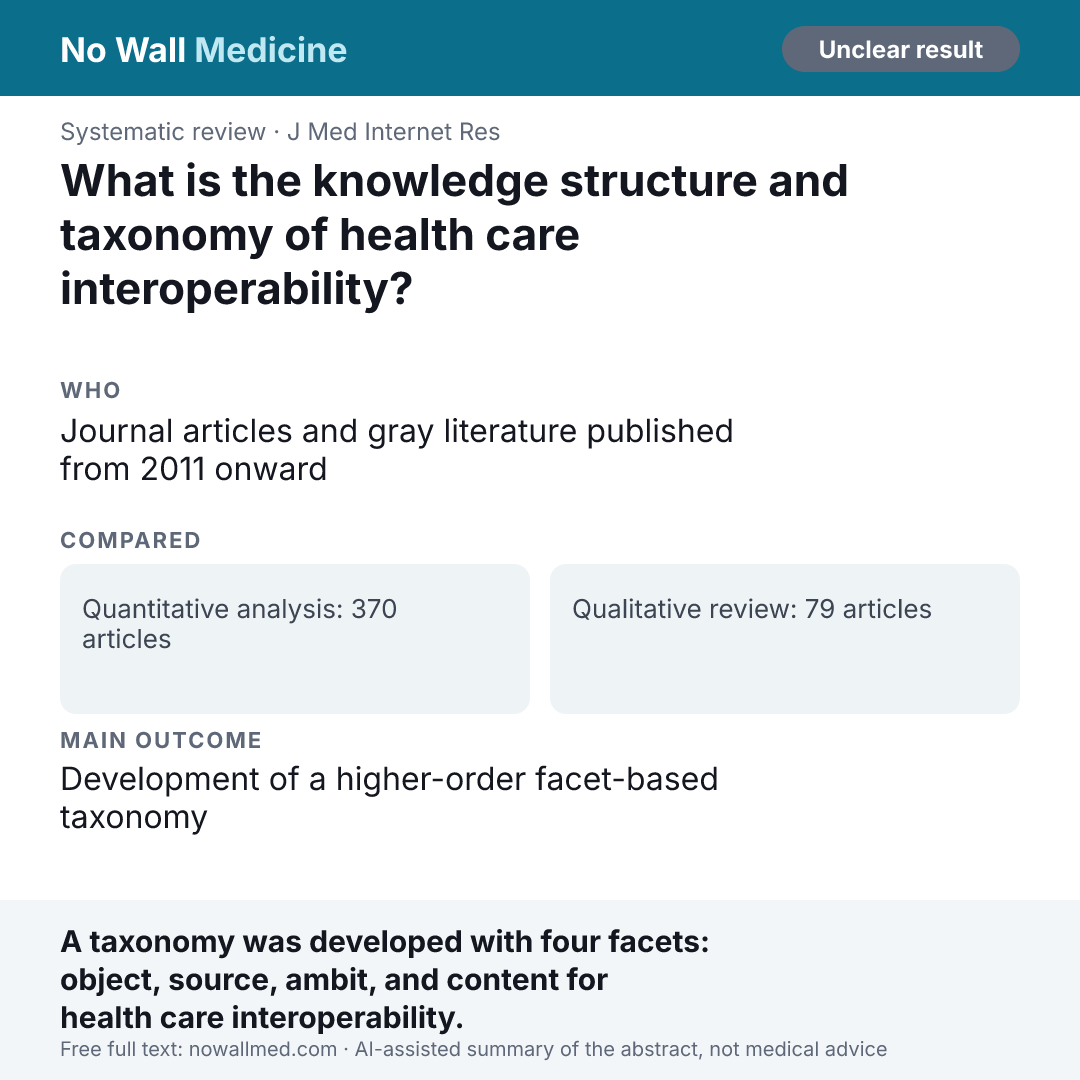
What is the knowledge structure and taxonomy of health care interoperability?
Who
Journal articles and gray literature published from 2011 onward
Compared
Quantitative analysis: 370 articles
Qualitative review: 79 articles
Main outcome
Development of a higher-order facet-based taxonomy
Bottom line: A taxonomy was developed with four facets: object, source, ambit, and content for health care interoperability.
J Med Internet Res · 2025-04-25 · Save PNG
Key points
- Researchers analyzed 370 articles using bibliometric techniques and 79 articles through qualitative synthesis to map the knowledge structure of health care interoperability.
- The study identified two major clusters involving electronic health records and the Internet of Things, with a factor analysis explaining 59.46% of the variance.
- A new taxonomy was created consisting of four higher-order facets: object, source, ambit, and content.
Discussion prompts
- Would these patients look like yours? Who was left out?
- Is the main outcome one that matters to patients?
- Is the difference large enough to change what you do?
Cite: Marino CA, Diaz Paz C. Enhancing Interoperability for a Sustainable, Patient-Centric Health Care Value Chain: Systematic Review for Taxonomy Development. J Med Internet Res. 2025;27:e69465. doi:10.2196/69465
Free full text: PubMed Central · Summary and visual abstract: nowallmed.com/a/enhancing-interoperability-for-a-sustainable-patient-centric-health-1839hv1/ (AI-assisted from the abstract; check the paper before relying on it).