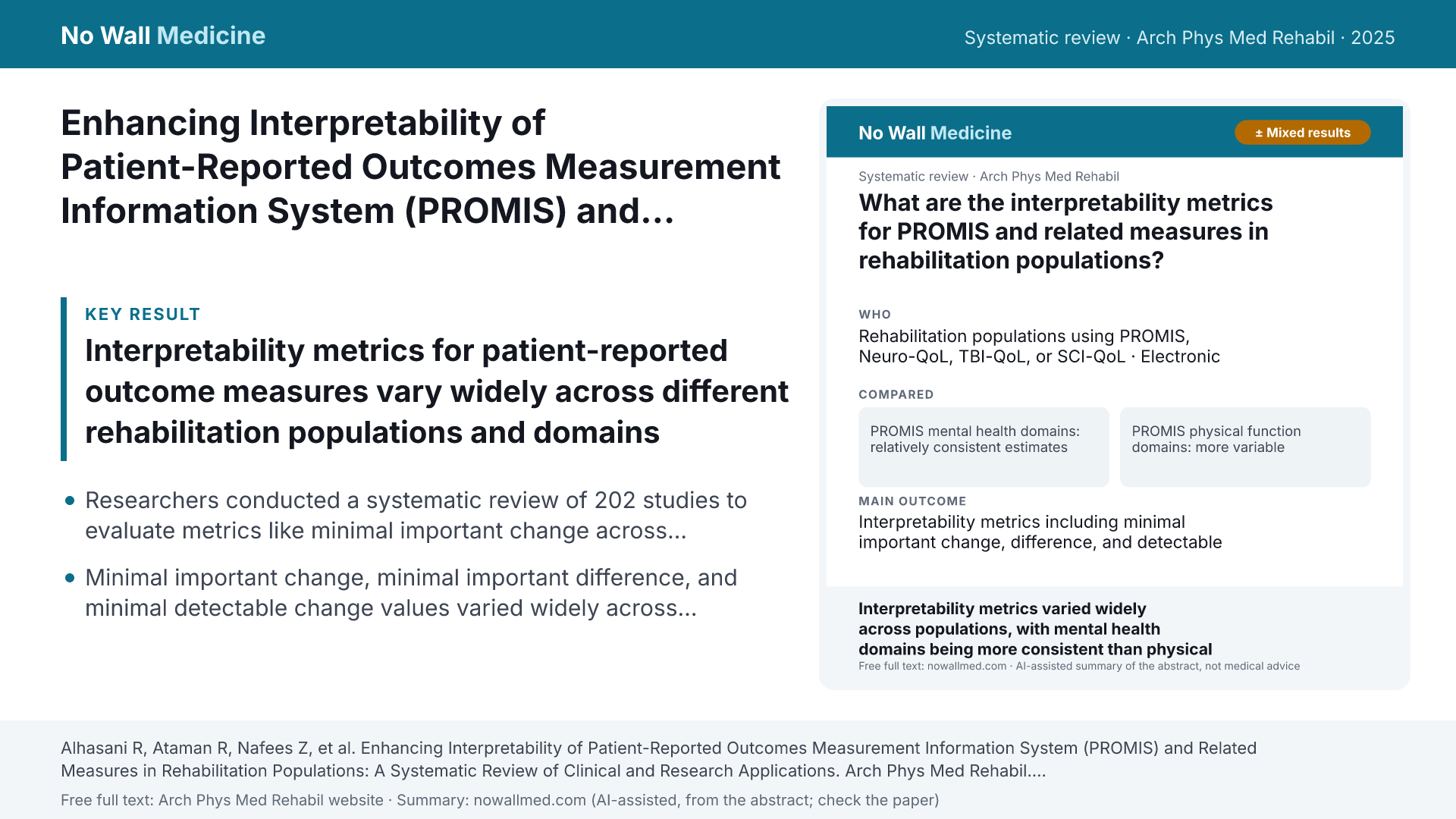
Interpretability metrics for patient-reported outcome measures vary widely across different rehabilitation populations and domains
Enhancing Interpretability of Patient-Reported Outcomes Measurement Information System (PROMIS) and Related Measures in Rehabilitation Populations: A Systematic Review of Clinical and Research Applications
Systematic reviewMixed results
What are the interpretability metrics for PROMIS and related measures in rehabilitation populations?
Who
202
Rehabilitation populations using PROMIS, Neuro-QoL, TBI-QoL, or SCI-QoL · Electronic databases and clinical trial registries
Compared
PROMIS mental health domains: relatively consistent estimates
PROMIS physical function domains: more variable
Main outcome
Interpretability metrics including minimal important change, difference, and detectable change
Bottom line: Interpretability metrics varied widely across populations, with mental health domains being more consistent than physical function domains.
Limitation: Limited data were available for Spinal Cord Injury Quality of Life and Traumatic Brain Injury Quality of Life.
Arch Phys Med Rehabil · 2025-12-01Download image
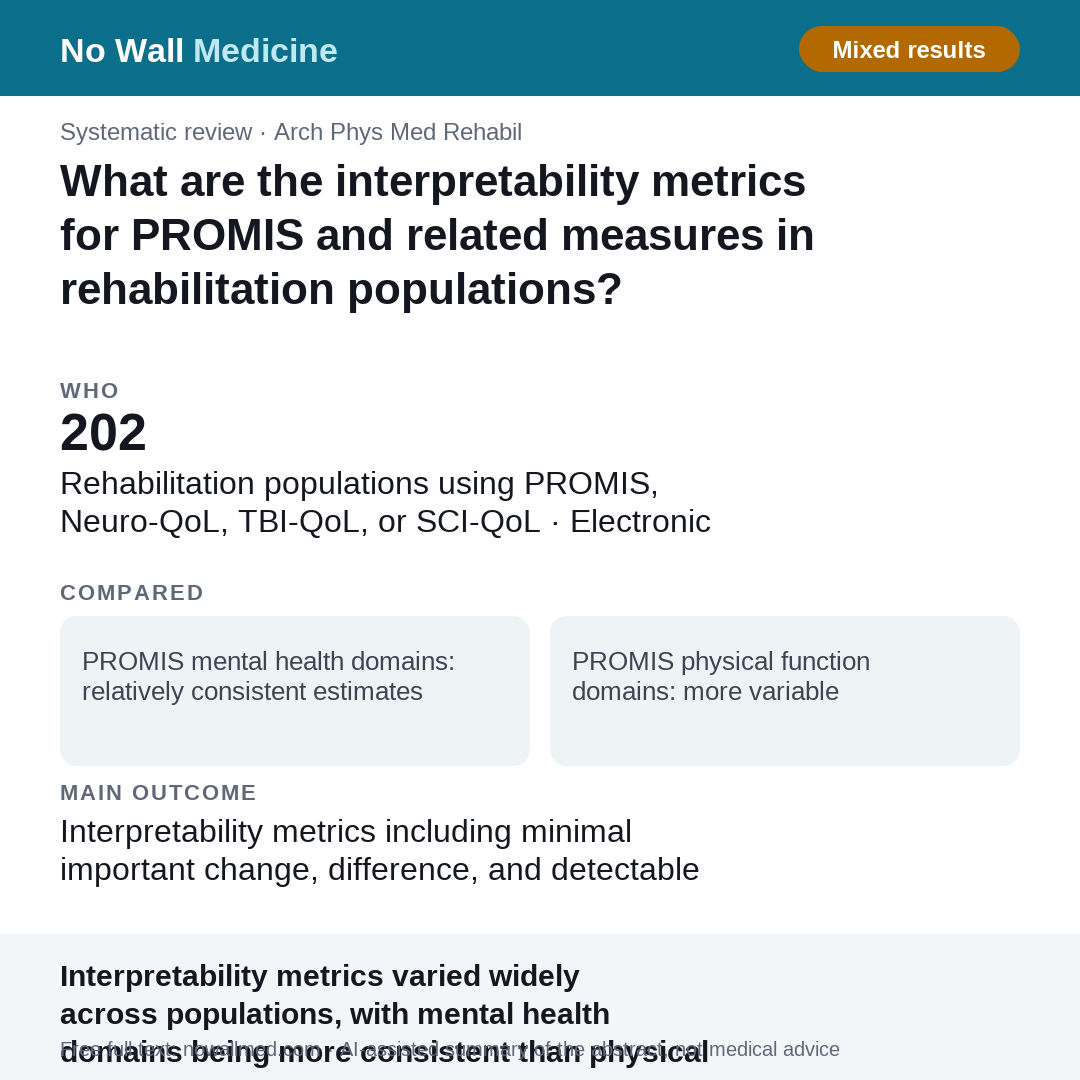
Clinical question: What are the interpretability metrics for PROMIS and related measures in rehabilitation populations?
Why it matters: Clinicians need standardized metrics like minimal important change to understand if changes in patient-reported scores are meaningful in rehabilitation settings.
Key points
- Researchers conducted a systematic review of 202 studies to evaluate metrics like minimal important change across various patient-reported outcome systems in rehabilitation populations.
- Minimal important change, minimal important difference, and minimal detectable change values varied widely across different populations and domains.
- Mental health domains showed relatively consistent estimates, while physical function domains were more variable, especially in chronic and geriatric groups.
Limitation the authors note: The authors noted that limited data were available for Quality of Life in Spinal Cord Injury and Quality of Life in Traumatic Brain Injury measures.
Headline and key points written with AI from the paper’s abstract, with every number checked against it. Read the paper before relying on them.
Was this summary helpful?
Subject terms
Cite this article
Alhasani R, Ataman R, Nafees Z, et al. Enhancing Interpretability of Patient-Reported Outcomes Measurement Information System (PROMIS) and Related Measures in Rehabilitation Populations: A Systematic Review of Clinical and Research Applications. Arch Phys Med Rehabil. 2025. doi:10.1016/j.apmr.2025.11.017
Spotted a mistake? Suggest a correction