Deep learning models using sequential diagnosis codes show links to better performance with larger sample sizes
Enhancing Patient Outcome Prediction Through Deep Learning With Sequential Diagnosis Codes From Structured Electronic Health Record Data: Systematic Review
Systematic reviewBenefit found
How is sequential diagnostic data integrated into deep learning models for outcome prediction?
Who
84
Studies using deep learning on sequential diagnosis codes
Compared
Recurrent neural networks: 47/84 (56%)
Transformers: 22/84 (26%)
Main outcome
Deep learning model characteristics and predictive performance
Bottom line: Deep learning using sequential medical codes shows promise, especially with larger sample sizes and multiple feature types.
Limitation: The main limitation was the heterogeneity of methods and outcomes.
J Med Internet Res · 2025-03-18Download image
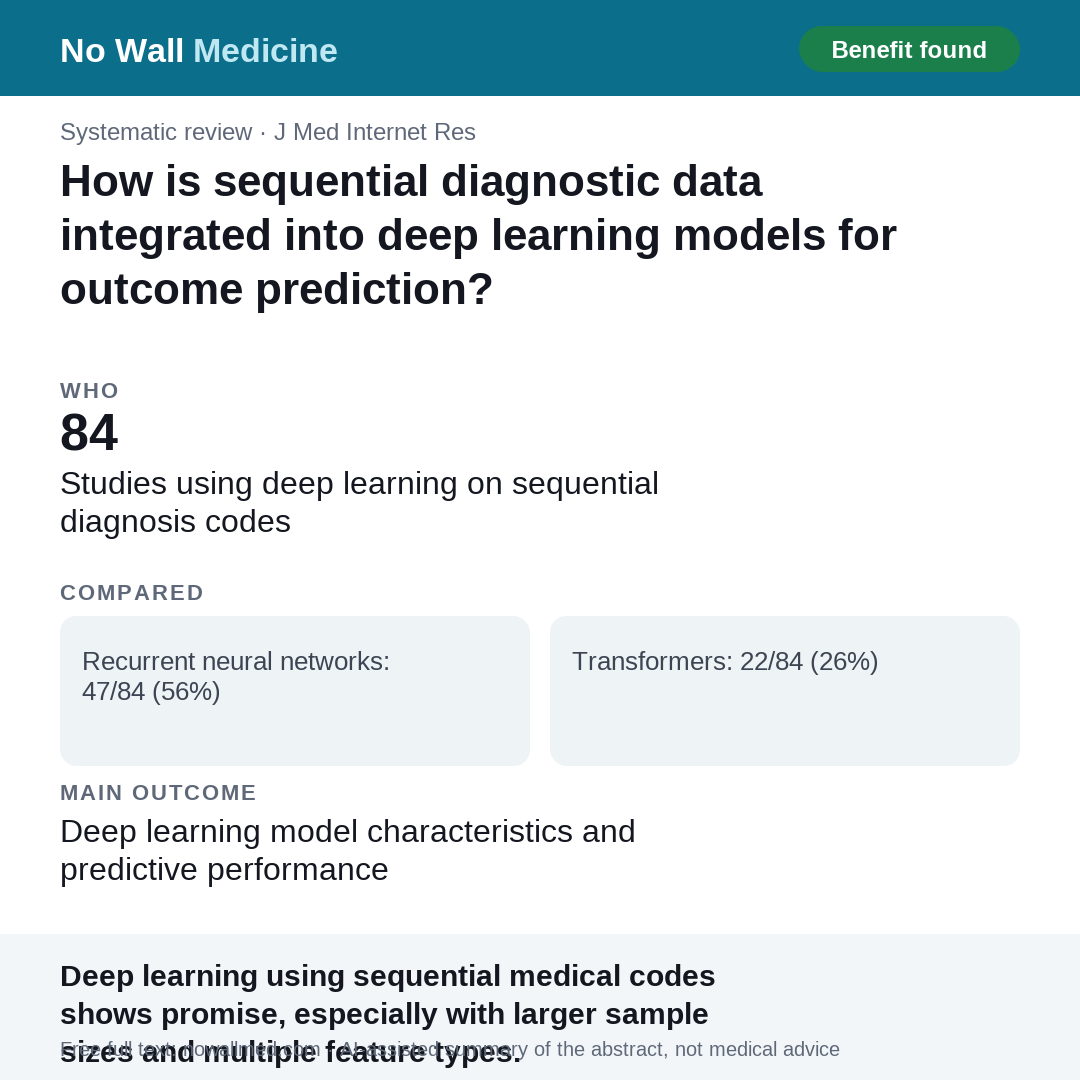
Clinical question: How is sequential diagnostic data integrated into deep learning models for outcome prediction?
Why it matters: It was unknown how sequential diagnostic data are integrated into deep learning models and whether larger sample sizes or specific architectures improve prediction performance.
Key points
- Researchers reviewed 84 studies that used deep learning, which is a type of artificial intelligence, to predict patient outcomes using sequential diagnosis codes.
- A positive correlation was observed between the size of the training sample and model performance, measured by the area under the receiver operating characteristic curve.
- While 56% of studies used recurrent neural networks and 26% used transformers, 70% of the included studies had a high risk of bias.
Limitation the authors note: The main limitation was the heterogeneity of methods and outcomes.
Headline and key points written with AI from the paper’s abstract, with every number checked against it. Read the paper before relying on them.
Topics
Cite this article
Hama T, Alsaleh MM, Allery F, Choi JW, Tomlinson C, Wu H. Enhancing Patient Outcome Prediction Through Deep Learning With Sequential Diagnosis Codes From Structured Electronic Health Record Data: Systematic Review. J Med Internet Res. 2025. doi:10.2196/57358
Spotted a mistake? Suggest a correction
Top studies every Monday
The week’s key trials and guidelines in your specialties, by email. Free.
Get the weekly digest