Virtual reality training improved theoretical knowledge of basic life support but not practical skills
Enhancing theoretical BLS knowledge with virtual reality: a randomized controlled trial in medical students
Single blind randomized controlled trialMixed results
Does a virtual reality session enhance basic life support knowledge and performance?
Who
126
Fourth-year medical students with prior basic life support training
Compared
Intervention group with virtual reality: significantly greater gains in knowledge at post-course and follow-up
Control group receiving standard preparation: no significant differences in OSCE performance
Main outcome
Theoretical knowledge and practical performance of basic life support skills
Bottom line: A virtual reality session enhanced theoretical knowledge but did not significantly affect practical performance in medical students.
Limitation: Further research is needed to evaluate long-term impact and optimal integration methods.
Resusc Plus · 2025-11-19Download image
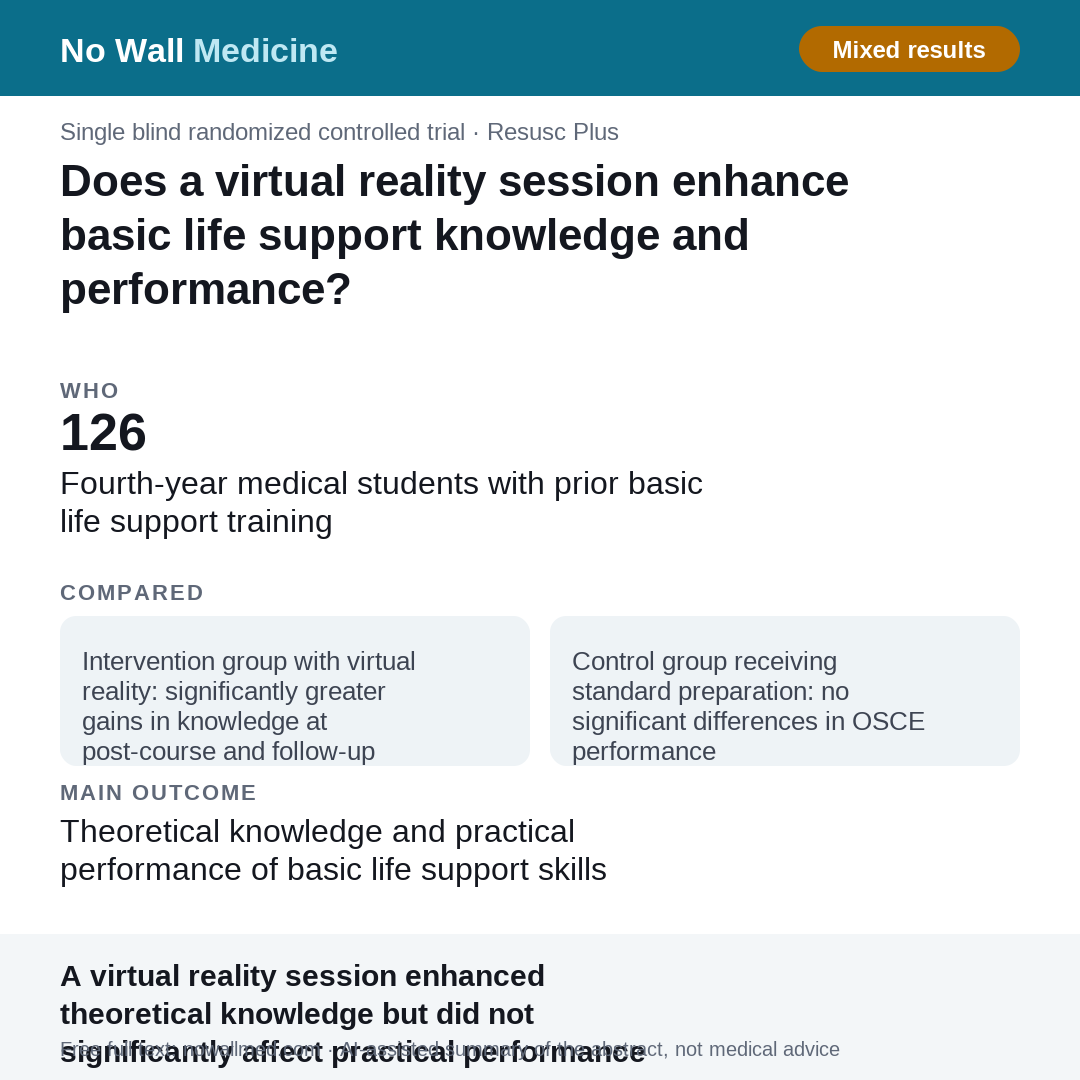
Clinical question: Does a virtual reality session enhance basic life support knowledge and performance?
Why it matters: It is unclear if adding immersive virtual reality sessions to standard preparation improves the knowledge or practical performance of medical students before advanced life support training.
Key points
- Researchers studied 126 fourth-year medical students who were assigned to either a standard preparation group or a group receiving an additional 3-part virtual reality session.
- The virtual reality group showed significantly greater gains in theoretical knowledge at post-course (p < 0.01) and 12-week follow-up (p = 0.04) compared to the control group.
- No significant differences were found between the two groups regarding performance in the Objective Structured Clinical Examination, which is a practical skills assessment.
Headline and key points written with AI from the paper’s abstract, with every number checked against it. Read the paper before relying on them.
Cite this article
Tannemann N, Tsarenko O, Herbstreit F, Gestmann M, Brenner T, Szalai C. Enhancing theoretical BLS knowledge with virtual reality: a randomized controlled trial in medical students. Resusc Plus. 2025. doi:10.1016/j.resplu.2025.101169
Spotted a mistake? Suggest a correction