Functional testing of CHEK2 genetic variants identifies those linked to increased breast cancer risk
ENIGMA CHEK2gether Project: A Comprehensive Study Identifies Functionally Impaired CHEK2 Germline Missense Variants Associated with Increased Breast Cancer Risk
Case-control analysis and functional characterizationBenefit found
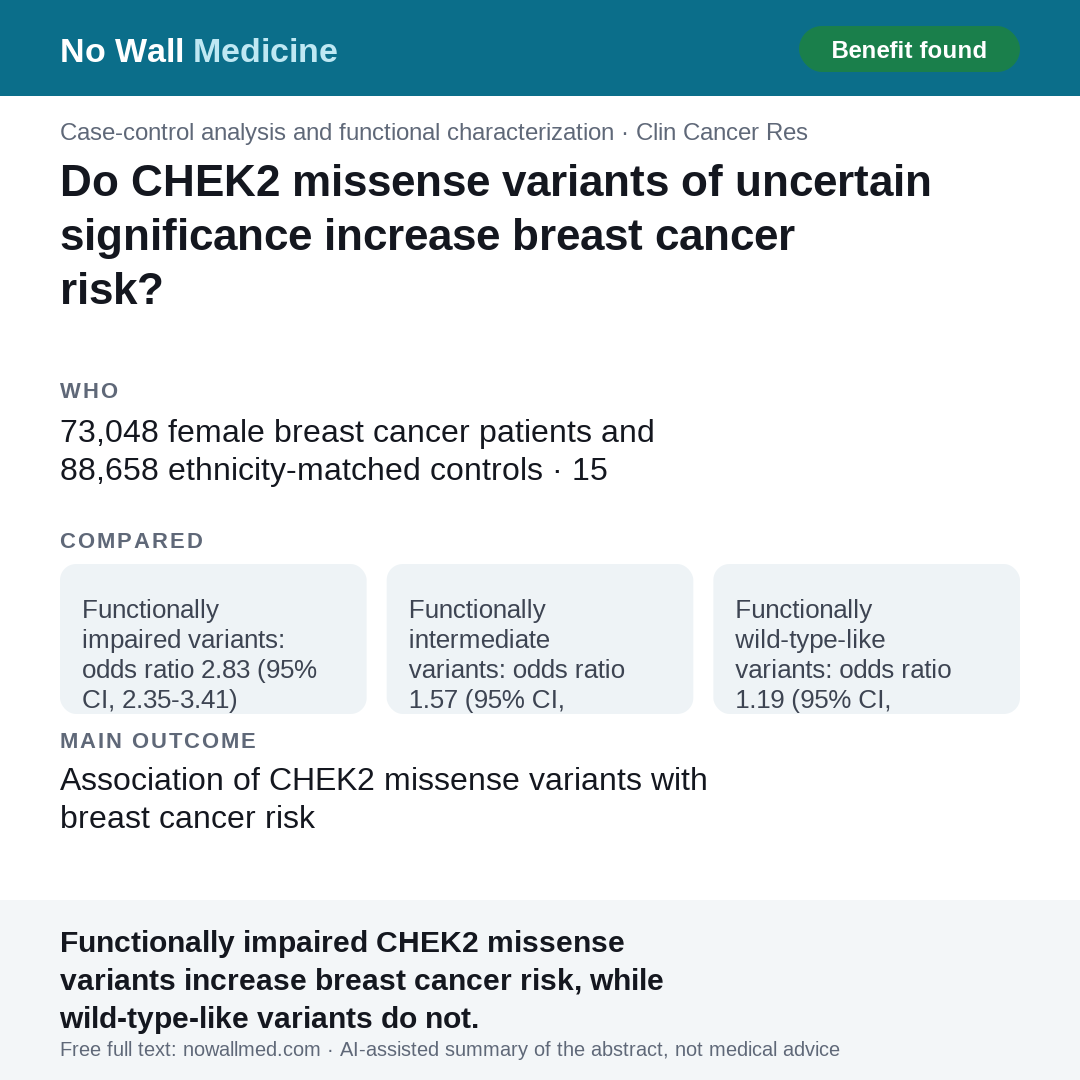
Do CHEK2 missense variants of uncertain significance increase breast cancer risk?
Who
73,048 female breast cancer patients and 88,658 ethnicity-matched controls · 15 countries
Compared
Functionally impaired variants: odds ratio 2.83 (95% CI, 2.35-3.41)
Functionally intermediate variants: odds ratio 1.57 (95% CI, 1.41-1.75)
Functionally wild-type-like variants: odds ratio 1.19 (95% CI, 1.08-1.31)
Main outcome
Association of CHEK2 missense variants with breast cancer risk
Result: odds ratio 2.83 (95% CI, 2.35-3.41) for functionally impaired variants
Bottom line: Functionally impaired CHEK2 missense variants increase breast cancer risk, while wild-type-like variants do not.
Clin Cancer Res · 2023-07-14Download image
Clinical question: Do CHEK2 missense variants of uncertain significance increase breast cancer risk?
Why it matters: Many missense variants of uncertain significance in the CHEK2 gene are identified during genetic testing, which limits the clinical usefulness of these results.
Key points
- Researchers analyzed 460 missense variants of uncertain significance in the CHEK2 gene using laboratory assays and 12 case-control datasets including 73,048 female breast cancer patients.
- Carriers of functionally impaired variants had an odds ratio of 2.83 (95% CI, 2.35-3.41) for breast cancer, while functionally wild-type-like variants had an odds ratio of 1.19 (95% CI, 1.08-1.31).
- Functionally impaired variants accounted for 0.5% of breast cancer patients, whereas 2.2% of patients carried variants that were functionally intermediate or wild-type-like.
Headline and key points written with AI from the paper’s abstract, with every number checked against it. Read the paper before relying on them.
Topics
Cite this article
Stolarova L, Kleiblova P, Zemankova P, Stastna B, Janatova M, Soukupova J. ENIGMA CHEK2gether Project: A Comprehensive Study Identifies Functionally Impaired CHEK2 Germline Missense Variants Associated with Increased Breast Cancer Risk. Clin Cancer Res. 2023. doi:10.1158/1078-0432.CCR-23-0212
Spotted a mistake? Suggest a correction
Top studies every Monday
The week’s key trials and guidelines in your specialties, plus any topics you follow. By email, free.
Get the weekly digest