Using exception from informed consent increased enrollment rates in a pediatric bleeding trial
Enrollment with and without exception from informed consent in a pilot trial of tranexamic acid in children with hemorrhagic injuries
Four-center randomized controlled pilot and feasibility trialBenefit found
Does federal exception from informed consent increase enrollment rates in a tranexamic acid trial?
Who
Children with severe hemorrhagic brain and/or torso injuries · Four centers
Compared
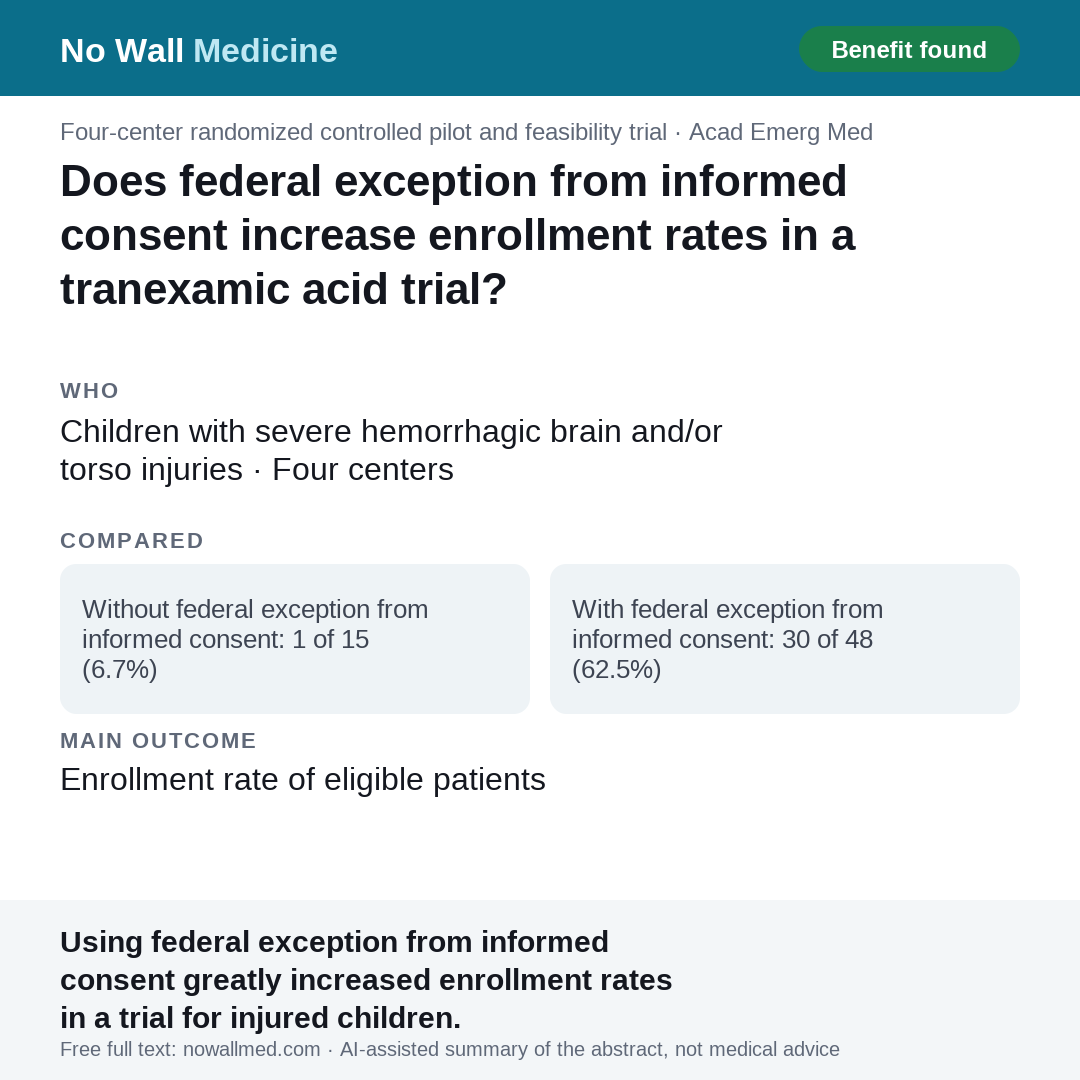
Without federal exception from informed consent: 1 of 15 (6.7%)
With federal exception from informed consent: 30 of 48 (62.5%)
Main outcome
Enrollment rate of eligible patients
Bottom line: Using federal exception from informed consent greatly increased enrollment rates in a trial for injured children.
Acad Emerg Med · 2021-08-06Download image
Clinical question: Does federal exception from informed consent increase enrollment rates in a tranexamic acid trial?
Why it matters: It was unknown how using federal exception from informed consent, which allows enrollment without written permission in emergencies, would affect recruitment in pediatric trauma trials.
Key points
- Researchers compared enrollment rates in a four-center pilot trial of tranexamic acid, a medication to stop bleeding, in children with severe brain or torso injuries.
- Enrollment increased from 6.7% of eligible patients before using exception from informed consent to 62.5% of eligible patients after the procedure was implemented.
- Of the 30 patients enrolled after implementing the exception from informed consent, 73.3% were enrolled using that specific procedure.
Headline and key points written with AI from the paper’s abstract, with every number checked against it. Read the paper before relying on them.
Was this summary helpful?
Subject terms
Cite this article
Linakis SW, Kuppermann N, Stanley RM, Hewes H, Myers S, VanBuren JM. Enrollment with and without exception from informed consent in a pilot trial of tranexamic acid in children with hemorrhagic injuries. Acad Emerg Med. 2021. doi:10.1111/acem.14343
Spotted a mistake? Suggest a correction
Top studies every Monday
The week’s key trials and guidelines in your specialties, plus any topics you follow. By email, free.
Get the weekly digest