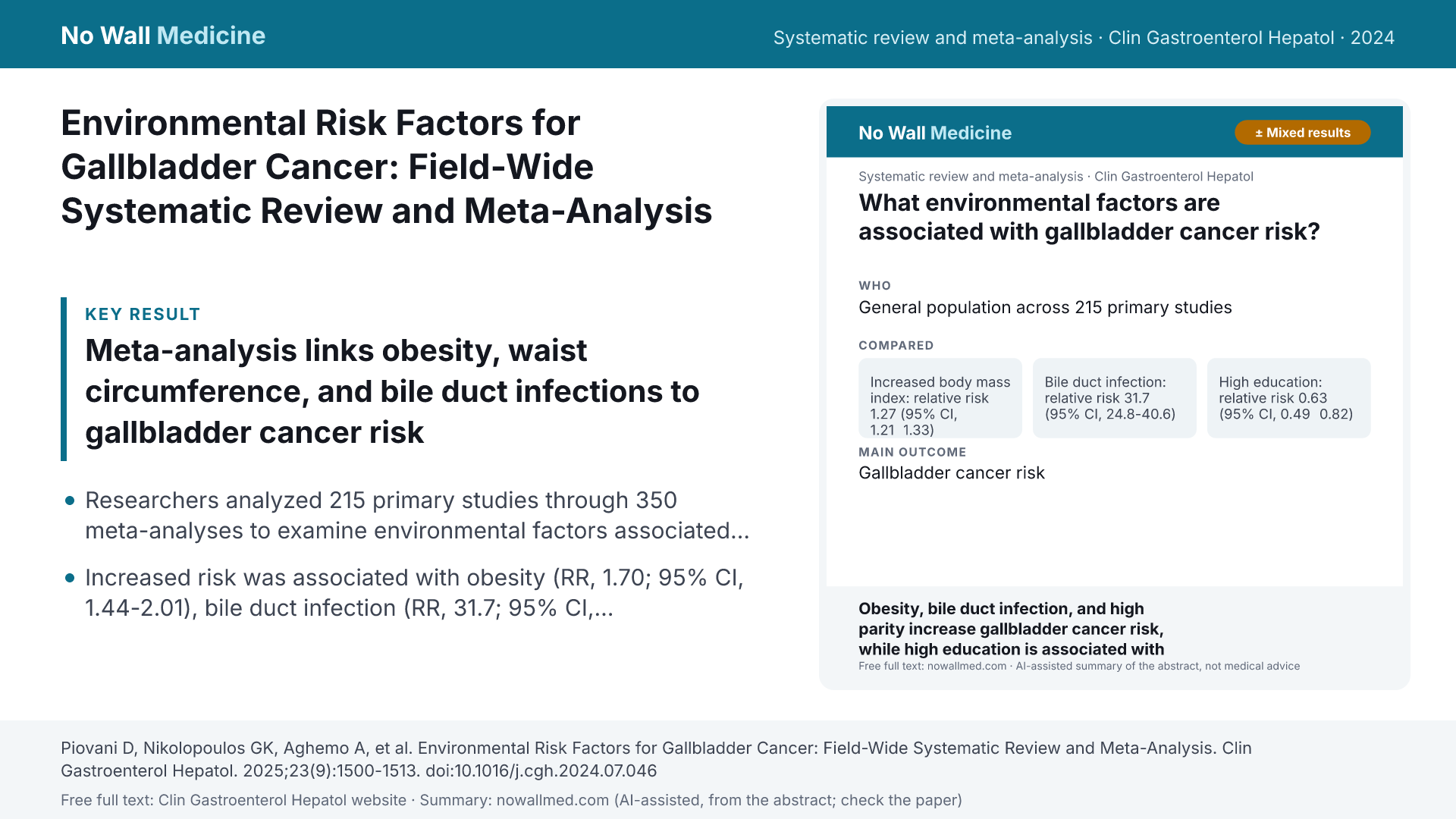
Environmental Risk Factors for Gallbladder Cancer: Field-Wide Systematic Review and Meta-Analysis
Key result: Meta-analysis links obesity, waist circumference, and bile duct infections to gallbladder cancer risk
Systematic review and meta-analysisMixed results
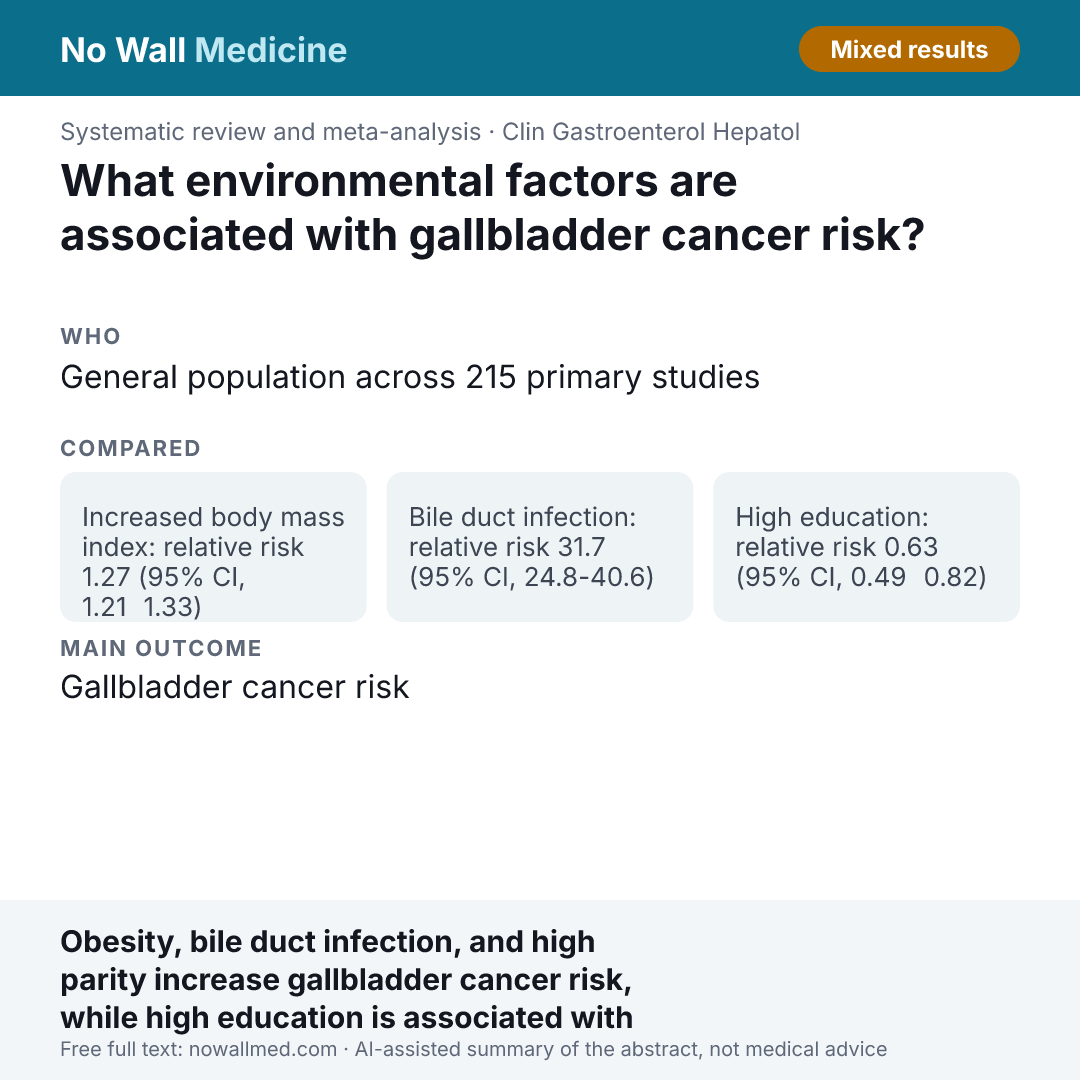
What environmental factors are associated with gallbladder cancer risk?
Who
General population across 215 primary studies
Compared
Increased body mass index: relative risk 1.27 (95% CI, 1.21‒1.33)
Bile duct infection: relative risk 31.7 (95% CI, 24.8-40.6)
High education: relative risk 0.63 (95% CI, 0.49‒0.82)
Main outcome
Gallbladder cancer risk
Bottom line: Obesity, bile duct infection, and high parity increase gallbladder cancer risk, while high education is associated with reduced risk.
Limitation: Further high-quality prospective studies are essential to validate emerging associations.
Clin Gastroenterol Hepatol · 2024-10-05 · Save PNG
Key points
- Researchers analyzed 215 primary studies through 350 meta-analyses to examine environmental factors associated with gallbladder cancer.
- Increased risk was associated with obesity (RR, 1.70; 95% CI, 1.44-2.01), bile duct infection (RR, 31.7; 95% CI, 24.8-40.6), and high parity (RR, 1.48; 95% CI, 1.30-1.68).
- Higher education levels were associated with a reduced risk of gallbladder cancer (RR, 0.63; 95% CI, 0.49-0.82).
Discussion prompts
- Would these patients look like yours? Who was left out?
- Is the main outcome one that matters to patients?
- Is the difference large enough to change what you do?
Cite: Piovani D, Nikolopoulos GK, Aghemo A, et al. Environmental Risk Factors for Gallbladder Cancer: Field-Wide Systematic Review and Meta-Analysis. Clin Gastroenterol Hepatol. 2025;23(9):1500-1513. doi:10.1016/j.cgh.2024.07.046
Free full text: Clin Gastroenterol Hepatol website · Summary and visual abstract: nowallmed.com/a/environmental-risk-factors-for-gallbladder-cancer-field-wide-s7c0uc/ (AI-assisted from the abstract; check the paper before relying on it).