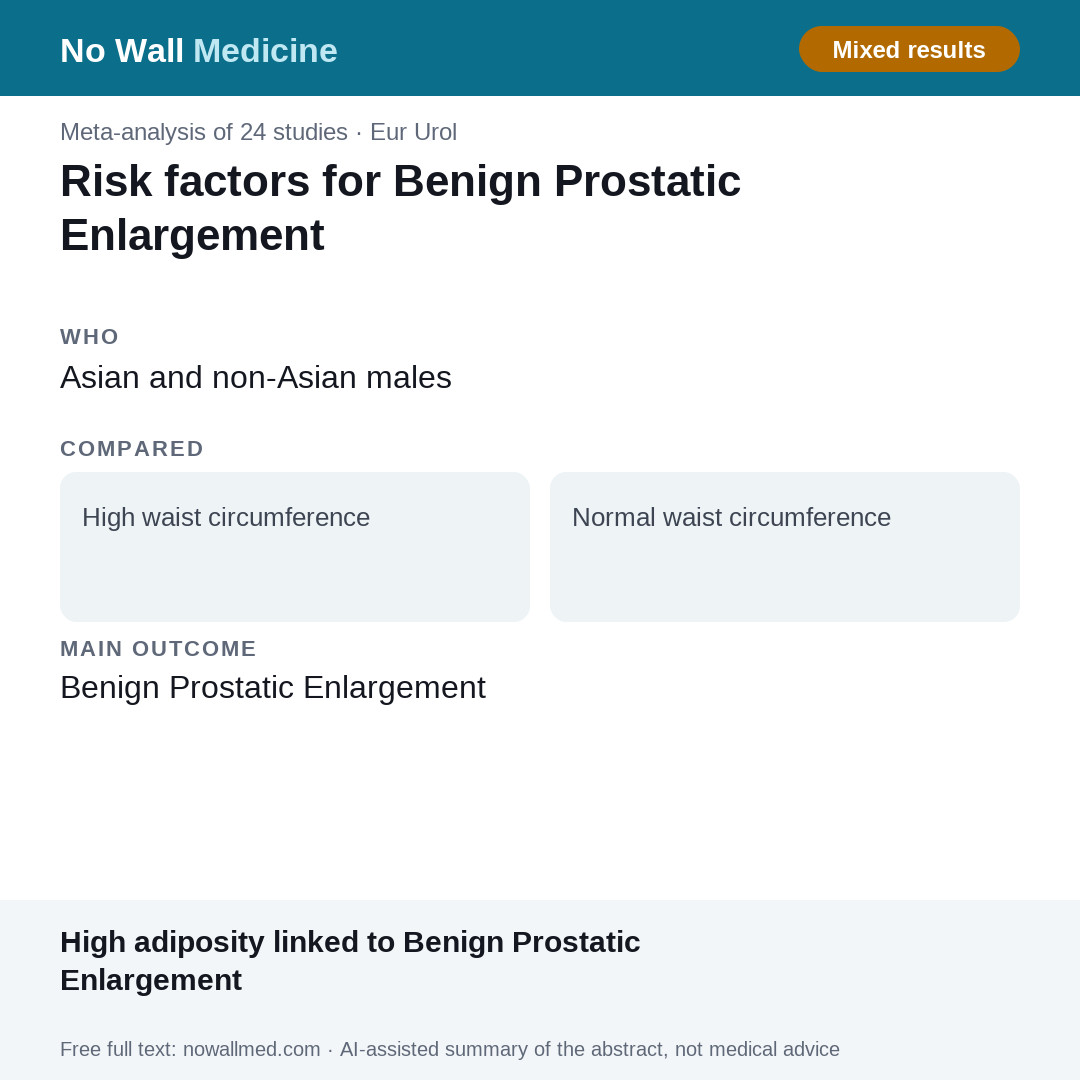
Epidemiology and Modifiable Risk Factors for Benign Prostatic Enlargement and Related Lower Urinary Tract Symptoms: A Systematic Review with Meta-analysis
Creta M, De Nunzio C, Cornu JN, Dmochowski RR, Gratzke C, McVary K, et al
Context and objective
Benign prostatic enlargement (BPE) and related lower urinary tract symptoms (LUTS/BPE) represent highly prevalent health issues globally, and related modifiable risk factors are recognized as a sensitive topic for prevention strategies. We summarized evidence on associations between the epidemiology of these conditions and modifiable risk factors. Evidence acquisition
We performed a systematic review with meta-analysis of studies in MEDLINE, Scopus, and Web of Science according to Preferred Reporting Items for Systematic Reviews and Meta-Analyses Protocols. Evidence synthesis
Twenty-four studies (four cohort and 20 cross-sectional) were included. Pooled synthesis showed positive associations between waist circumference (WC) >90 cm (two studies) and body mass index >24 kg/m2 (three studies) and prevalent BPE in Asian males. WC >90 cm was positively associated with prevalent moderate-to-severe LUTS in the same ethnicity (two studies). Narrative synthesis showed associations between abnormal adiposity and prevalent BPE/moderate-to-severe LUTS also in non-Asian males as well as associations between the epidemiology of LUTS and physical activity, alcohol intake, metabolic syndrome, and smoking status in both ethnicities. Associations between dietary/sleep patterns and LUTS epidemiology were evident in Asian males. The certainty of evidence was very low. Conclusions
BPE and related LUTS represent highly prevalent health issues with global incidence and prevalence rates projected to increase in the next decade. Positive associations between high adiposity indices and prevalent BPE have been observed in both Asian and non-Asian males. Modifiable risk factors associated with moderate-to-severe LUTS include: abnormal adiposity indices, levels of physical activity, smoking status, alcohol intake, metabolic syndrome (all in both ethnicities), and sleep/dietary patterns (in Asian males). However, definitive clinical recommendations could not be provided.
Which Patients with Advanced Clear Cell Renal Cell Carcinoma Benefit Most from First-line Checkpoint Inhibitor Combination Regimens: A Meta-analysis of Individual Patient Data and Aggregate Data from Randomised Trials
Diagnostic Performance of Nectin-4-targeted [68Ga]Ga-DOTA-N188 PET/CT versus [18F]-FDG PET/CT for Staging of Locally Advanced and Metastatic Urothelial Carcinoma: A Prospective, Single-center, Phase 2 Feasibility Trial