Predictive models for epilepsy in children and adolescents show varying accuracy in a systematic review
Epilepsy prediction models for children and adolescents: a systematic review and meta-analysis
Systematic review and meta-analysisMixed results
What is the accuracy of epilepsy prediction models for children and adolescents?
Who
Children and adolescents · Multiple databases including PubMed and Embase
Compared
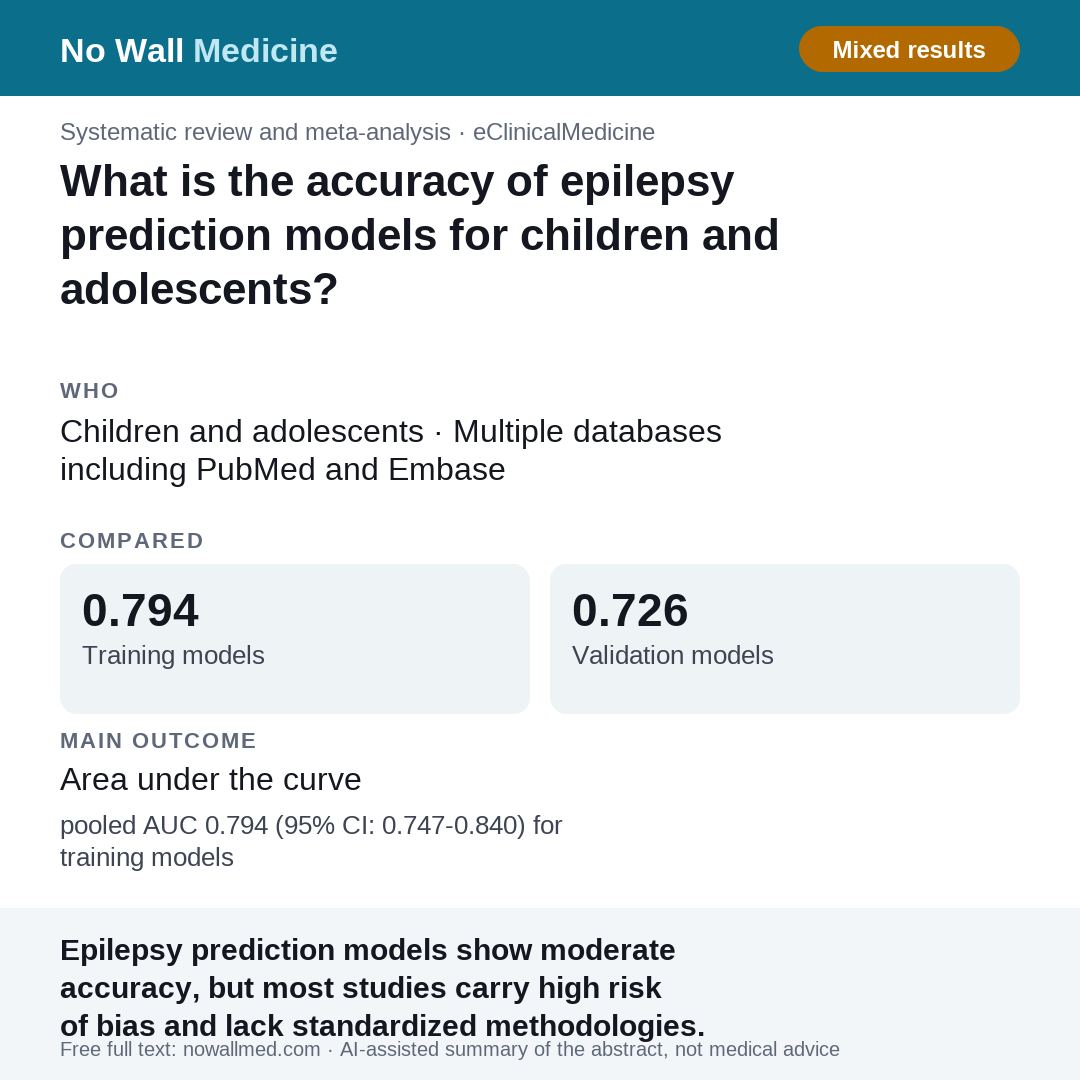
0.794Training models (95% CI: 0.747-0.840)
0.726Validation models (95% CI: 0.659-0.792)
Main outcome
Area under the curve
Result: pooled AUC 0.794 (95% CI: 0.747-0.840) for training models
Bottom line: Epilepsy prediction models show moderate accuracy, but most studies carry high risk of bias and lack standardized methodologies.
Limitation: Most studies carry a high risk of bias and rarely undergo validation.
Funded by: Natural Science Foundation of Hunan Province
eClinicalMedicine · 2025-10-24Download image
Clinical question: What is the accuracy of epilepsy prediction models for children and adolescents?
Why it matters: Current predictive models for epilepsy in young people have yielded inconsistent results, making it difficult to guide clinical strategies.
Key points
- Researchers analyzed 27 studies to evaluate the accuracy of models used to predict epilepsy in children and adolescents.
- The pooled area under the curve, a measure of model accuracy, was 0.794 for 14 training models and 0.726 for 17 validation models.
- Models using clinical features and electroencephalogram (EEG) results showed higher accuracy than those including magnetic resonance imaging (MRI).
Limitation the authors note: Most studies included in the review carried a high risk of bias and rarely underwent validation.
Headline and key points written with AI from the paper’s abstract, with every number checked against it. Read the paper before relying on them.
Was this summary helpful?
Cite this article
Luo Y, Chai X, Li Y. Epilepsy prediction models for children and adolescents: a systematic review and meta-analysis. eClinicalMedicine. 2025. doi:10.1016/j.eclinm.2025.103602
Spotted a mistake? Suggest a correction
Top studies every Monday
The week’s key trials and guidelines in your specialties, plus any topics you follow. By email, free.
Get the weekly digest