Nosebleeds were less severe than other bleeding types but linked to similar drug discontinuation rates
Epistaxis Versus Nonepistaxis Bleeding in Anticoagulated Patients With Atrial Fibrillation: Results From the ENGAGE AF-TIMI 48 Trial
Randomized trialMixed results
How does epistaxis compare to nonepistaxis bleeding in anticoagulated patients with atrial fibrillation?
Who
21105
Patients with atrial fibrillation and CHADS2 risk score ≥2
Compared
Epistaxis: 3.2% major bleeding
Nonepistaxis bleeding: 20.7% major bleeding
Main outcome
Severity and discontinuation of bleeding events
Result: hazard ratio 0.73 (95% CI 0.62 to 0.86) for lower-dose edoxaban
Bottom line: Epistaxis was less severe than nonepistaxis bleeding but associated with similar rates of anticoagulant discontinuation.
J Am Heart Assoc · 2025-01-10Download image
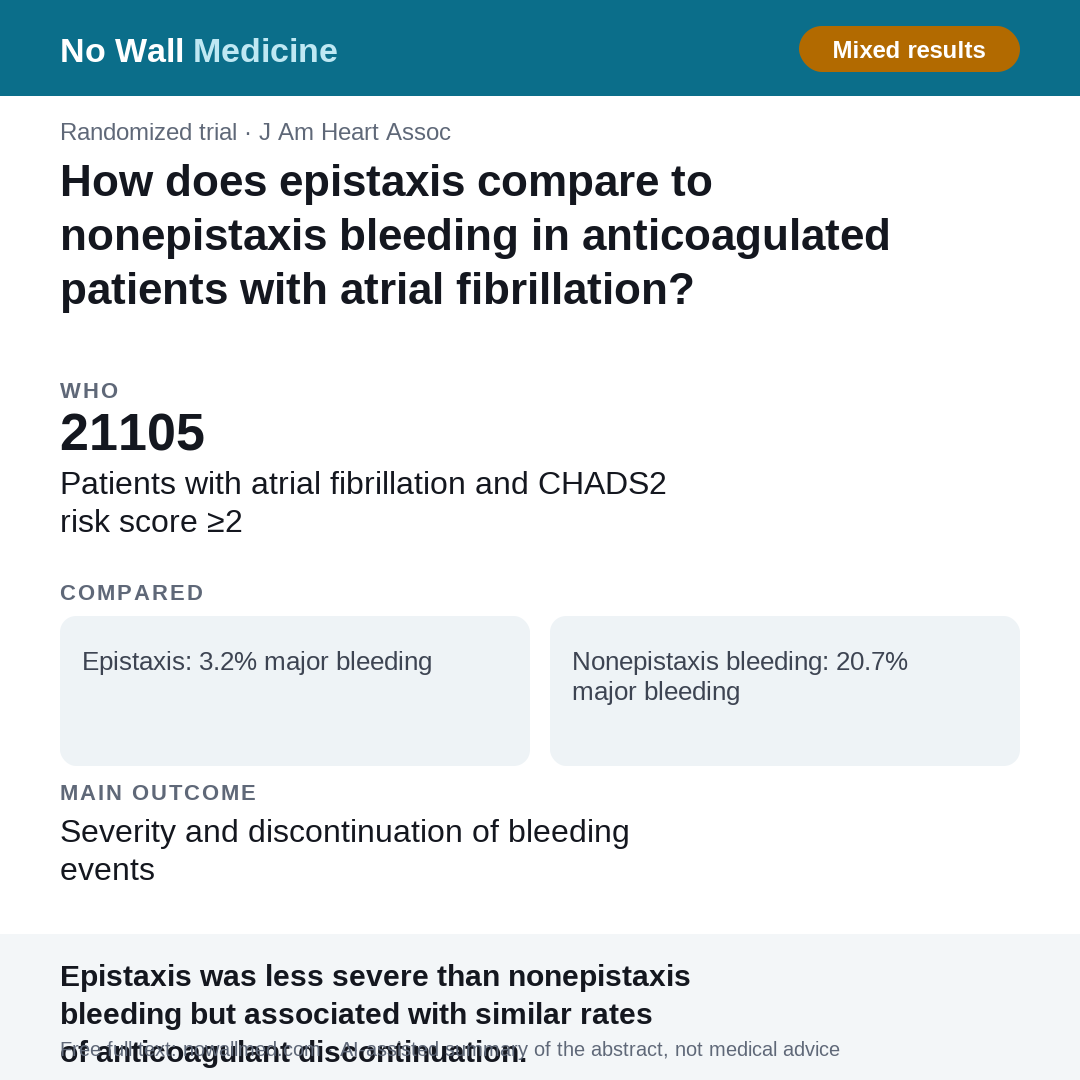
Clinical question: How does epistaxis compare to nonepistaxis bleeding in anticoagulated patients with atrial fibrillation?
Why it matters: The frequency, severity, and clinical outcomes of nosebleeds in patients taking blood thinners are poorly characterized.
Key points
- Researchers analyzed 21,105 patients with atrial fibrillation receiving edoxaban or warfarin to compare nosebleeds with other types of bleeding.
- Among 5247 patients with bleeding, 19.2% had epistaxis (nosebleeds) and 80.8% had nonepistaxis bleeding, with nosebleeds being less likely to be major bleeds (3.2% versus 20.7%).
- Permanent discontinuation of anticoagulants was significantly higher for minor nosebleeds (33.3%) compared to other minor bleeds (23.9%).
Headline and key points written with AI from the paper’s abstract, with every number checked against it. Read the paper before relying on them.
Topics
Cite this article
Semco RS, Bergmark RW, Murphy SA, Cange AL, Unverdorben M, Chen CZL. Epistaxis Versus Nonepistaxis Bleeding in Anticoagulated Patients With Atrial Fibrillation: Results From the ENGAGE AF-TIMI 48 Trial. J Am Heart Assoc. 2025. doi:10.1161/JAHA.123.031434
Spotted a mistake? Suggest a correction
Top studies every Monday
The week’s key trials and guidelines in your specialties, plus any topics you follow. By email, free.
Get the weekly digest