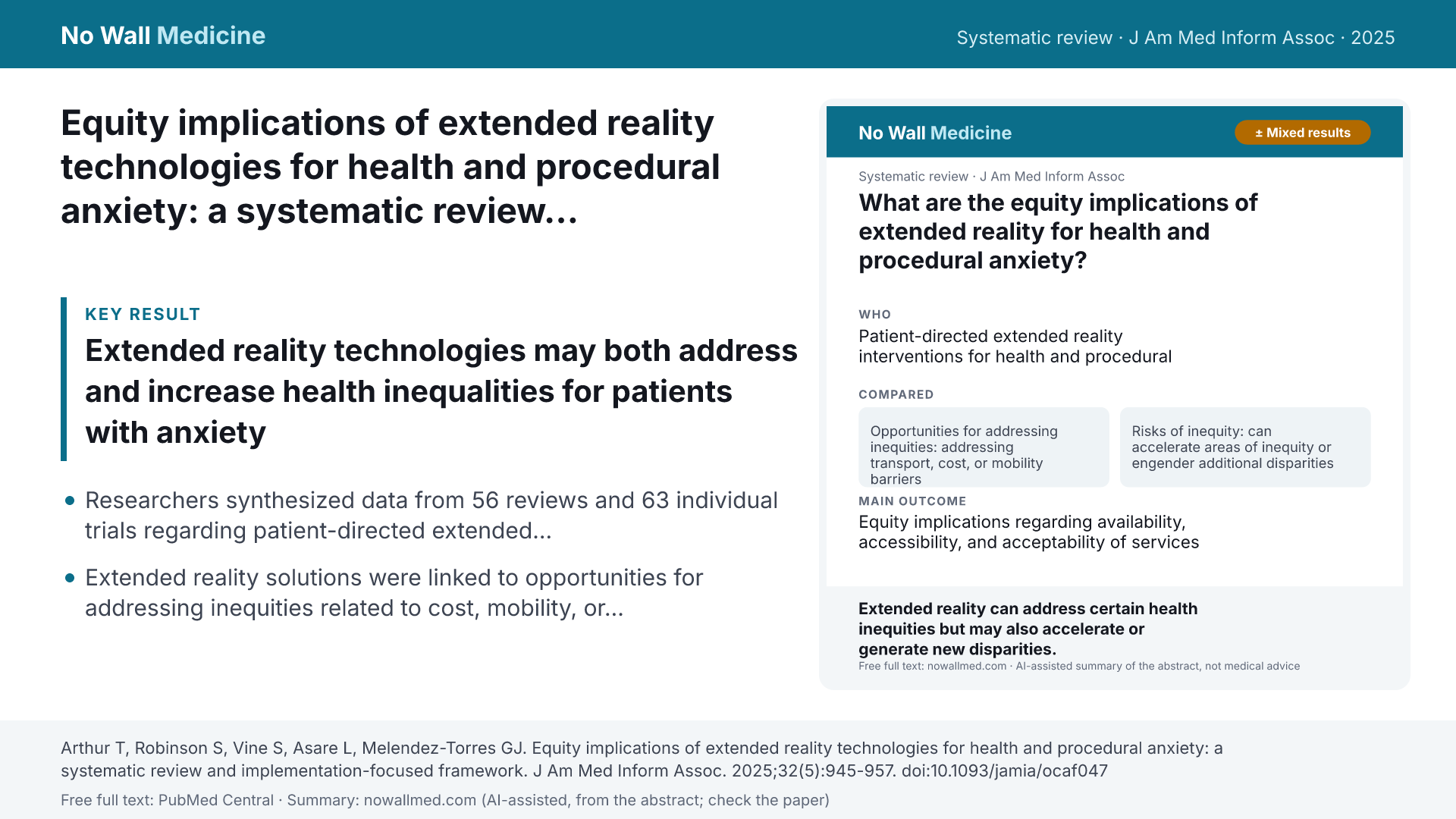
Extended reality technologies may both address and increase health inequalities for patients with anxiety
Equity implications of extended reality technologies for health and procedural anxiety: a systematic review and implementation-focused framework
Systematic reviewMixed results
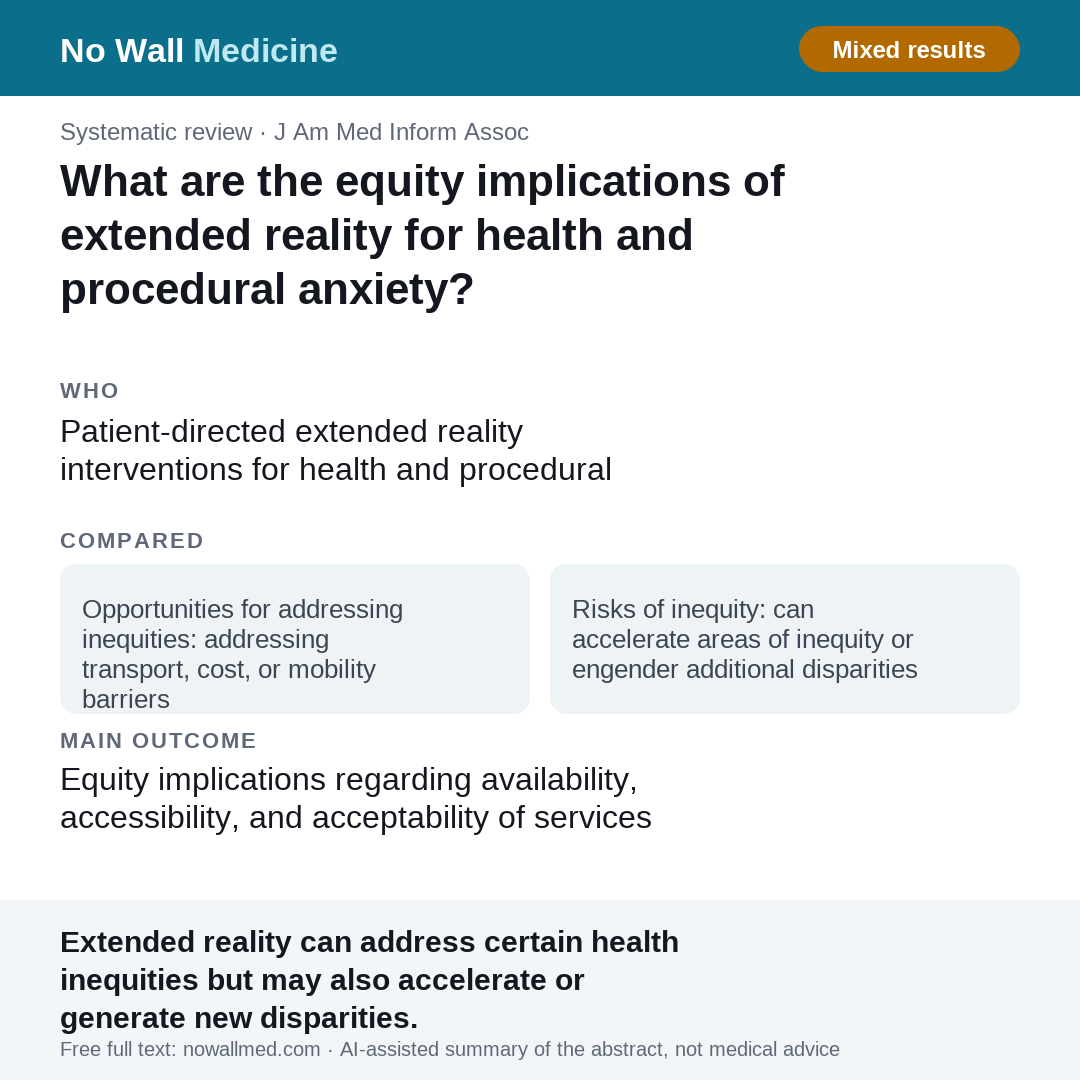
What are the equity implications of extended reality for health and procedural anxiety?
Who
Patient-directed extended reality interventions for health and procedural anxiety
Compared
Opportunities for addressing inequities: addressing transport, cost, or mobility barriers
Risks of inequity: can accelerate areas of inequity or engender additional disparities
Main outcome
Equity implications regarding availability, accessibility, and acceptability of services
Bottom line: Extended reality can address certain health inequities but may also accelerate or generate new disparities.
J Am Med Inform Assoc · 2025-03-20Download image
Clinical question: What are the equity implications of extended reality for health and procedural anxiety?
Why it matters: It is unknown how the use of extended reality technologies for managing patient anxiety impacts health service inequalities.
Key points
- Researchers synthesized data from 56 reviews and 63 individual trials regarding patient-directed extended reality—technologies like virtual or augmented reality—for health and procedural anxiety.
- Extended reality solutions were linked to opportunities for addressing inequities related to cost, mobility, or transport, but were also linked to accelerating or generating additional disparities.
- The study developed a framework to help guide how these technologies are implemented to manage the potential for both helping and harming health equity.
Headline and key points written with AI from the paper’s abstract, with every number checked against it. Read the paper before relying on them.
Was this summary helpful?
Subject terms
Cite this article
Arthur T, Robinson S, Vine S, Asare L, Melendez-Torres GJ. Equity implications of extended reality technologies for health and procedural anxiety: a systematic review and implementation-focused framework. J Am Med Inform Assoc. 2025. doi:10.1093/jamia/ocaf047
Spotted a mistake? Suggest a correction