Esmolol as an Adjunct in Multimodal Anesthesia: A Systematic Review and Meta-Analysis of Its Opioid-Sparing and Analgesic Effects
Systematic review and meta-analysisBenefit found
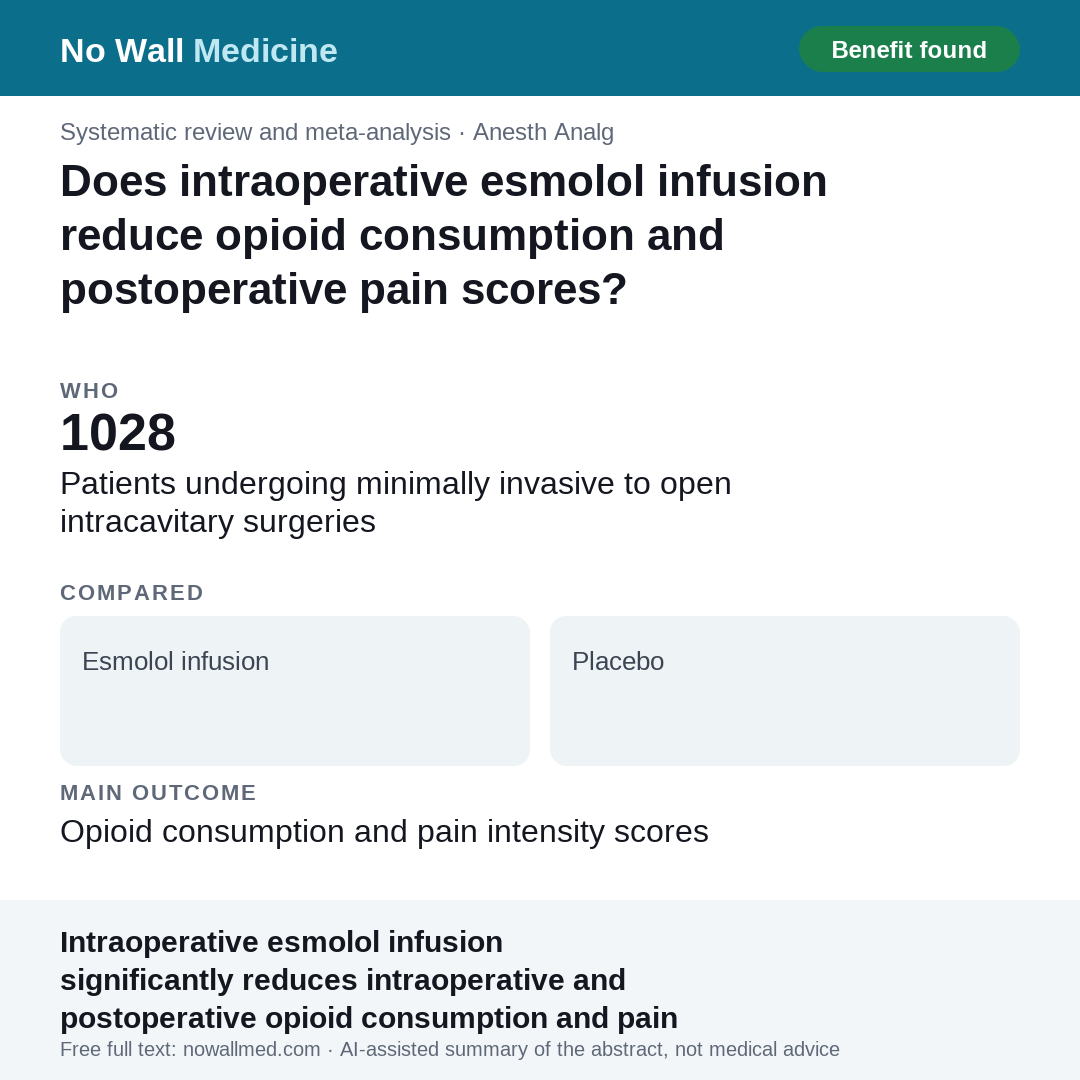
Does intraoperative esmolol infusion reduce opioid consumption and postoperative pain scores?
Who
1028
Patients undergoing minimally invasive to open intracavitary surgeries
Compared
Esmolol infusion
Placebo
Main outcome
Opioid consumption and pain intensity scores
Result: intraoperative opioid consumption MD -12.89 IV MME (95% CI -24.74 to -1.05)
Bottom line: Intraoperative esmolol infusion significantly reduces intraoperative and postoperative opioid consumption and pain scores.
Limitation: Persistent heterogeneity and uncertainty in later pain outcomes warrant further research.
Anesth Analg · 2025-10-24Download image
Clinical question: Does intraoperative esmolol infusion reduce opioid consumption and postoperative pain scores?
Abstract
Background
Esmolol, an ultra-short-acting β1-selective adrenergic antagonist, has been investigated for its potential opioid-sparing effects in multimodal anesthesia. Previous systematic reviews included trials with different control groups causing severe limitations to the generalization of the findings. This systematic review and meta-analysis exclusively synthesized placebo-controlled randomized trials to evaluate the impact of intraoperative esmolol infusion on opioid consumption and postoperative pain scores within the first 24 hours after surgery. Methods
A systematic search was conducted in Medline, Embase, Cochrane Library, and Google Scholar to identify randomized placebo-controlled trials assessing the effects of continuous intraoperative esmolol infusion on opioid consumption and pain scores. The outcomes of interest were total intraoperative and postoperative opioid consumption, converted to intravenous morphine milligram equivalents (IV MME), and pain intensity, and assessed using either the visual analog scale (VAS) or the Numeric Rating Scale (NRS), both of which were standardized using validated methods to a common 0 to 10 scale. Meta-analyses were performed using a random-effects model, and heterogeneity was assessed using Cochran's Q test and I² statistics. Meta-regression and subgroup analyses explored the effects of esmolol infusion rate, type of surgery, intraoperative anesthetic and hemodynamic management, and patient age as potential moderators. Results
Nineteen randomized trials (1028 patients) were included, involving esmolol regimens with a loading dose ranging from 0.5 to 1.0 mg/kg and a maintenance infusion rate of 0.3 to 6 mg/kg/h. Surgical procedures ranged from minimally invasive to open intracavitary surgeries. Esmolol infusion significantly reduced in 32% the intraoperative opioid consumption (mean differences [MD], -12.89 IV MME; 95% Confidence Interval, 95% confidence interval [CI], -24.74 to -1.05; P < .001; I² = 93.6%) and 38.6% the postoperative opioid consumption (MD, -3.03 IV MME; 95% CI, -4.29 to -1.76; P < .001; I² = 89.9%). For pain scores, 3 analyses were performed at the following intervals: within 30 minutes (MD, -1.47; 95% CI, -2.02 to -0.93; P < .001), between 2 and 4 hours (MD, -0.67; 95% CI, -1.29 to -0.06; P = .032), and at 24 hours (MD, -0.48; 95% CI, -0.92 to -0.03; P =.038). Based on the weighted mean values for the placebo group in each pooled analysis, we observed reductions in pain scores of 27.3%, 15.8%, and 23.5%, respectively. In addition, esmolol significantly reduced intraoperative heart rate in most cases and lowered MAP at multiple time points in several studies. Despite this, no significant increase in hypotension or bradycardia was reported, and only 1 study noted higher ephedrine and atropine use. Conclusions
Esmolol infusion significantly reduces opioid consumption and postoperative pain, with a magnitude of effect that may have clinical significance. The observed effects remained consistent in subgroups where confounding variables, expected to bias the results toward the null, were present. However, the uncertainty in later pain outcomes and the persistent heterogeneity warrant further research into esmolol's applicability across different surgical contexts and populations.
Subject terms
Cite this article
Neto EDDS, de Lara FST, Abreu SN, Sanches MC, de Freitas MCF, Oliveira ARDS. Esmolol as an Adjunct in Multimodal Anesthesia: A Systematic Review and Meta-Analysis of Its Opioid-Sparing and Analgesic Effects. Anesth Analg. 2025. doi:10.1213/ANE.0000000000007787
Spotted a mistake? Suggest a correction
Top studies every Monday
The week’s key trials and guidelines in your specialties, plus any topics you follow. By email, free.
Get the weekly digest