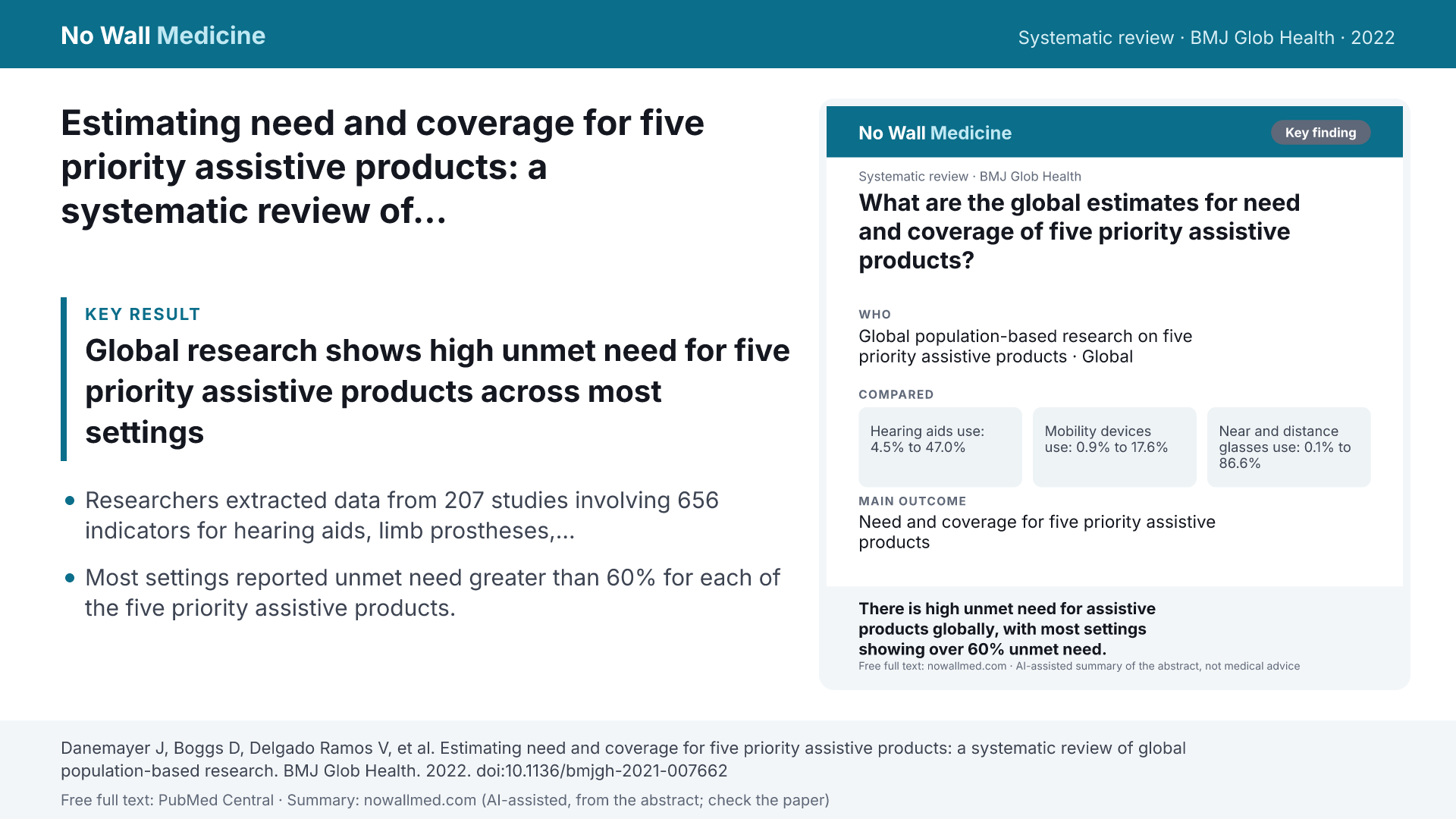
Estimating need and coverage for five priority assistive products: a systematic review of global population-based research
Key result: Global research shows high unmet need for five priority assistive products across most settings
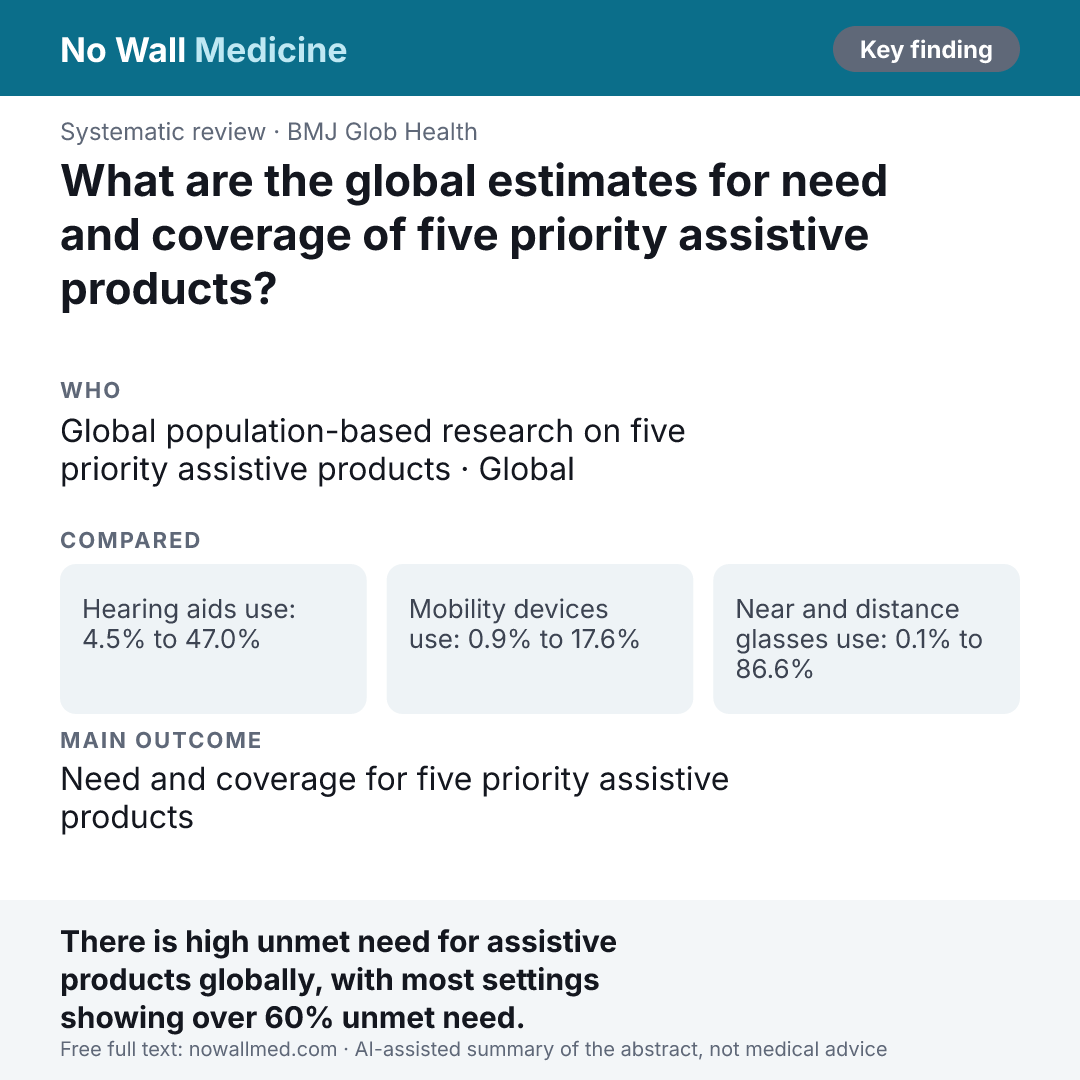
Key points
- Researchers extracted data from 207 studies involving 656 indicators for hearing aids, limb prostheses, wheelchairs, glasses, and personal digital assistants.
- Most settings reported unmet need greater than 60% for each of the five priority assistive products.
- Reported use of assistive products among people with functional difficulties ranged from 4.5% to 47.0% for hearing aids and 0.1% to 86.6% for glasses.
Why it matters: Data on the global need and coverage of assistive products are disparate and lack standardized definitions for indicators.
Limitation the authors note: Variation in definitions of indicators for access to assistive products likely led to overestimates or underestimates of need and coverage.
Discussion prompts
- Would these patients look like yours? Who was left out?
- Is the main outcome one that matters to patients?
- Is the difference large enough to change what you do?
Cite: Danemayer J, Boggs D, Delgado Ramos V, et al. Estimating need and coverage for five priority assistive products: a systematic review of global population-based research. BMJ Glob Health. 2022. doi:10.1136/bmjgh-2021-007662
Free full text: PubMed Central · Summary and visual abstract: nowallmed.com/a/estimating-need-and-coverage-for-five-priority-assistive-products-a-10m477a/ (AI-assisted from the abstract; check the paper before relying on it).