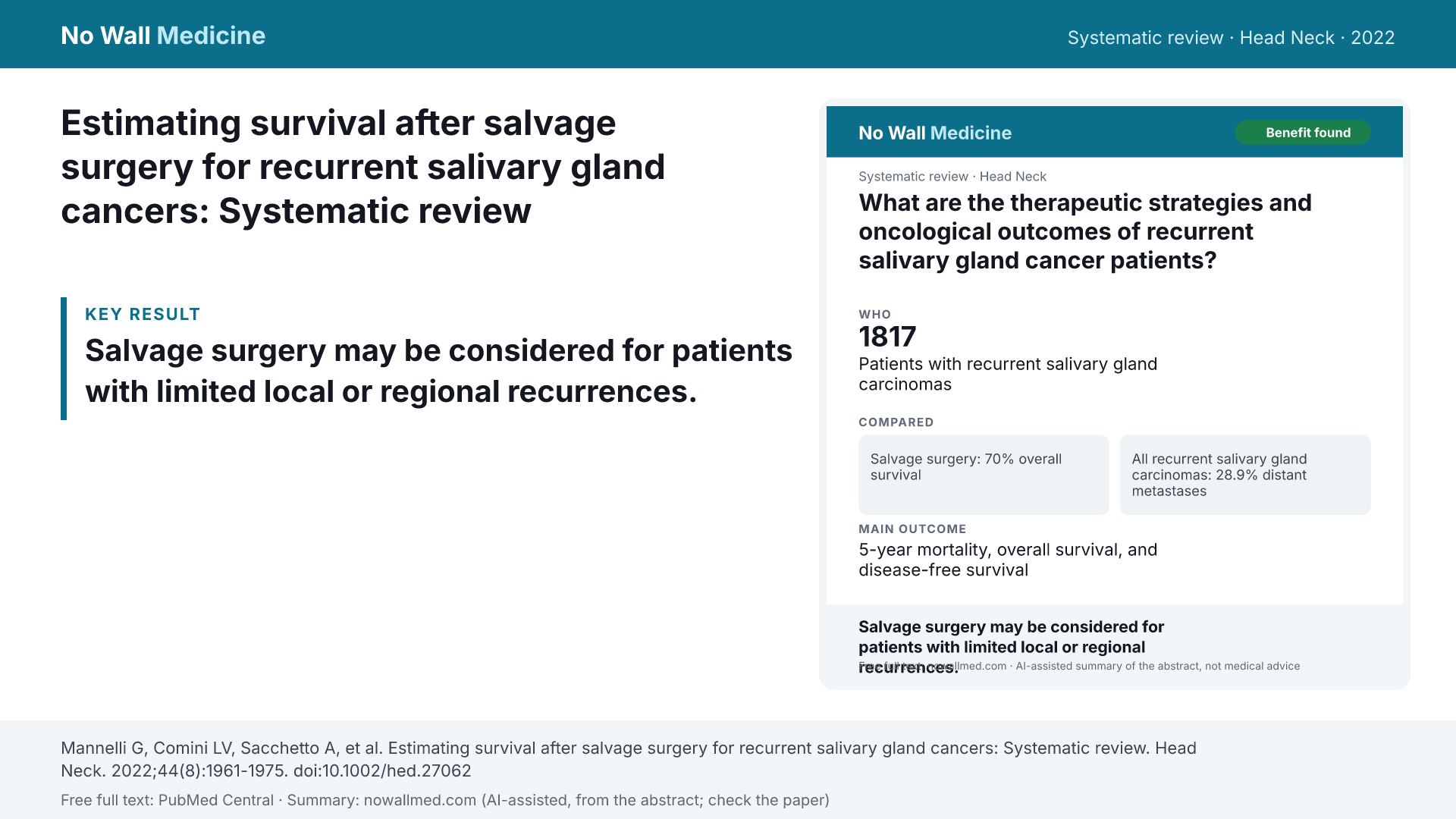
Estimating survival after salvage surgery for recurrent salivary gland cancers: Systematic review
Systematic reviewBenefit found
What are the therapeutic strategies and oncological outcomes of recurrent salivary gland cancer patients?
Who
1817
Patients with recurrent salivary gland carcinomas
Compared
Salvage surgery: 70% overall survival
All recurrent salivary gland carcinomas: 28.9% distant metastases
Main outcome
5-year mortality, overall survival, and disease-free survival
Bottom line: Salvage surgery may be considered for patients with limited local or regional recurrences.
Head Neck · 2022-04-20 · Save PNG
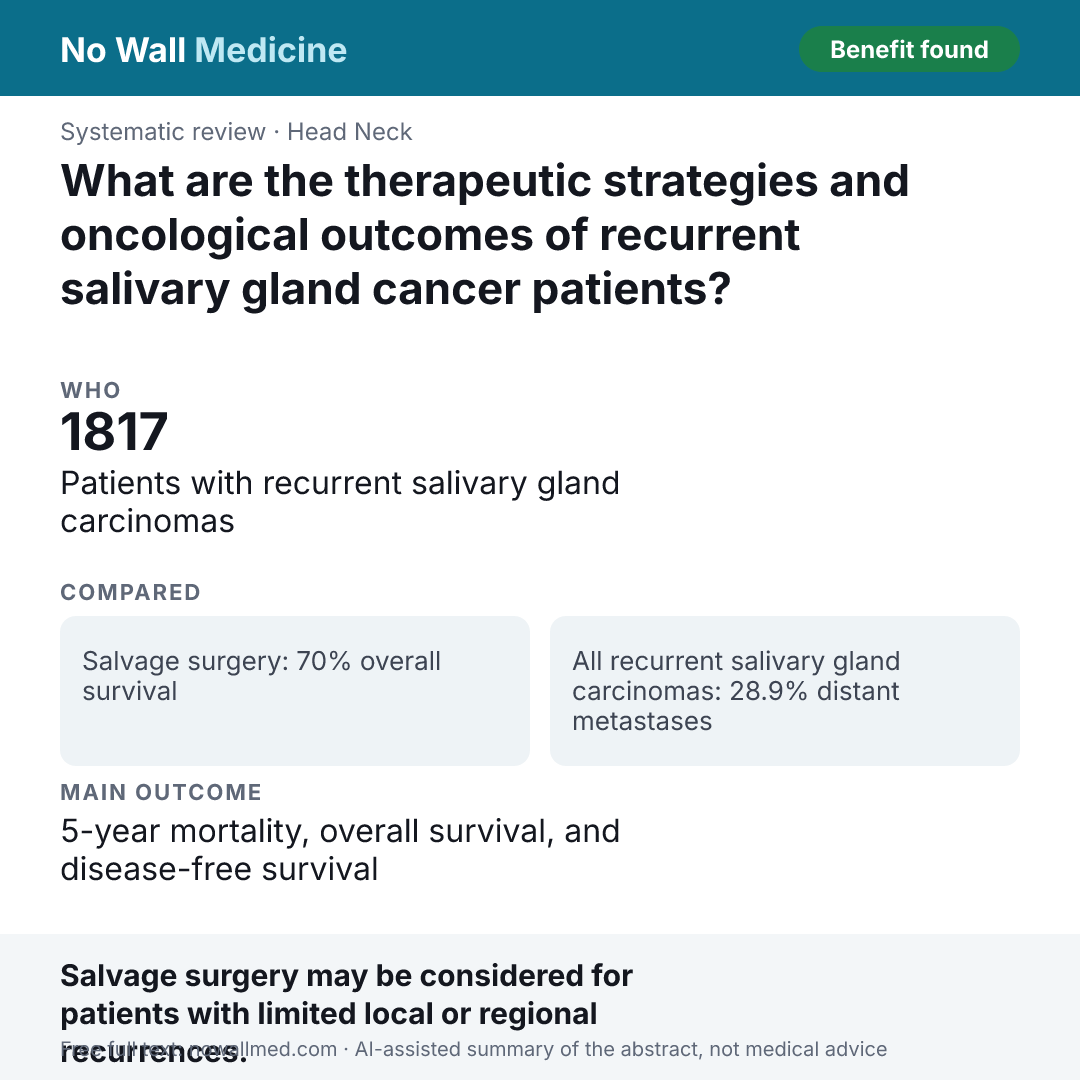
Clinical question: What are the therapeutic strategies and oncological outcomes of recurrent salivary gland cancer patients?
Abstract
Recurrent salivary gland carcinomas (RSCs) are poorly characterized and their clinical features and treatment options have not yet been fully described. The goal of this study was to analyze the therapeutic strategies and oncological outcomes of RSC patients through a literature review analysis. This systematic review was performed according to the PRISMA statements. Inclusion criteria for the systematic review were based on the population, intervention, comparison, and outcomes according to (PICO) framework. Two thousand seven hundred and four records were selected and 1817 recurrences were studied. Three hundred and sixty-five patients underwent salvage surgery (20.1%) and their 5-year mortality rate, overall survival and disease-free survival were 35%, 70%, and 42%, respectively. RSCs are aggressive neoplasms with a high rate of distant metastases (28.9%). Salvage surgery can be considered in patients with limited local and/or regional recurrences, even in case of single distant relapse, appearing within the first 3 years of follow-up.
Subject terms
Headline, design, result, key points, caveat and citation as plain text.
Cite this article
Mannelli G, Comini LV, Sacchetto A, et al. Estimating survival after salvage surgery for recurrent salivary gland cancers: Systematic review. Head Neck. 2022;44(8):1961-1975. doi:10.1002/hed.27062
Spotted a mistake? Suggest a correction