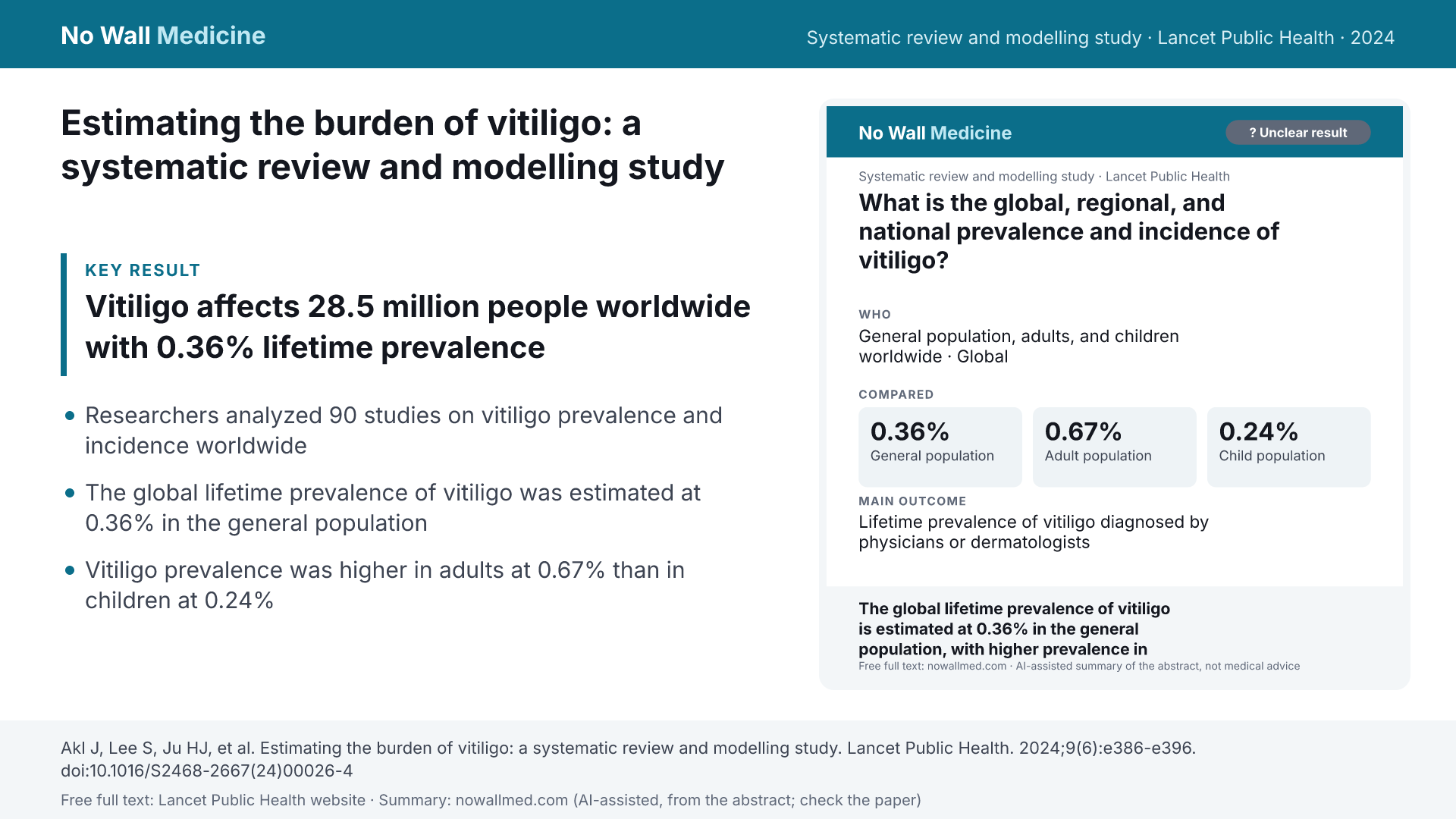
Vitiligo affects 28.5 million people worldwide with 0.36% lifetime prevalence
Estimating the burden of vitiligo: a systematic review and modelling study
Public & Global HealthAdult and pediatric
Systematic review and modelling studyUnclear result
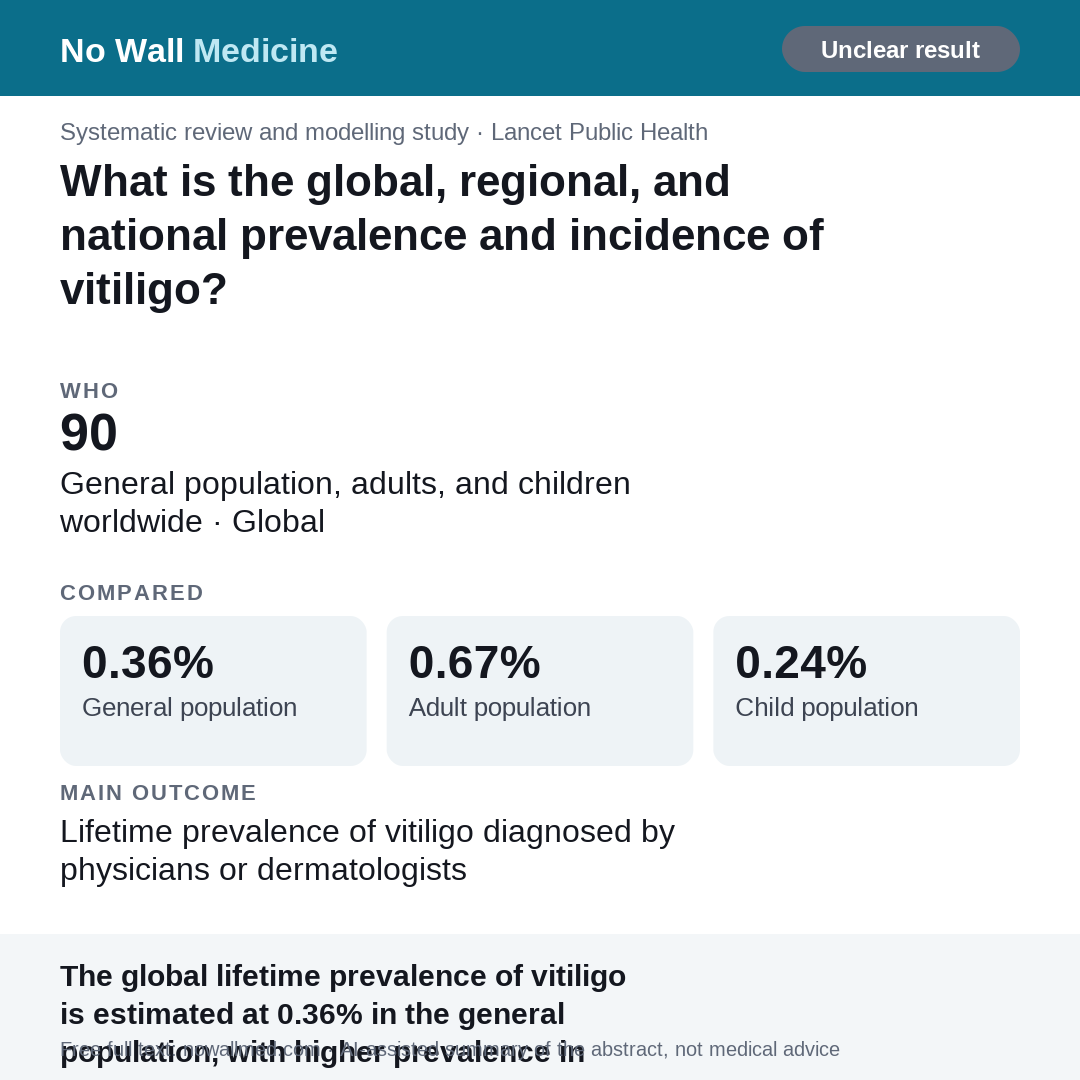
What is the global, regional, and national prevalence and incidence of vitiligo?
Who
90
General population, adults, and children worldwide · Global
Compared
0.36%General population (95% credible interval 0.24-0.54)
0.67%Adult population (0.43-1.07)
0.24%Child population (0.16-0.37)
Main outcome
Lifetime prevalence of vitiligo diagnosed by physicians or dermatologists
Result: 0.36% (95% credible interval 0.24-0.54) in the general population
Bottom line: The global lifetime prevalence of vitiligo is estimated at 0.36% in the general population, with higher prevalence in adults.
Lancet Public Health · 2024-03-26Download image
Clinical question: What is the global, regional, and national prevalence and incidence of vitiligo?
Why it matters: There is an absence of standardized global epidemiological data on vitiligo
Key points
- Researchers analyzed 90 studies on vitiligo prevalence and incidence worldwide.
- The global lifetime prevalence of vitiligo was estimated at 0.36% in the general population.
- Vitiligo prevalence was higher in adults at 0.67% than in children at 0.24%.
Limitation the authors note: Due to a small number of studies, the data on incidence were presented in a descriptive summary only
Headline and key points written with AI from the paper’s abstract, with every number checked against it. Read the paper before relying on them.
Was this summary helpful?
Abstract
Background
Vitiligo is a chronic autoimmune disease characterised by depigmented skin patches, which can pose substantial psychosocial challenges particularly in individuals with dark skin tones. Despite its impact on quality of life, there is an absence of standardised global epidemiological data. We sought to address this gap with the present study. Methods
In this study we did a systematic review and modelling analysis to estimate the global, regional, and national prevalence and incidence of vitiligo. We did a comprehensive search of nine digital libraries (PubMed, Embase, Web of Science, Scientific Electronic Library Online, KCI Korean Journal Database, Russian Science Citation Index, Western Pacific Region Index Medicus, Informit, and Health Research and Development Information Network) from inception up to May 25, 2023. We included cross-sectional or cohort studies reporting the incidence rate or prevalence of vitiligo, or data from which incidence rate or prevalence could be calculated, in the general population of a country or area of a country. Summary estimate data were extracted. A main outcome was to estimate the worldwide, regional, and country-specific lifetime prevalence of vitiligo diagnosed by physicians or dermatologists among the general population and in adults and children (as per age groups defined in included studies). We used a Bayesian hierarchical linear mixed model to estimate prevalence, and calculated number of affected individuals using the UN population structure in 2022. In estimating lifetime prevalence, studies reporting point or period prevalence were excluded. Our other main outcome was to estimate incidence rates of vitiligo, but due to a small number of studies, the data on incidence were presented in a descriptive summary. This study was registered on PROSPERO, CRD42023390433. Findings
Our search identified 22 192 records, of which 90 studies met our inclusion criteria. Of these studies, six focused on the incidence of vitiligo, 79 reported on the prevalence of vitiligo, and five provided data on both incidence and prevalence. 71 studies reported on lifetime prevalence. In the most recent years studied, incidence rates in the general population ranged from 24·7 cases (95% CI 24·3-25·2) per 100 000 person-years in South Korea in 2019, to 61·0 cases (60·6-61·4) in the USA in 2017. In individual studies, incidence rates showed an increasing trend over the periods studied. The global lifetime prevalence of vitiligo diagnosed by a physician or dermatologist was estimated at 0·36% (95% credible interval [CrI] 0·24-0·54) in the general population (28·5 million people [95% CrI 18·9-42·6]), 0·67% (0·43-1·07) in the adult population (37·1 million adults [23·9-58·9]), and 0·24% (0·16-0·37) in the child population (5·8 million children [3·8-8·9]). Vitiligo prevalence was higher in adults than in children across all regions. Central Europe and south Asia reported the highest prevalence (0·52% [0·28-1·07] and 0·52% [0·33-0·82], respectively, in the general population). Interpretation
This study highlights the need for standardised epidemiological data collection globally to inform public health policies and improve vitiligo diagnosis and management. Emphasis on the impact on individuals with darker skin tones is crucial to reducing stigma and improving quality of life. Furthermore, our study highlights the need to conduct more research in regions and populations that have been historically under-represented, to effectively address the worldwide burden of vitiligo. Funding
None.
Abstract reproduced under the article’s CC BY NC ND licence.
Subject terms
Cite this article
Akl J, Lee S, Ju HJ, et al. Estimating the burden of vitiligo: a systematic review and modelling study. Lancet Public Health. 2024. doi:10.1016/S2468-2667(24)00026-4
Spotted a mistake? Suggest a correction