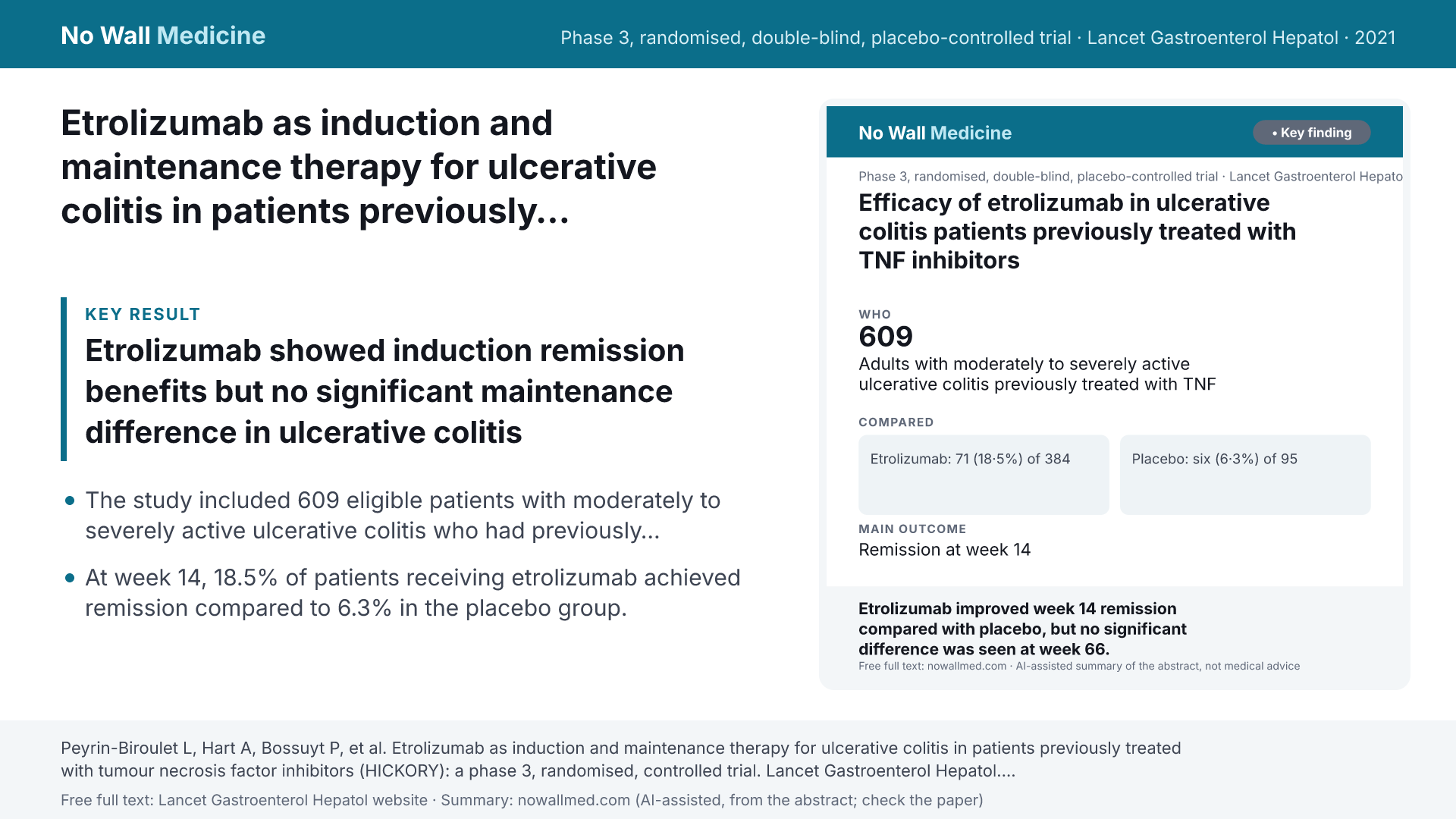
Etrolizumab as induction and maintenance therapy for ulcerative colitis in patients previously treated with tumour necrosis factor inhibitors (HICKORY): a phase 3, randomised, controlled trial
Key result: Etrolizumab showed induction remission benefits but no significant maintenance difference in ulcerative colitis
Key points
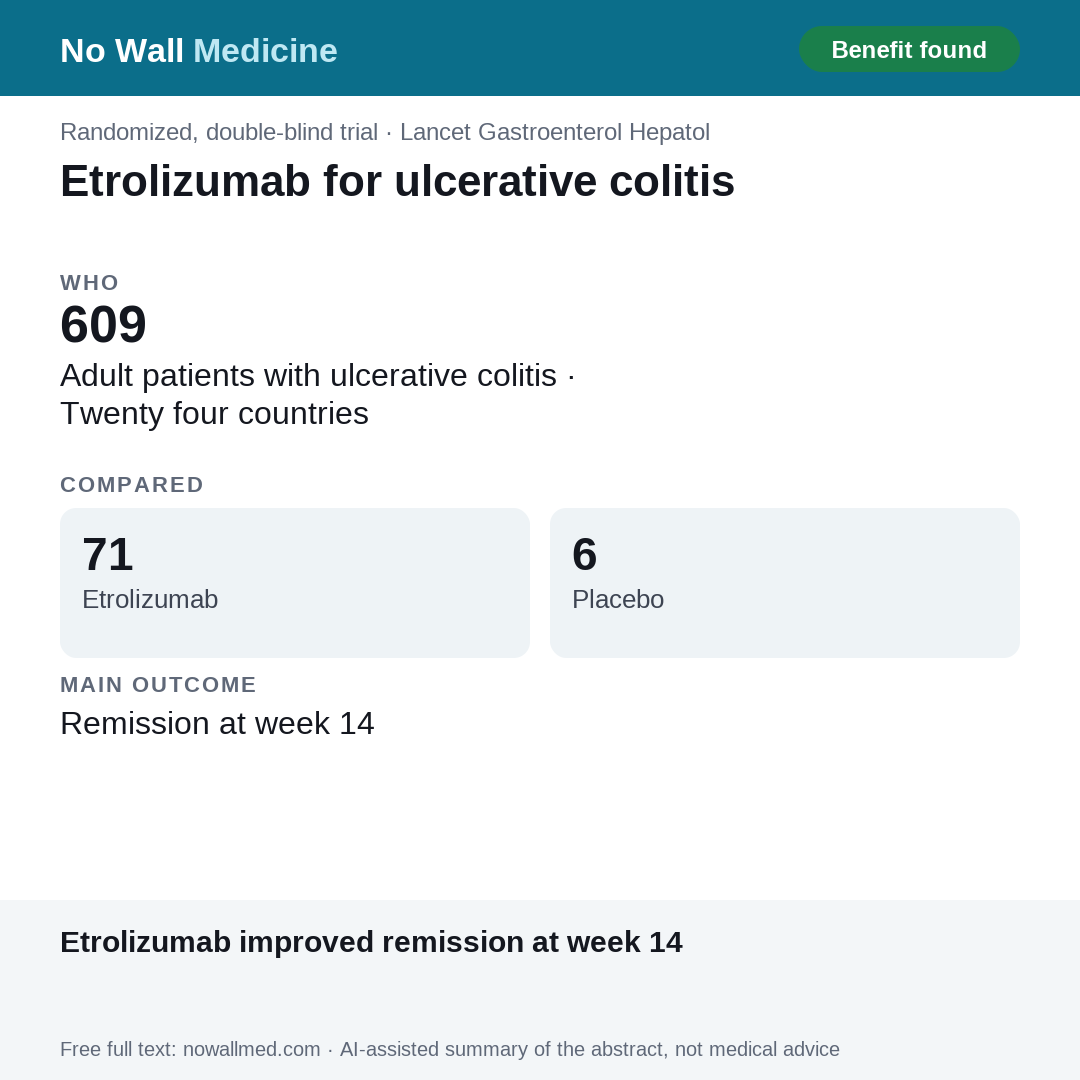
- The study included 609 eligible patients with moderately to severely active ulcerative colitis who had previously used anti-tumour necrosis factor drugs.
- At week 14, 18.5% of patients receiving etrolizumab achieved remission compared to 6.3% in the placebo group.
- At week 66, there was no significant difference in remission between the etrolizumab group (24.1%) and the placebo group (20.2%).
Why it matters: It was unknown if etrolizumab, a gut-targeted monoclonal antibody, is effective for both induction and maintenance therapy in patients who failed previous anti-tumour necrosis factor treatments.
Discussion prompts
- Would these patients look like yours? Who was left out?
- Is the main outcome one that matters to patients?
- Is the difference large enough to change what you do?
Cite: Peyrin-Biroulet L, Hart A, Bossuyt P, et al. Etrolizumab as induction and maintenance therapy for ulcerative colitis in patients previously treated with tumour necrosis factor inhibitors (HICKORY): a phase 3, randomised, controlled trial. Lancet Gastroenterol Hepatol. 2021. doi:10.1016/S2468-1253(21)00298-3
Free full text: Lancet Gastroenterol Hepatol website · Summary and visual abstract: nowallmed.com/a/etrolizumab-as-induction-and-maintenance-therapy-for-ulcerative-1hj0mch/ (AI-assisted from the abstract; check the paper before relying on it).