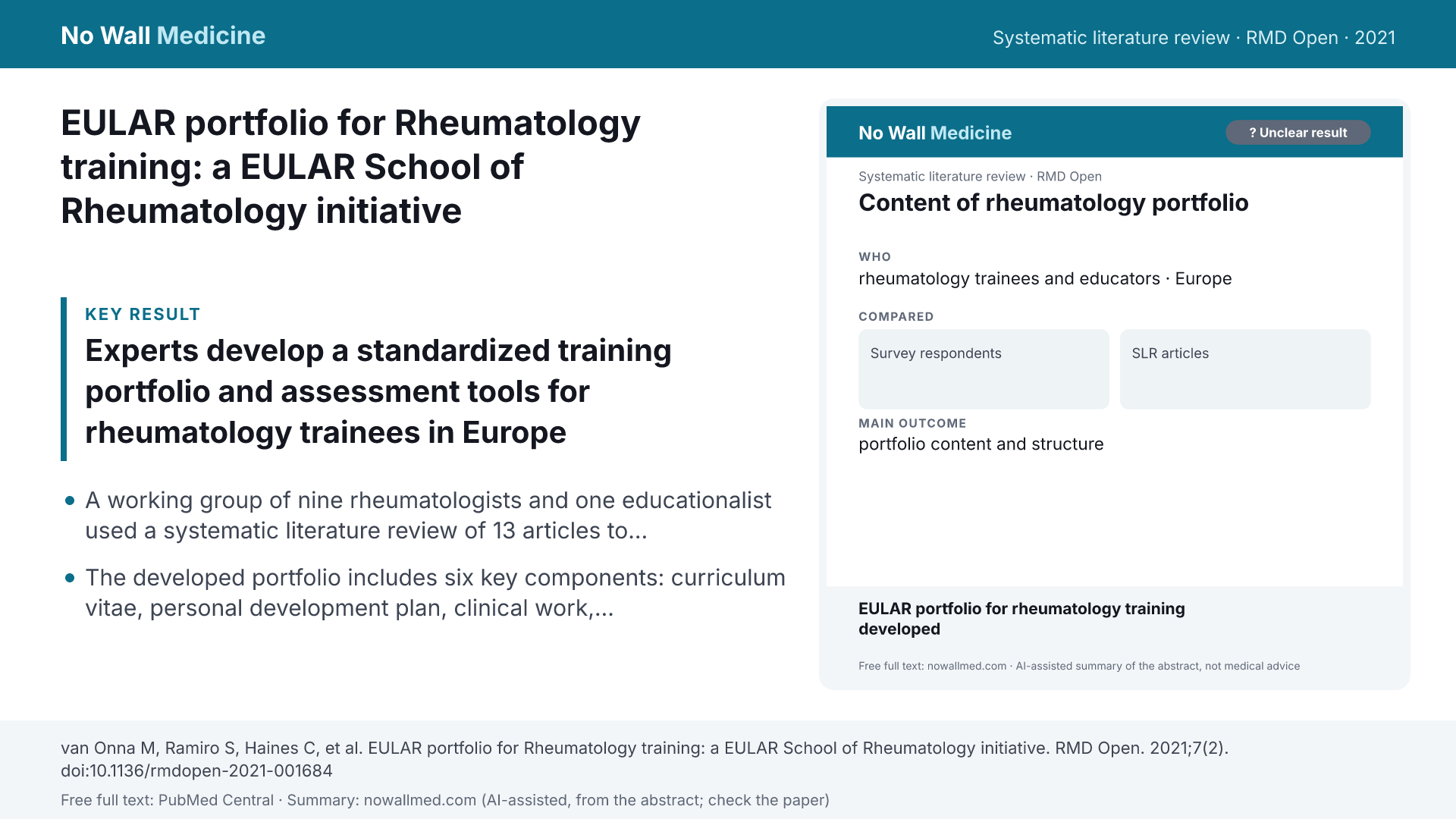
Experts develop a standardized training portfolio and assessment tools for rheumatology trainees in Europe
EULAR portfolio for Rheumatology training: a EULAR School of Rheumatology initiative
Systematic literature reviewUnclear result
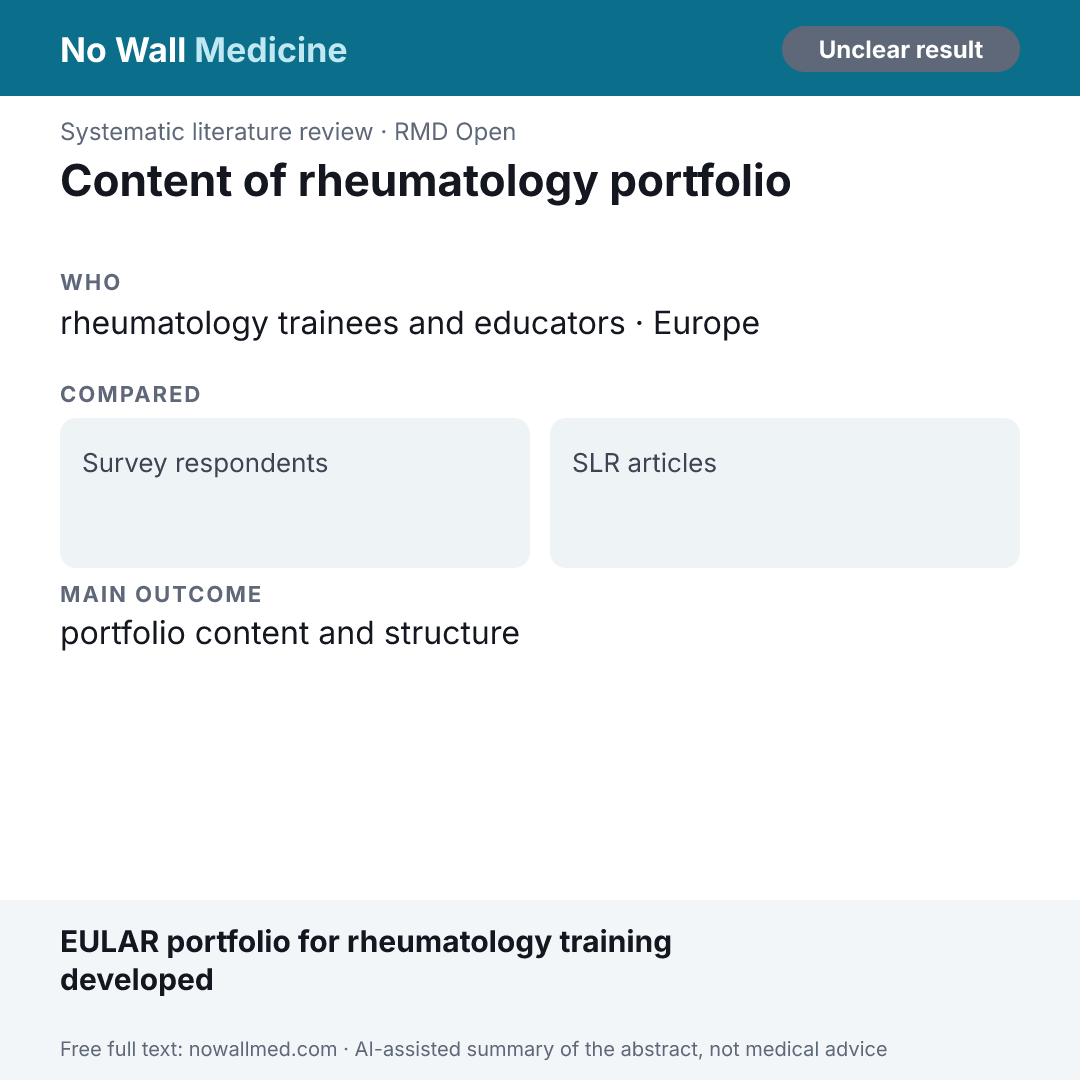
Content of rheumatology portfolio
Who
rheumatology trainees and educators · Europe
Compared
Survey respondents
SLR articles
Main outcome
portfolio content and structure
Bottom line: EULAR portfolio for rheumatology training developed
RMD Open · 2021-06-17 · Save PNG
Why it matters: Approximately half of rheumatology trainees do not use a portfolio, and there is a lack of consensus regarding the content and structure of such tools.
Key points
- A working group of nine rheumatologists and one educationalist used a systematic literature review of 13 articles to identify essential portfolio components.
- The developed portfolio includes six key components: curriculum vitae, personal development plan, clinical work, professional behaviours, education, and research activities.
- Four assessment forms, such as case-based discussions, were successfully pilot-tested by 11 rheumatologists and their trainees.
Headline and key points written with AI from the paper’s abstract, with every number checked against it. Read the paper before relying on them.
Was this summary helpful?
Abstract
Objective
About half of the rheumatology trainees do not use a portfolio. This project was established to reach consensus about the content of a EULAR portfolio for Rheumatology training and subsequently develop portfolio assessment forms. Methods
After establishing a portfolio working group (WG), including nine rheumatologists and one educationalist, a systematic literature review (SLR) on the content and structure of portfolios for postgraduate learning was conducted (November 2018). This was followed by a survey among WG members and members of the EMerging EUlar NETwork, inquiring about the content and structure of existing national portfolios. The portfolio WG selected the key components of the portfolio, taking previous experience and feasibility into account. Assessment forms (eg, case-based discussion) were developed and pilot-tested. Results
13/2034 articles were included in the SLR (12 high/1 moderate risk of bias). Information on procedural skills, personal reflections, learning goals and multisource feedback was most often included a portfolio. Twenty-five respondents completed the survey (response≈50%). Feedback from assessors, reflective writing and formulation of learning goals were considered important dimensions to be covered in a portfolio. Six key components of the portfolio were established: curriculum vitae, personal development plan, clinical work, professional behaviours, education and research activities. Suggested minimal content for each component was formulated. Four assessment forms were successfully pilot-tested by 11 rheumatologists and their trainees. Conclusion
A EULAR portfolio for Rheumatology training and assessment forms were developed. Portfolio implementation, particularly in countries without an existing portfolio, may promote a higher standard of rheumatology training across Europe.
Abstract reproduced under the article’s CC BY NC licence.
Subject terms
Headline, design, result, key points, caveat and citation as plain text.
Cite this article
van Onna M, Ramiro S, Haines C, et al. EULAR portfolio for Rheumatology training: a EULAR School of Rheumatology initiative. RMD Open. 2021. doi:10.1136/rmdopen-2021-001684
Spotted a mistake? Suggest a correction