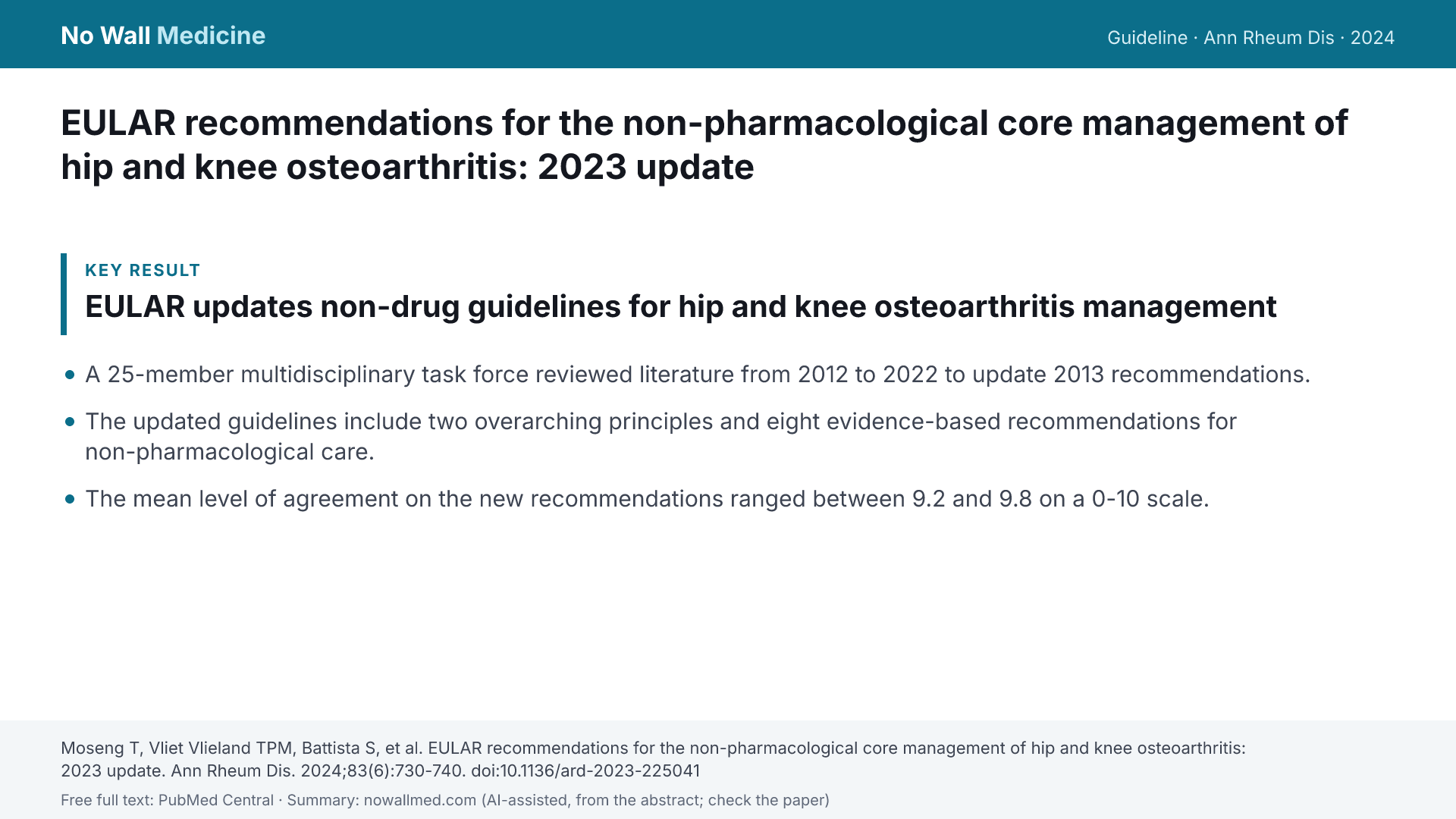
EULAR updates non-drug guidelines for hip and knee osteoarthritis management
EULAR recommendations for the non-pharmacological core management of hip and knee osteoarthritis: 2023 update
No newer version found (checked 2026-11-27). PubMed lists no update or withdrawal of this guideline. Issuing bodies sometimes publish updates elsewhere, so check their website before relying on it.
Why it matters: The 2013 recommendations required updating due to the large number of subsequent studies on non-pharmacological treatments.
Key points
- A 25-member multidisciplinary task force reviewed literature from 2012 to 2022 to update 2013 recommendations.
- The updated guidelines include two overarching principles and eight evidence-based recommendations for non-pharmacological care.
- The mean level of agreement on the new recommendations ranged between 9.2 and 9.8 on a 0-10 scale.
Headline and key points written with AI from the paper’s abstract, with every number checked against it. Read the paper before relying on them.
Was this summary helpful?
Abstract
Introduction
Hip and knee osteoarthritis (OA) are increasingly common with a significant impact on individuals and society. Non-pharmacological treatments are considered essential to reduce pain and improve function and quality of life. EULAR recommendations for the non-pharmacological core management of hip and knee OA were published in 2013. Given the large number of subsequent studies, an update is needed. Methods
The Standardised Operating Procedures for EULAR recommendations were followed. A multidisciplinary Task Force with 25 members representing 14 European countries was established. The Task Force agreed on an updated search strategy of 11 research questions. The systematic literature review encompassed dates from 1 January 2012 to 27 May 2022. Retrieved evidence was discussed, updated recommendations were formulated, and research and educational agendas were developed. Results
The revised recommendations include two overarching principles and eight evidence-based recommendations including (1) an individualised, multicomponent management plan; (2) information, education and self-management; (3) exercise with adequate tailoring of dosage and progression; (4) mode of exercise delivery; (5) maintenance of healthy weight and weight loss; (6) footwear, walking aids and assistive devices; (7) work-related advice and (8) behaviour change techniques to improve lifestyle. The mean level of agreement on the recommendations ranged between 9.2 and 9.8 (0-10 scale, 10=total agreement). The research agenda highlighted areas related to these interventions including adherence, uptake and impact on work. Conclusions
The 2023 updated recommendations were formulated based on research evidence and expert opinion to guide the optimal management of hip and knee OA.
Abstract reproduced under the article’s CC BY NC ND licence.
Subject terms
Headline, design, result, key points, caveat and citation as plain text.
Cite this article
Moseng T, Vliet Vlieland TPM, Battista S, et al. EULAR recommendations for the non-pharmacological core management of hip and knee osteoarthritis: 2023 update. Ann Rheum Dis. 2024;83(6):730-740. doi:10.1136/ard-2023-225041
Spotted a mistake? Suggest a correction