Digital health tool eSense showed potential for reducing sexual distress in women
Evaluating a Digital Health Tool Designed to Improve Low Sexual Desire in Women: Mixed-Methods Implementation Science Study
Mixed-methods implementation science studyBenefit found
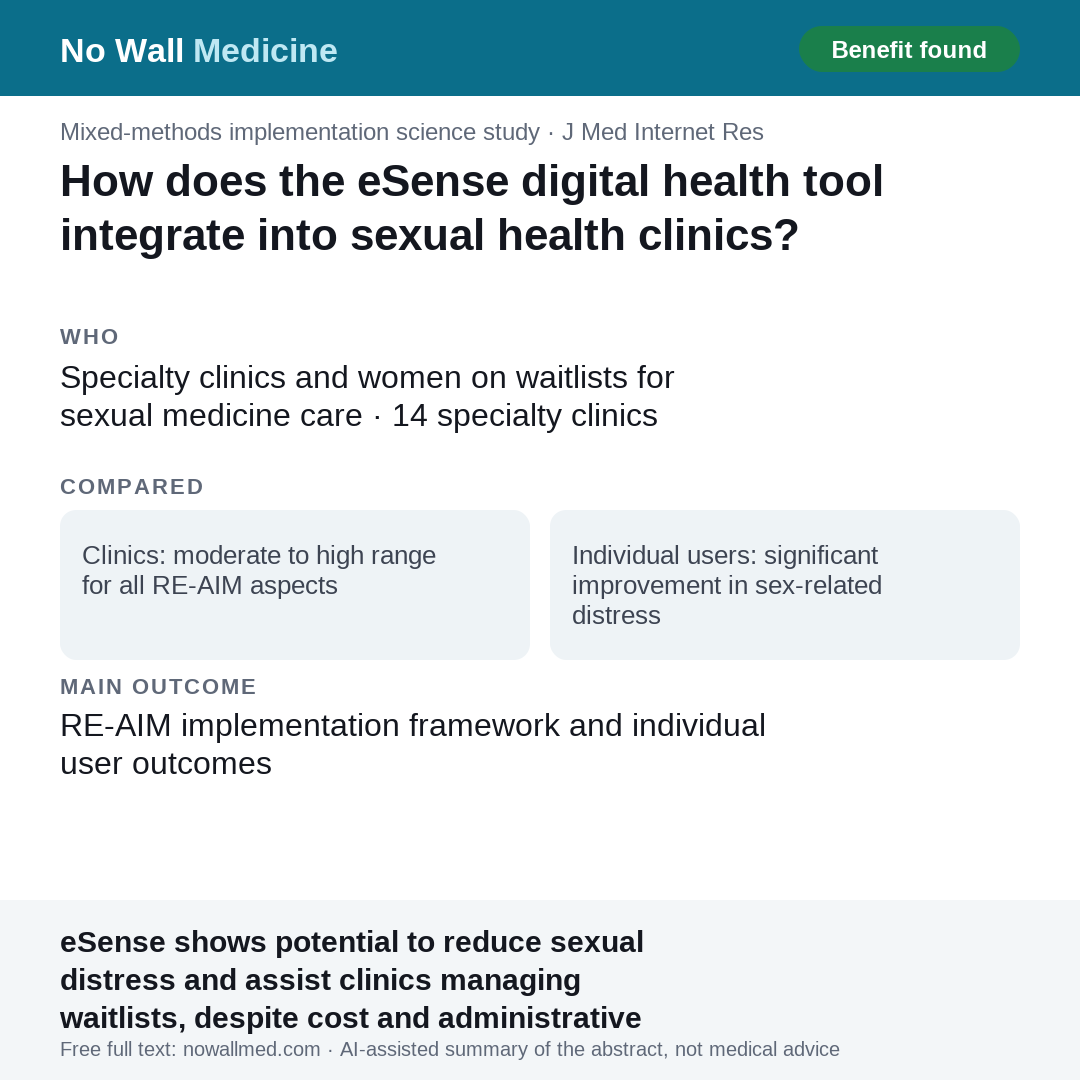
How does the eSense digital health tool integrate into sexual health clinics?
Who
Specialty clinics and women on waitlists for sexual medicine care · 14 specialty clinics
Compared
Clinics: moderate to high range for all RE-AIM aspects
Individual users: significant improvement in sex-related distress
Main outcome
RE-AIM implementation framework and individual user outcomes
Bottom line: eSense shows potential to reduce sexual distress and assist clinics managing waitlists, despite cost and administrative challenges.
Limitation: Half of the clinics noted cost as a key issue for future implementation.
J Med Internet Res · 2025-03-25Download image
Clinical question: How does the eSense digital health tool integrate into sexual health clinics?
Why it matters: Access to traditional cognitive behavioral therapy and mindfulness-based therapy for sexual health is limited by specialist shortages, cost, and embarrassment.
Key points
- Researchers assessed the integration of the eSense digital program into 14 specialty clinics and surveyed 12 women on therapy waitlists.
- Users experienced a significant improvement in sex-related distress, though most participants did not complete the entire program.
- Half of the participating clinics identified cost as a key issue for future implementation, while one-third noted administrative burdens.
Limitation the authors note: The study was an implementation science study involving a small number of individual users and clinics.
Headline and key points written with AI from the paper’s abstract, with every number checked against it. Read the paper before relying on them.
Was this summary helpful?
Subject terms
Cite this article
Brotto LA, Stephenson KR, Marshall N, Balvan M, Okara Y, Mahar EA. Evaluating a Digital Health Tool Designed to Improve Low Sexual Desire in Women: Mixed-Methods Implementation Science Study. J Med Internet Res. 2025. doi:10.2196/69828
Spotted a mistake? Suggest a correction
Top studies every Monday
The week’s key trials and guidelines in your specialties, plus any topics you follow. By email, free.
Get the weekly digest