Systematic review finds most large language model evaluations in ophthalmology use closed-source text-only models
Evaluating Large Language Models in Ophthalmology: Systematic Review
Meta-analysis of 187 studiesMixed results
Are large language models effective in ophthalmology?
Who
187
Ophthalmology patients and tasks
Compared
Closed-source models
Open-source models
Main outcome
Diagnostic accuracy
Result: overall accuracy 0.594 (95% CI 0.488-0.692)
Bottom line: Large language models show promise but need standardized testing
J Med Internet Res · 2025-10-27Download image
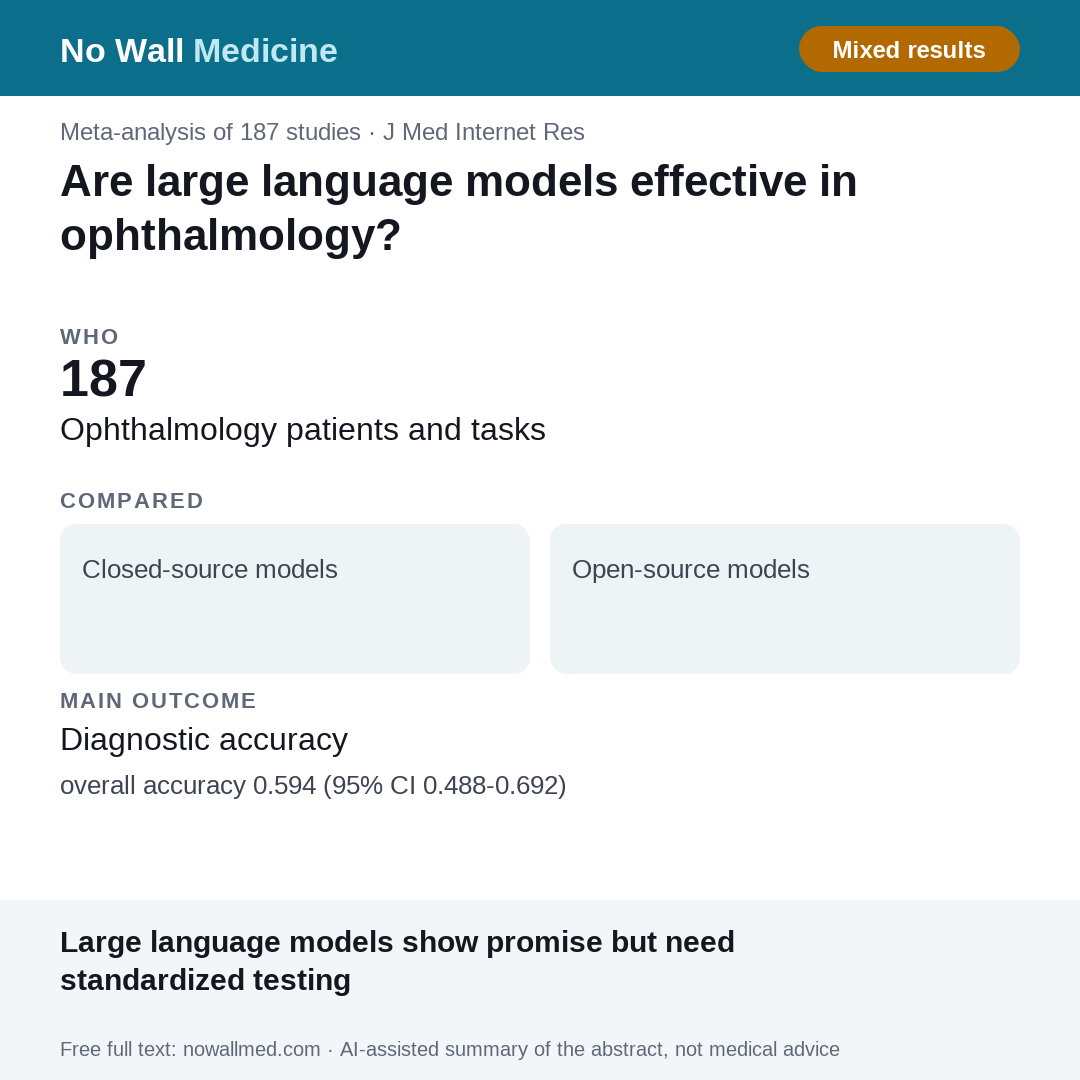
Clinical question: Are large language models effective in ophthalmology?
Why it matters: Evaluation practices for large language models in ophthalmology are currently fragmented and lack standardized benchmarks for multimodal tasks or real-world deployment.
Key points
- Researchers reviewed 187 studies that quantitatively assessed large language models on ophthalmology-related tasks.
- Closed-source models dominated the research, while open-source models appeared in only 13.4% of studies.
- A meta-analysis of 28 diagnostic evaluations showed an overall accuracy of 0.594 (95% CI 0.488-0.692) with extreme heterogeneity (I2=94.5%).
Headline and key points written with AI from the paper’s abstract, with every number checked against it. Read the paper before relying on them.
Topics
Cite this article
Zhang Z, Zhang H, Pan Z, Bi Z, Wan Y, Song X. Evaluating Large Language Models in Ophthalmology: Systematic Review. J Med Internet Res. 2025. doi:10.2196/76947
Spotted a mistake? Suggest a correction