Combined personal and environmental cleaning did not change skin infection rates in households
Evaluating Personal and Environmental Decolonization Strategies for Children With Skin and Soft Tissue Infection and Their Households - A Randomized Clinical Trial
Open-label randomized trialMixed results
Does an integrated decolonization approach reduce skin and soft tissue infection incidence?
Who
623
Households of children with community-associated Staphylococcus aureus skin and soft tissue infection
Compared
Integrated approach
Combined periodic-personal and environmental-hygiene
Main outcome
Household-level cumulative skin and soft tissue infection at 3 months
Bottom line: Integrated decolonization reduced infections in those with prior infections, but cumulative incidence did not differ overall.
Clin Infect Dis · 2025-11-24Download image
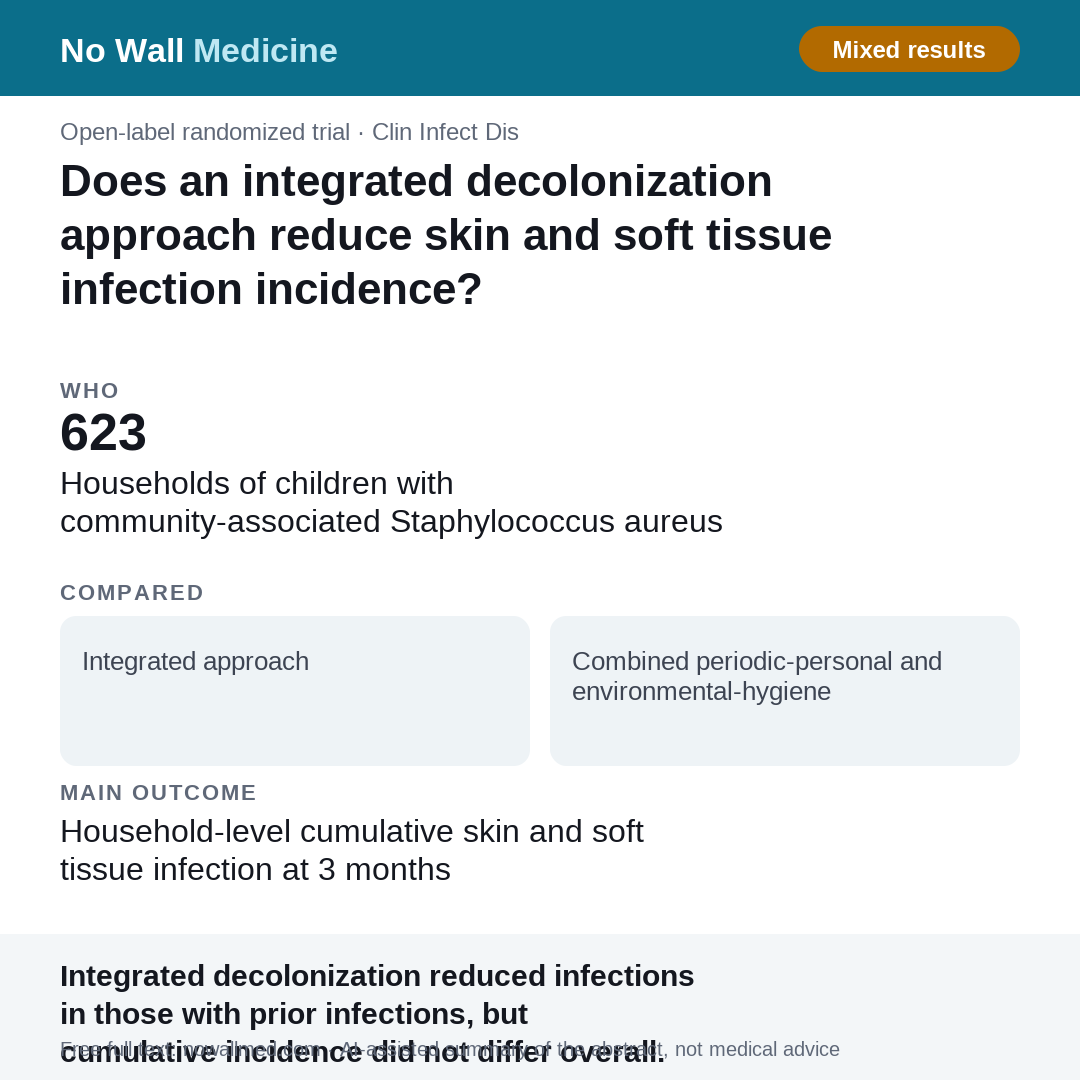
Clinical question: Does an integrated decolonization approach reduce skin and soft tissue infection incidence?
Why it matters: The effectiveness of combining personal decolonization with household environmental cleaning to reduce skin and soft tissue infections is unknown.
Key points
- Researchers studied 196 index patients and 623 household contacts to compare personal decolonization, environmental hygiene, or an integrated approach of both.
- The cumulative incidence of skin and soft tissue infections did not differ between the integrated-approach group and the combined personal and environmental groups during the 3-month intervention.
- All interventions were associated with a reduction in methicillin-resistant Staphylococcus aureus personal colonization, but not methicillin-susceptible Staphylococcus aureus, over 9 months.
Headline and key points written with AI from the paper’s abstract, with every number checked against it. Read the paper before relying on them.
Topics
Cite this article
Robinson AL, Boyle MG, Hogan PG, Malone SM, Krauss MJ, Richardson LM. Evaluating Personal and Environmental Decolonization Strategies for Children With Skin and Soft Tissue Infection and Their Households - A Randomized Clinical Trial. Clin Infect Dis. 2025. doi:10.1093/cid/ciaf627
Spotted a mistake? Suggest a correction