Pharmacological treatments showed no significant difference from placebo for cocaine or methamphetamine use disorder
Evaluating Reduced Use and Abstinence as Outcomes in Pharmacotherapy Trials for Stimulant Use Disorder: A Meta-Analysis of 12 Randomized Controlled Trials
Meta-analysis of 12 randomized controlled trialsNo clear difference
Does pharmacological intervention compare better for reduced use versus total abstinence in stimulant use disorder?
Who
2000
People seeking treatment for cocaine or methamphetamine dependence · United States multisite trials
Compared
Active treatment: 31.2% (weighted) achieved reduced use
Placebo: 13.3% (weighted) achieved abstinence
Main outcome
Reduced drug use and abstinence
Bottom line: No significant differences were observed between active treatment and placebo for reduced use or abstinence overall.
Funded by: National Institute on Drug Abuse
JAMA Psychiatry · 2026-06-03Download image
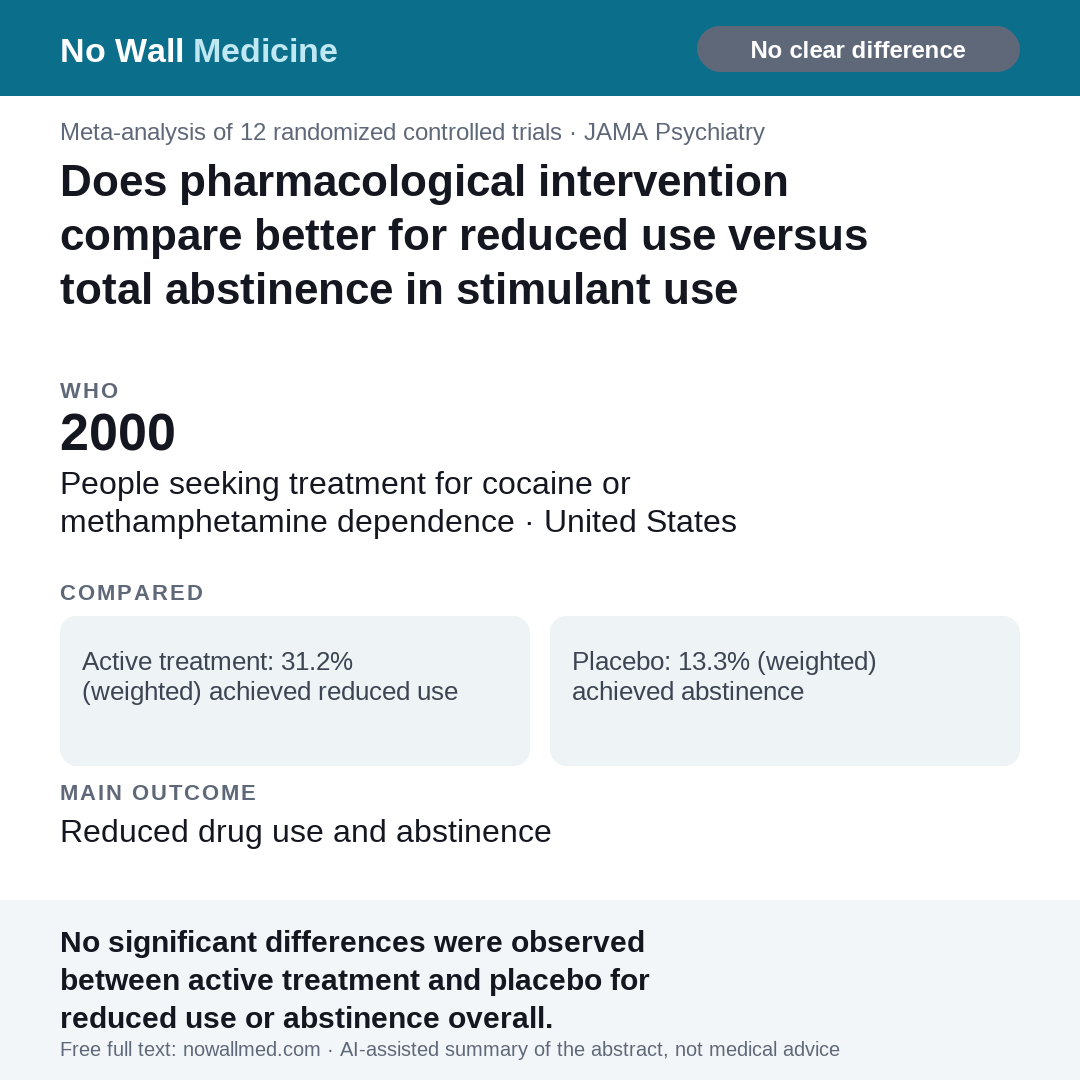
Clinical question: Does pharmacological intervention compare better for reduced use versus total abstinence in stimulant use disorder?
Why it matters: Relying solely on complete abstinence as a trial endpoint may hinder the identification of effective therapies for stimulant use disorders.
Key points
- Researchers analyzed 12 randomized controlled trials involving 2000 participants seeking treatment for cocaine or methamphetamine dependence.
- While 31.2% achieved reduced use and 13.3% achieved abstinence, no significant differences were found between active treatments and placebo.
- In individual medication analyses, cabergoline showed significantly higher rates of reduced cocaine use compared to the pooled placebo group.
Headline and key points written with AI from the paper’s abstract, with every number checked against it. Read the paper before relying on them.
Topics
Spotted a mistake? Suggest a correction