Specific brain connectivity and electrical patterns were identified as robust biomarkers for depression treatment response
Evaluating Robustness of Brain Stimulation Biomarkers for Depression: A Systematic Review of Magnetic Resonance Imaging and Electroencephalography Studies
Systematic reviewUnclear result
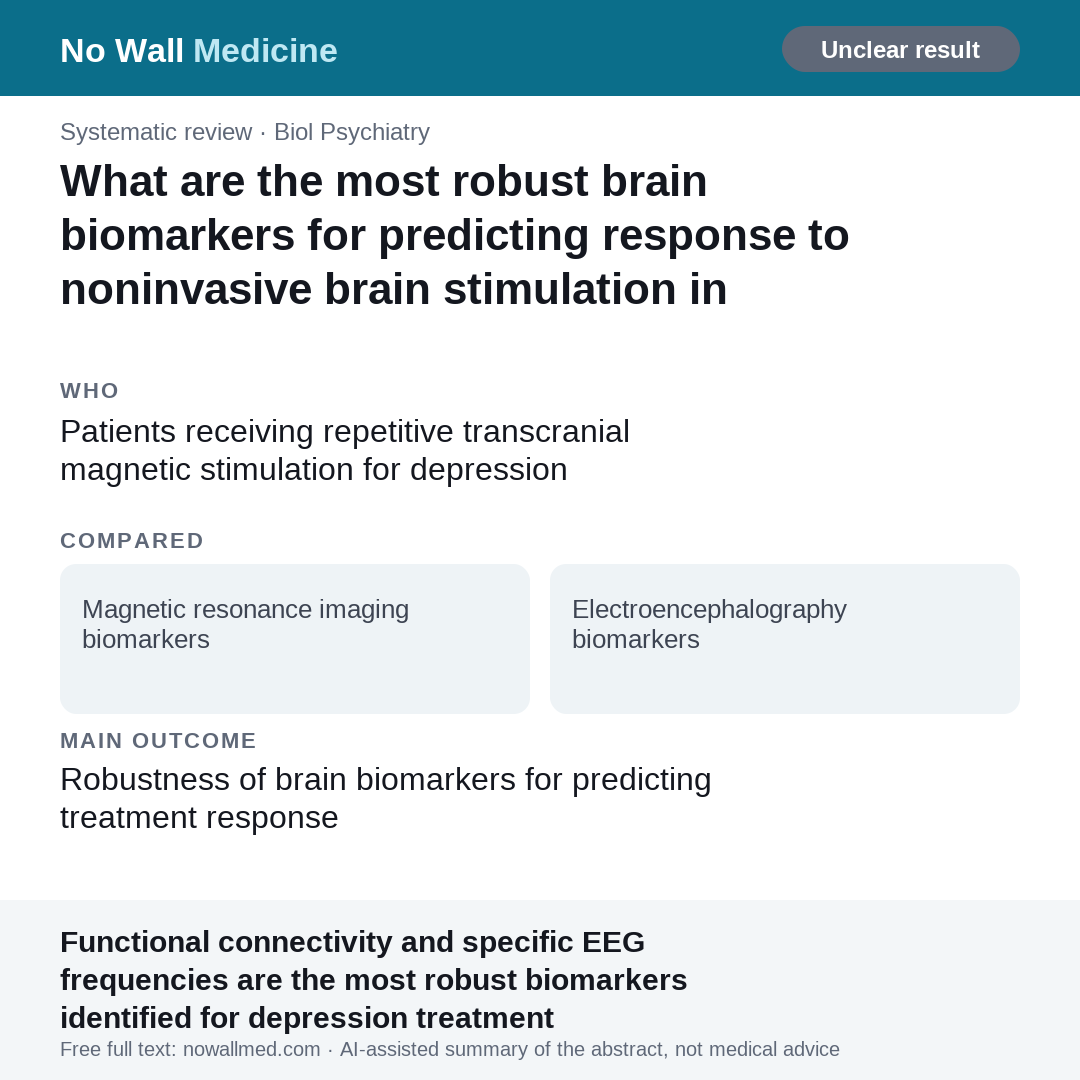
What are the most robust brain biomarkers for predicting response to noninvasive brain stimulation in depression?
Who
Patients receiving repetitive transcranial magnetic stimulation for depression
Compared
Magnetic resonance imaging biomarkers
Electroencephalography biomarkers
Main outcome
Robustness of brain biomarkers for predicting treatment response
Bottom line: Functional connectivity and specific EEG frequencies are the most robust biomarkers identified for depression treatment response.
Limitation: Future prospective studies are needed to investigate the clinical actionability of these specific biomarkers.
Biol Psychiatry · 2023-09-19Download image
Clinical question: What are the most robust brain biomarkers for predicting response to noninvasive brain stimulation in depression?
Why it matters: It is unknown which brain biomarkers identified through neuroimaging are robust enough to be used for predicting clinical responses to noninvasive brain stimulation in depression.
Key points
- Researchers reviewed 18 magnetic resonance imaging studies and 18 electroencephalography studies that focused on repetitive transcranial magnetic stimulation for depression.
- The most robust biomarkers identified included functional connectivity between the dorsolateral prefrontal cortex and subgenual anterior cingulate cortex, network connectivity, task-induced frontal-midline theta, and individual alpha frequency.
- The review included only well-powered studies with 88 or more participants or those attempting to independently replicate previous findings.
Headline and key points written with AI from the paper’s abstract, with every number checked against it. Read the paper before relying on them.
Was this summary helpful?
Subject terms
Cite this article
Klooster D, Voetterl H, Baeken C, Arns M. Evaluating Robustness of Brain Stimulation Biomarkers for Depression: A Systematic Review of Magnetic Resonance Imaging and Electroencephalography Studies. Biol Psychiatry. 2023. doi:10.1016/j.biopsych.2023.09.009
Spotted a mistake? Suggest a correction
Top studies every Monday
The week’s key trials and guidelines in your specialties, plus any topics you follow. By email, free.
Get the weekly digest