Social cognitive remediation increased employment hours by 6.5% in severe mental illness
Evaluating social cognitive remediation for labour participation in severe mental illness: insights from a small-scale randomised controlled trial
Randomised controlled trialBenefit found
Does social cognitive remediation improve labour participation?
Who
105
individuals with severe mental illness · France, three sites
Compared
Social cognitive remediation: 6.5% increase
Active control
Main outcome
hours worked versus expected
Bottom line: Social cognitive remediation improves employment maintenance
BJPsych Open · 2026-10-12Download image
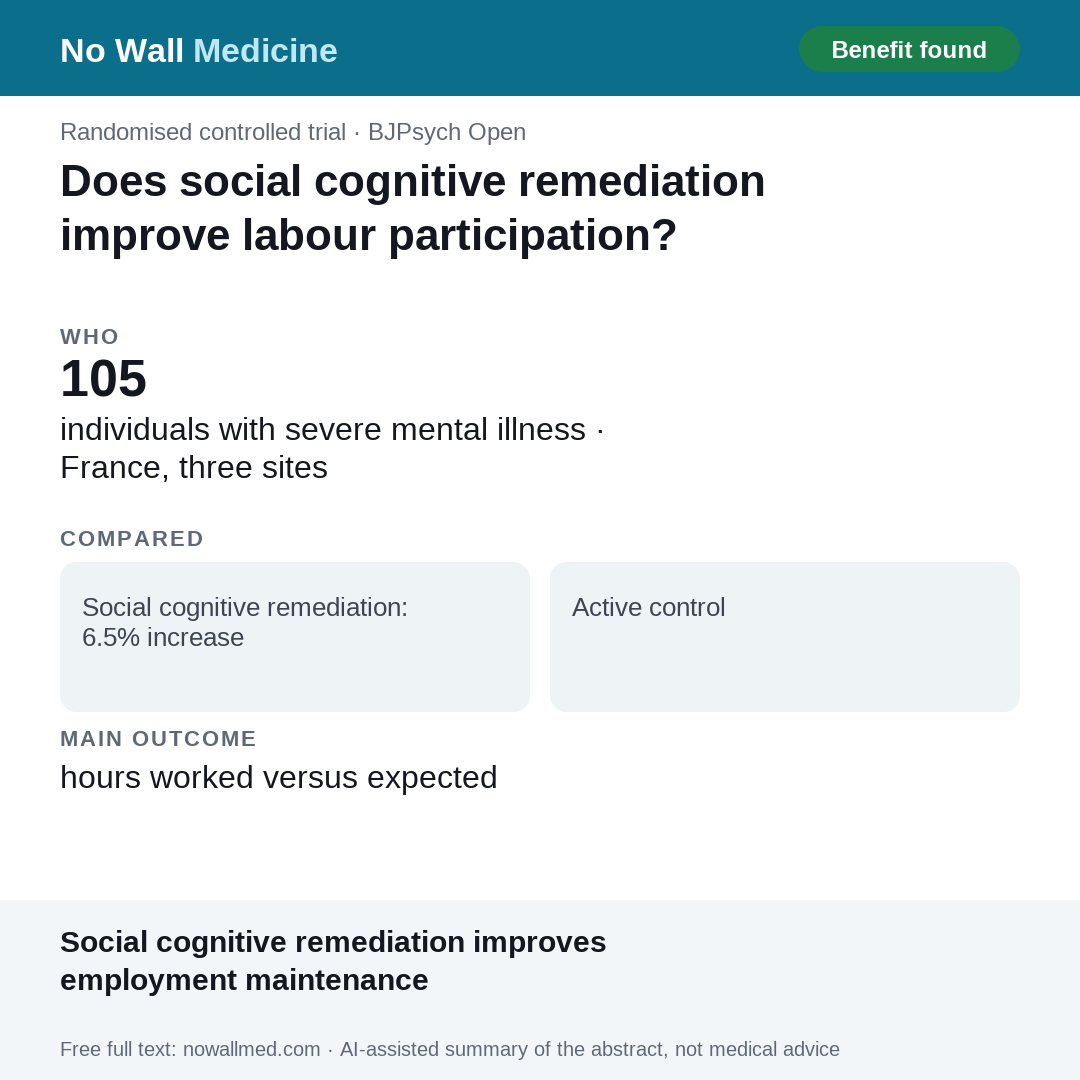
Clinical question: Does social cognitive remediation improve labour participation?
Why it matters: Research into social cognitive interventions for severe mental illness has remained scarce
Key points
- 105 participants with severe mental illness were randomised to social cognitive remediation or control.
- Social cognitive remediation increased employment hours by 6.5% and reduced internalised stigma.
- 39 participants dropped out, yielding a per-protocol sample of 33 participants per arm.
Headline and key points written with AI from the paper’s abstract, with every number checked against it. Read the paper before relying on them.
Cite this article
Barbalat G, Plasse J, Bralet MC, Cervello S, Franck N. Evaluating social cognitive remediation for labour participation in severe mental illness: insights from a small-scale randomised controlled trial. BJPsych Open. 2026. doi:10.1192/bjo.2026.12124
Spotted a mistake? Suggest a correction