Multidisciplinary lifestyle intervention showed no clinical health improvements for people with severe mental illness
Evaluating the implementation of a multidisciplinary lifestyle intervention for people with severe mental illness in sheltered housing: effectiveness-implementation hybrid randomised controlled trial
Effectiveness-implementation hybrid cluster-randomised controlled trialNo clear difference
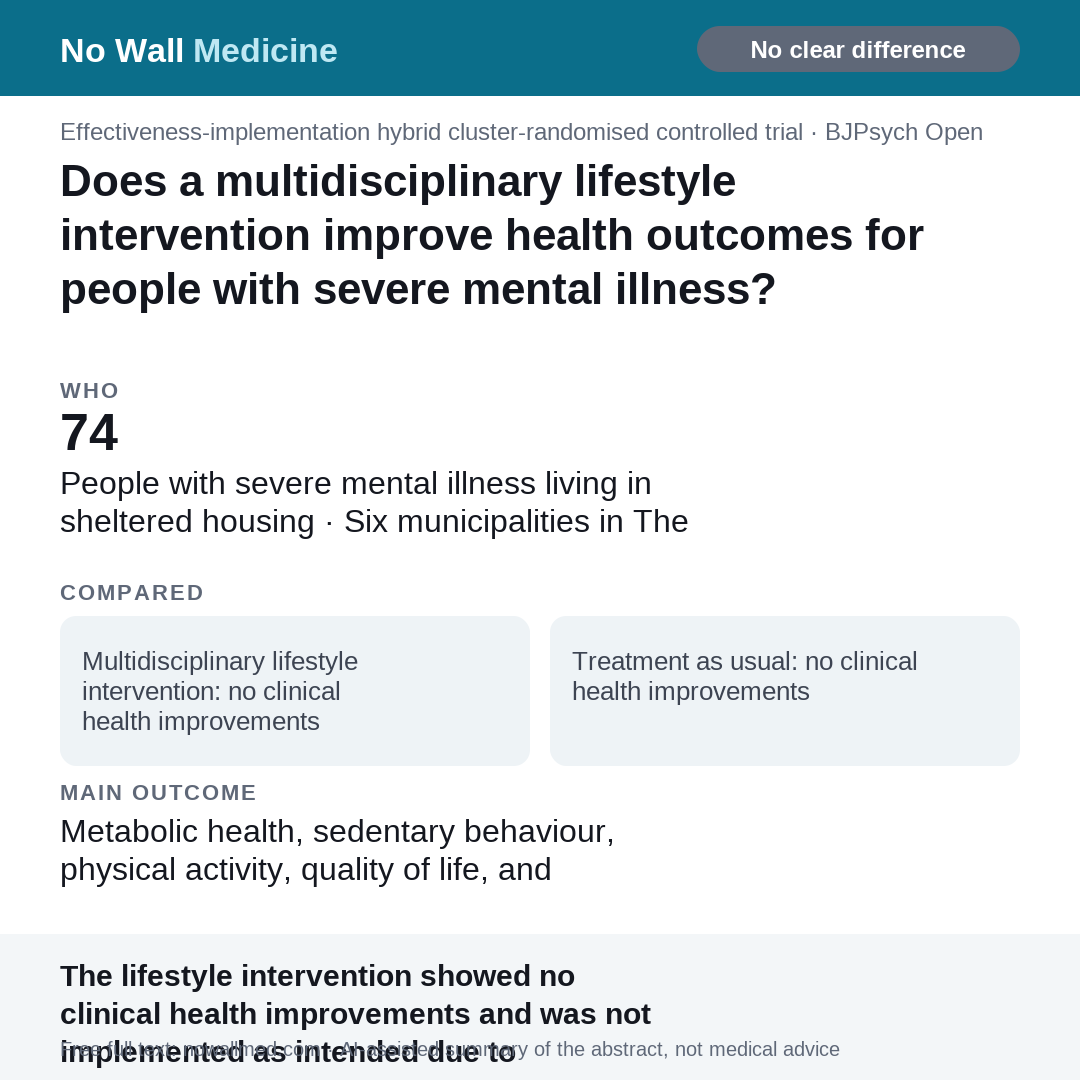
Does a multidisciplinary lifestyle intervention improve health outcomes for people with severe mental illness?
Who
74
People with severe mental illness living in sheltered housing · Six municipalities in The Netherlands
Compared
Multidisciplinary lifestyle intervention: no clinical health improvements
Treatment as usual: no clinical health improvements
Main outcome
Metabolic health, sedentary behaviour, physical activity, quality of life, and psychopathology
Bottom line: The lifestyle intervention showed no clinical health improvements and was not implemented as intended due to organisational factors.
BJPsych Open · 2022-11-22Download image
Clinical question: Does a multidisciplinary lifestyle intervention improve health outcomes for people with severe mental illness?
Why it matters: It was unknown if a multidisciplinary lifestyle intervention could be effectively implemented and improve health outcomes for people with severe mental illness in everyday sheltered housing settings.
Key points
- Researchers conducted a cluster-randomized controlled trial involving 74 patients with severe mental illness living in sheltered housing in the Netherlands.
- The lifestyle intervention group showed no substantial improvements in metabolic health, physical activity, quality of life, or psychopathology compared to treatment as usual.
- Implementation was hindered by organizational factors such as staff shortages, lack of time, and difficulty involving patients.
Headline and key points written with AI from the paper’s abstract, with every number checked against it. Read the paper before relying on them.
Was this summary helpful?
Cite this article
Smit MMC, Waal E, Tenback DE, Deenik J. Evaluating the implementation of a multidisciplinary lifestyle intervention for people with severe mental illness in sheltered housing: effectiveness-implementation hybrid randomised controlled trial. BJPsych Open. 2022. doi:10.1192/bjo.2022.600
Spotted a mistake? Suggest a correction
Top studies every Monday
The week’s key trials and guidelines in your specialties, plus any topics you follow. By email, free.
Get the weekly digest