Impaired blood flow reserve is associated with cognitive impairment in patients with carotid artery narrowing
Evaluating the influence of altered cerebral hemodynamics on cognitive performance in asymptomatic carotid artery stenosis: A systematic review
Systematic review of prospective case-control studiesBenefit found
Does impaired cerebral hemodynamics influence cognitive performance in asymptomatic carotid artery stenosis?
Who
782
Patients with moderate to severe asymptomatic carotid artery stenosis
Compared
ACS with impaired ipsilateral cerebrovascular reserve: significant cognitive impairment
ACS with normal cerebrovascular reserve: cognitive scores similar to controls
ACS with bilateral cerebrovascular reserve impairment: lowest cognitive scores
Main outcome
global cognition or cognitive function domains
Bottom line: Impaired cerebrovascular reserve is associated with cognitive impairment in patients with asymptomatic carotid artery stenosis.
J Vasc Surg · 2023-08-22Download image
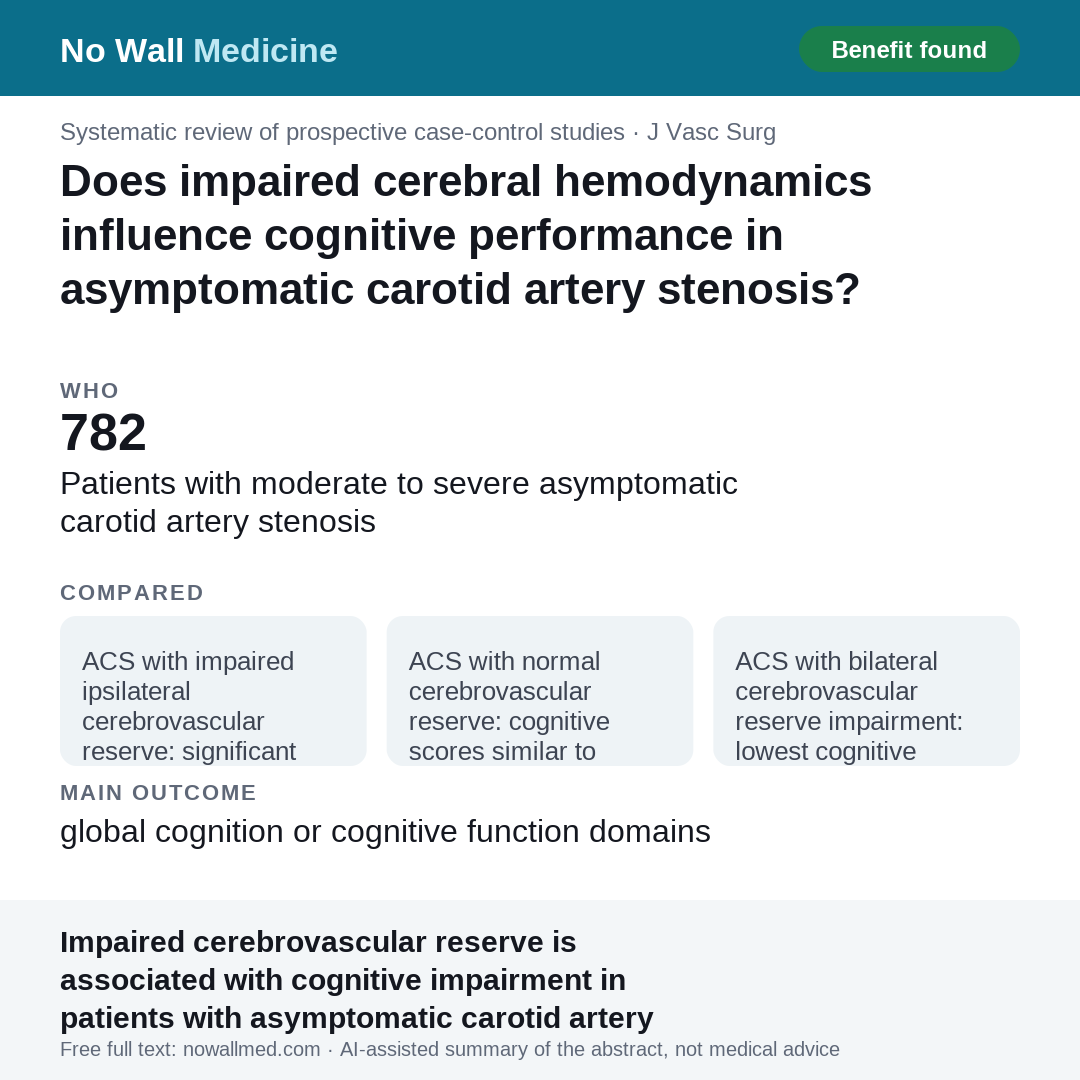
Clinical question: Does impaired cerebral hemodynamics influence cognitive performance in asymptomatic carotid artery stenosis?
Why it matters: It is unknown if impaired blood flow in the brain plays a role in the development of cognitive impairment for patients with asymptomatic carotid artery stenosis.
Key points
- Researchers reviewed five prospective case-control studies involving 782 patients with moderate (50%-69%) to severe (70%-99%) asymptomatic carotid artery stenosis.
- Patients with impaired cerebrovascular reserve, which is the ability of the brain to increase blood flow, showed significant cognitive impairment compared to controls.
- The lowest cognitive scores were observed in patients who had impaired cerebrovascular reserve on both sides of the brain.
Headline and key points written with AI from the paper’s abstract, with every number checked against it. Read the paper before relying on them.
Was this summary helpful?
Subject terms
Cite this article
Bhandari A, Feridooni T, Pikula A, Styra R, Mikulis DJ, Howe KL. Evaluating the influence of altered cerebral hemodynamics on cognitive performance in asymptomatic carotid artery stenosis: A systematic review. J Vasc Surg. 2023. doi:10.1016/j.jvs.2023.08.111
Spotted a mistake? Suggest a correction
Top studies every Monday
The week’s key trials and guidelines in your specialties, plus any topics you follow. By email, free.
Get the weekly digest