Test-negative design provides reliable estimates of COVID-19 vaccine effectiveness compared to randomized clinical trials
Evaluating the Test-Negative Design for COVID-19 Vaccine Effectiveness Using Randomized Trial Data: A Secondary Cross-Protocol Analysis of 5 Randomized Clinical Trials
Meta-analysis of 5 trialsBenefit found
Does test-negative design evaluate vaccine effectiveness
Who
12157
Adults with COVID-19-like symptoms · 16 countries
Compared
Vaccine
Placebo
Main outcome
Symptomatic COVID-19
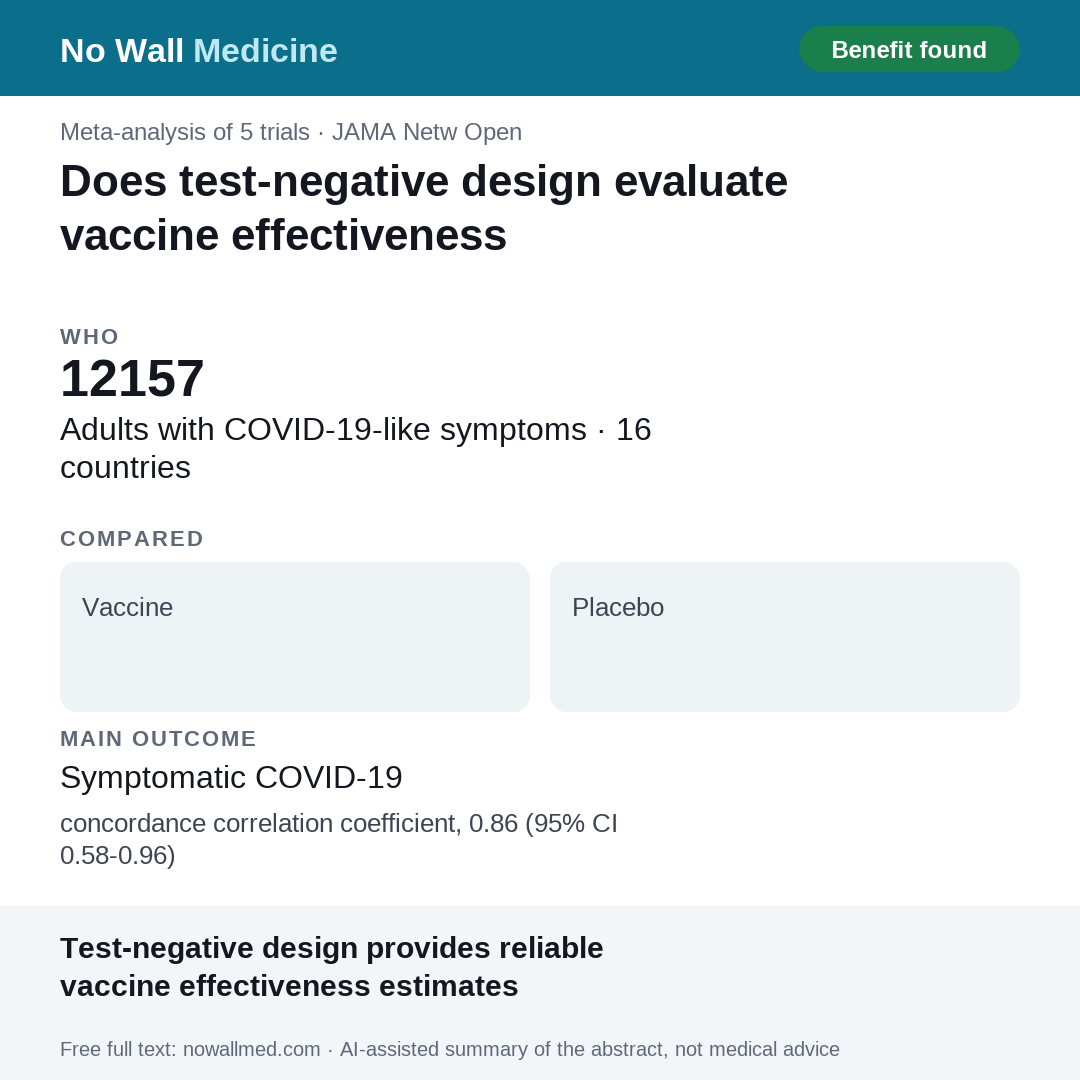
Result: concordance correlation coefficient, 0.86 (95% CI 0.58-0.96)
Bottom line: Test-negative design provides reliable vaccine effectiveness estimates
Limitation: confounding and selection bias
JAMA Netw Open · 2025-05-01Download image
Why it matters: The test-negative design is widely used to assess vaccine effectiveness after a product is on the market, but its reliability needs evaluation using controlled trial data.
Key points
- Researchers analyzed 12,157 participants from five randomized clinical trials across 16 countries to see if the test-negative design method accurately measures vaccine effectiveness.
- The test-negative design estimates were concordant with randomized clinical trial estimates, with a concordance correlation coefficient of 0.86 for both primary and CDC-defined outcomes.
- A semiparametric method used in the analysis had 48% smaller variance estimates than ordinary logistic regression.
Headline and key points written with AI from the paper’s abstract, with every number checked against it. Read the paper before relying on them.
Topics
Cite this article
Andrews LIB, Halloran ME, Neuzil KM, van der Laan L, Huang Y, Andriesen J. Evaluating the Test-Negative Design for COVID-19 Vaccine Effectiveness Using Randomized Trial Data: A Secondary Cross-Protocol Analysis of 5 Randomized Clinical Trials. JAMA Netw Open. 2025. doi:10.1001/jamanetworkopen.2025.12763
Spotted a mistake? Suggest a correction