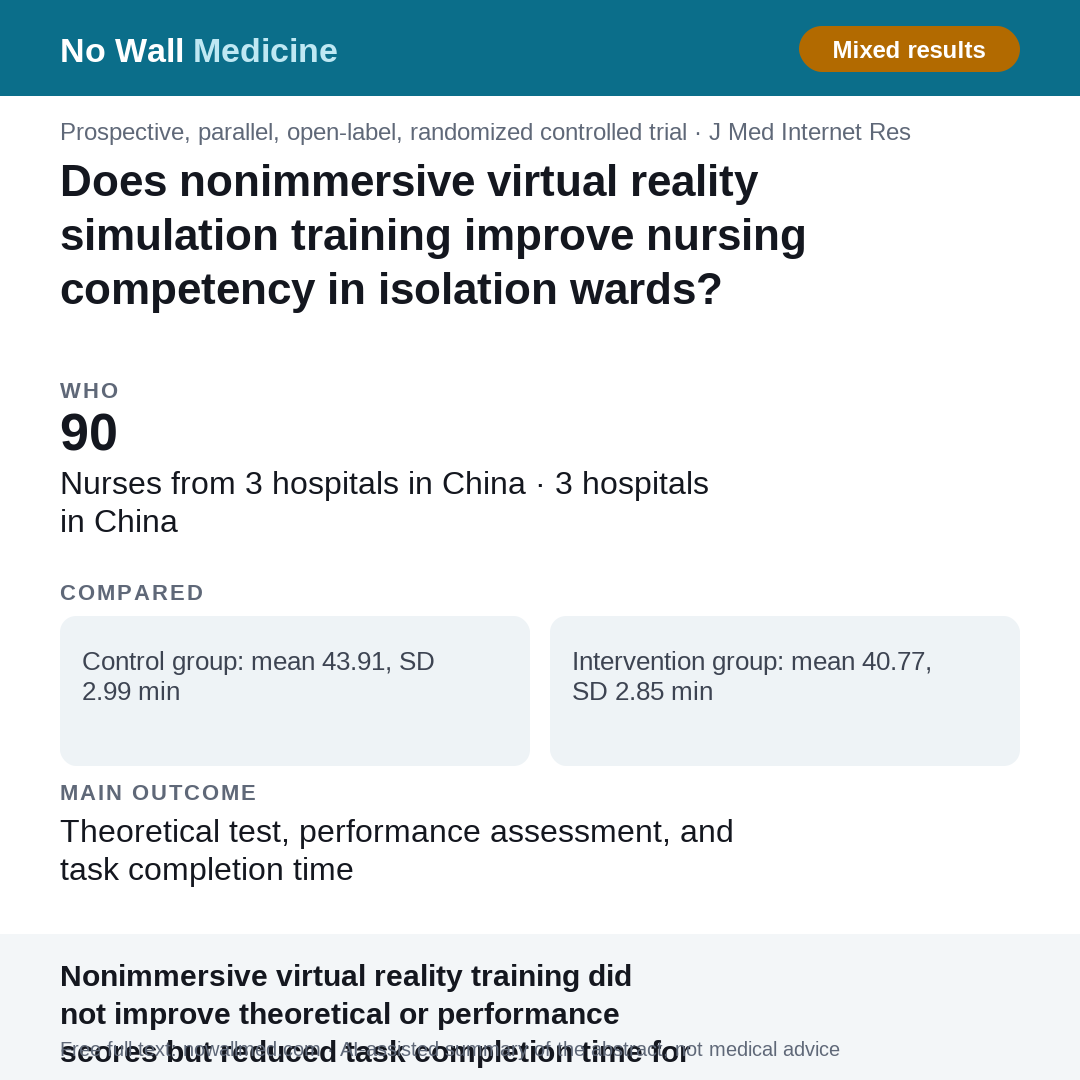
Nonimmersive virtual reality training did not improve nursing scores but increased task speed
Evaluating Whether Nonimmersion Virtual Reality Simulation Training Improves Nursing Competency in Isolation Wards: Randomized Controlled Trial
Prospective, parallel, open-label, randomized controlled trialMixed results
Does nonimmersive virtual reality simulation training improve nursing competency in isolation wards?
Who
90
Nurses from 3 hospitals in China · 3 hospitals in China
Compared
Control group: mean 43.91, SD 2.99 min
Intervention group: mean 40.77, SD 2.85 min
Main outcome
Theoretical test, performance assessment, and task completion time
Result: average reduction of about 3 minutes (control group: mean 43.91, SD 2.99 min; intervention group: mean 40.77, SD 2.85 min)
Bottom line: Nonimmersive virtual reality training did not improve theoretical or performance scores but reduced task completion time for specific activities.
J Med Internet Res · 2025-01-17Download image
Clinical question: Does nonimmersive virtual reality simulation training improve nursing competency in isolation wards?
Why it matters: It is unknown if nonimmersive virtual reality simulation training is effective for helping nurses adapt to isolation ward settings.
Key points
- Researchers conducted a randomized controlled trial with 90 nurses from 3 hospitals in China to compare nonimmersive virtual reality training with conventional training.
- There were no significant differences in theoretical test or performance assessment scores between the groups, but the virtual reality group completed 6 tasks faster.
- The virtual reality group had an average task completion time of 40.77 minutes compared to 43.91 minutes for the control group.
Headline and key points written with AI from the paper’s abstract, with every number checked against it. Read the paper before relying on them.
Topics
Cite this article
Zhang D, Fu M, Zhang J, Li Y, Chen L, Chen YJ. Evaluating Whether Nonimmersion Virtual Reality Simulation Training Improves Nursing Competency in Isolation Wards: Randomized Controlled Trial. J Med Internet Res. 2025. doi:10.2196/63131
Spotted a mistake? Suggest a correction