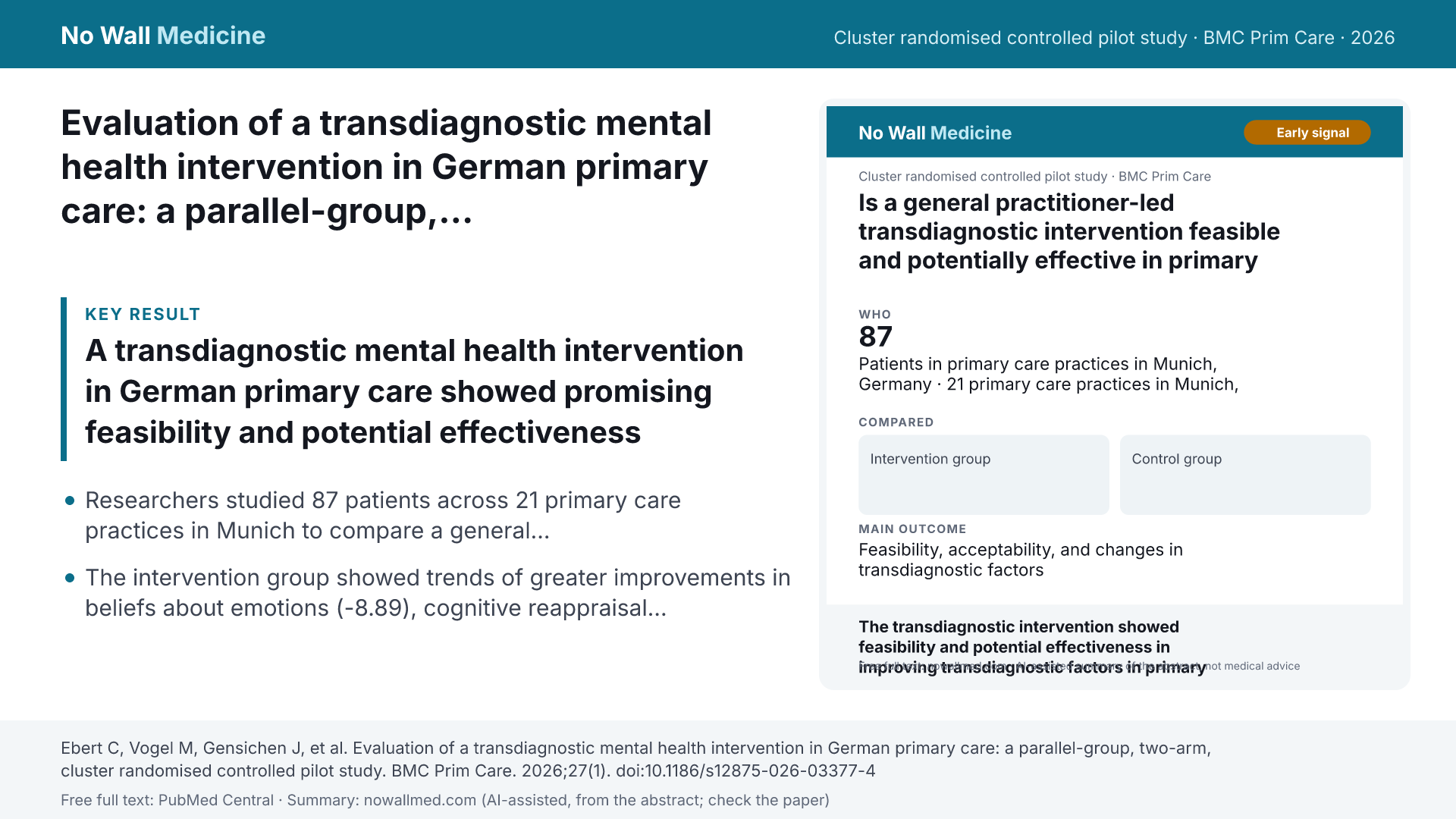
A transdiagnostic mental health intervention in German primary care showed promising feasibility and potential effectiveness
Evaluation of a transdiagnostic mental health intervention in German primary care: a parallel-group, two-arm, cluster randomised controlled pilot study
Cluster randomised controlled pilot studyEarly signal
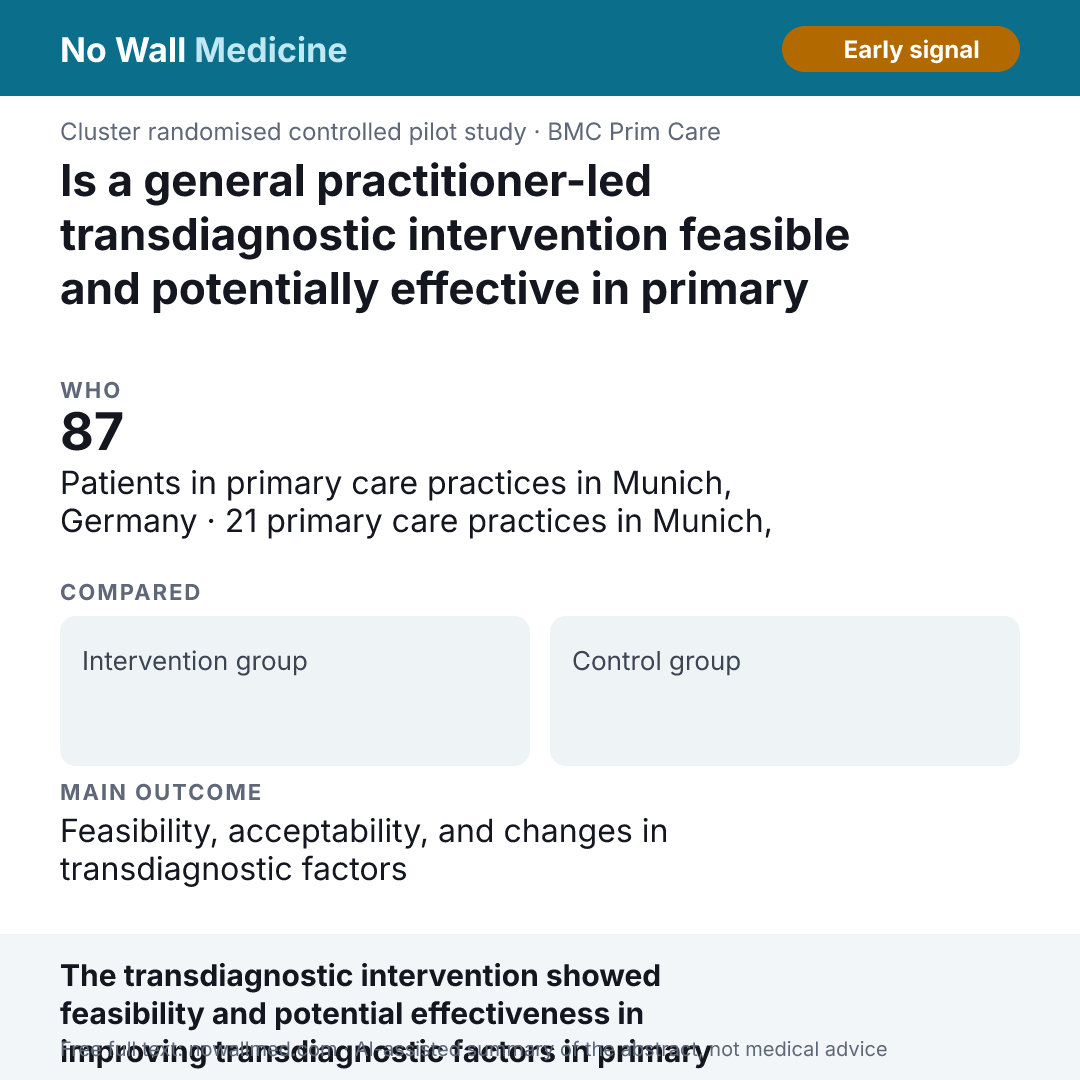
Is a general practitioner-led transdiagnostic intervention feasible and potentially effective in primary care?
Who
87
Patients in primary care practices in Munich, Germany · 21 primary care practices in Munich, Germany
Compared
Intervention group
Control group
Main outcome
Feasibility, acceptability, and changes in transdiagnostic factors
Result: beliefs about emotions: -8.89, 95% CI [-15.10, -2.74]
Bottom line: The transdiagnostic intervention showed feasibility and potential effectiveness in improving transdiagnostic factors in primary care.
Limitation: The study was a pilot study, requiring a fully powered main trial.
BMC Prim Care · 2026-05-21 · Save PNG
Clinical question: Is a general practitioner-led transdiagnostic intervention feasible and potentially effective in primary care?
Why it matters: Evidence remains limited on how interventions addressing multiple mental health conditions simultaneously can be delivered by general practitioners in primary care settings.
Key points
- Researchers studied 87 patients across 21 primary care practices in Munich to compare a general practitioner-led transdiagnostic intervention against improved standard care.
- The intervention group showed trends of greater improvements in beliefs about emotions (-8.89), cognitive reappraisal (6.03), and experiential avoidance (-4.57) compared to the control group.
- General practitioners and patients in the intervention group reported higher satisfaction with the treatment structure, content, and integration into daily care.
Headline and key points written with AI from the paper’s abstract, with every number checked against it. Read the paper before relying on them.
Was this summary helpful?
Subject terms
Headline, design, result, key points, caveat and citation as plain text.
Cite this article
Ebert C, Vogel M, Gensichen J, et al. Evaluation of a transdiagnostic mental health intervention in German primary care: a parallel-group, two-arm, cluster randomised controlled pilot study. BMC Prim Care. 2026;27(1). doi:10.1186/s12875-026-03377-4
Spotted a mistake? Suggest a correction