Field sobriety tests differentiated cannabis users from placebo group but showed high error rates
Evaluation of Field Sobriety Tests for Identifying Drivers Under the Influence of Cannabis: A Randomized Clinical Trial
Double-blind, placebo-controlled parallel randomized clinical trialMixed results
How accurate are field sobriety tests for identifying drivers under cannabis influence?
Who
184
Participants aged 21 to 55 years who used cannabis in the past month · University of California, San Diego
Compared
81.0%THC group
49.2%Placebo group
Main outcome
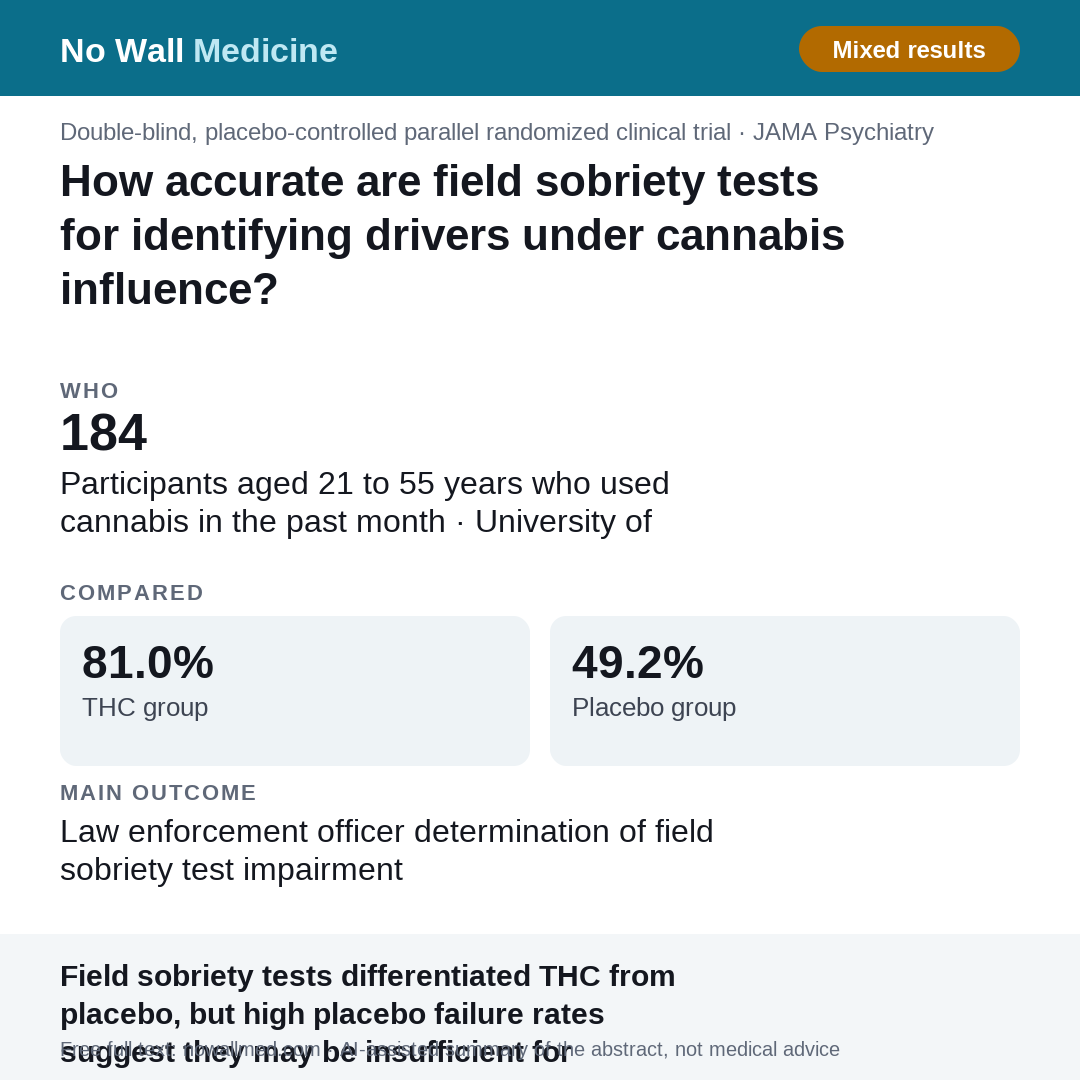
Law enforcement officer determination of field sobriety test impairment
Result: difference, 31.8 percentage points; 95% CI, 16.4-47.2 percentage points
Bottom line: Field sobriety tests differentiated THC from placebo, but high placebo failure rates suggest they may be insufficient for THC-specific impairment.
Limitation: The placebo group did not complete a median of 8 field sobriety test components as instructed.
JAMA Psychiatry · 2023-08-02Download image
Clinical question: How accurate are field sobriety tests for identifying drivers under cannabis influence?
Why it matters: Controlled studies regarding the efficacy of field sobriety tests in detecting whether a person is under the influence of THC are currently inconclusive.
Key points
- Researchers conducted a randomized trial with 184 participants aged 21 to 55 years to compare field sobriety tests after consuming placebo or varying levels of THC.
- At 70 minutes, officers classified 81.0% of the THC group as impaired compared to 49.2% of the placebo group.
- While driving simulator performance was associated with some test results, the placebo group failed to complete a median of 8 field sobriety test components as instructed.
Headline and key points written with AI from the paper’s abstract, with every number checked against it. Read the paper before relying on them.
Was this summary helpful?
Subject terms
Cite this article
Marcotte TD, Umlauf A, Grelotti DJ, Sones EG, Mastropietro KF, Suhandynata RT. Evaluation of Field Sobriety Tests for Identifying Drivers Under the Influence of Cannabis: A Randomized Clinical Trial. JAMA Psychiatry. 2023. doi:10.1001/jamapsychiatry.2023.2345
Spotted a mistake? Suggest a correction
Top studies every Monday
The week’s key trials and guidelines in your specialties, plus any topics you follow. By email, free.
Get the weekly digest