Evaluation of pathological complete response as surrogate endpoint in neoadjuvant randomised clinical trials of early stage breast cancer: systematic review and meta-analysis
Systematic review and meta-analysisNo clear difference
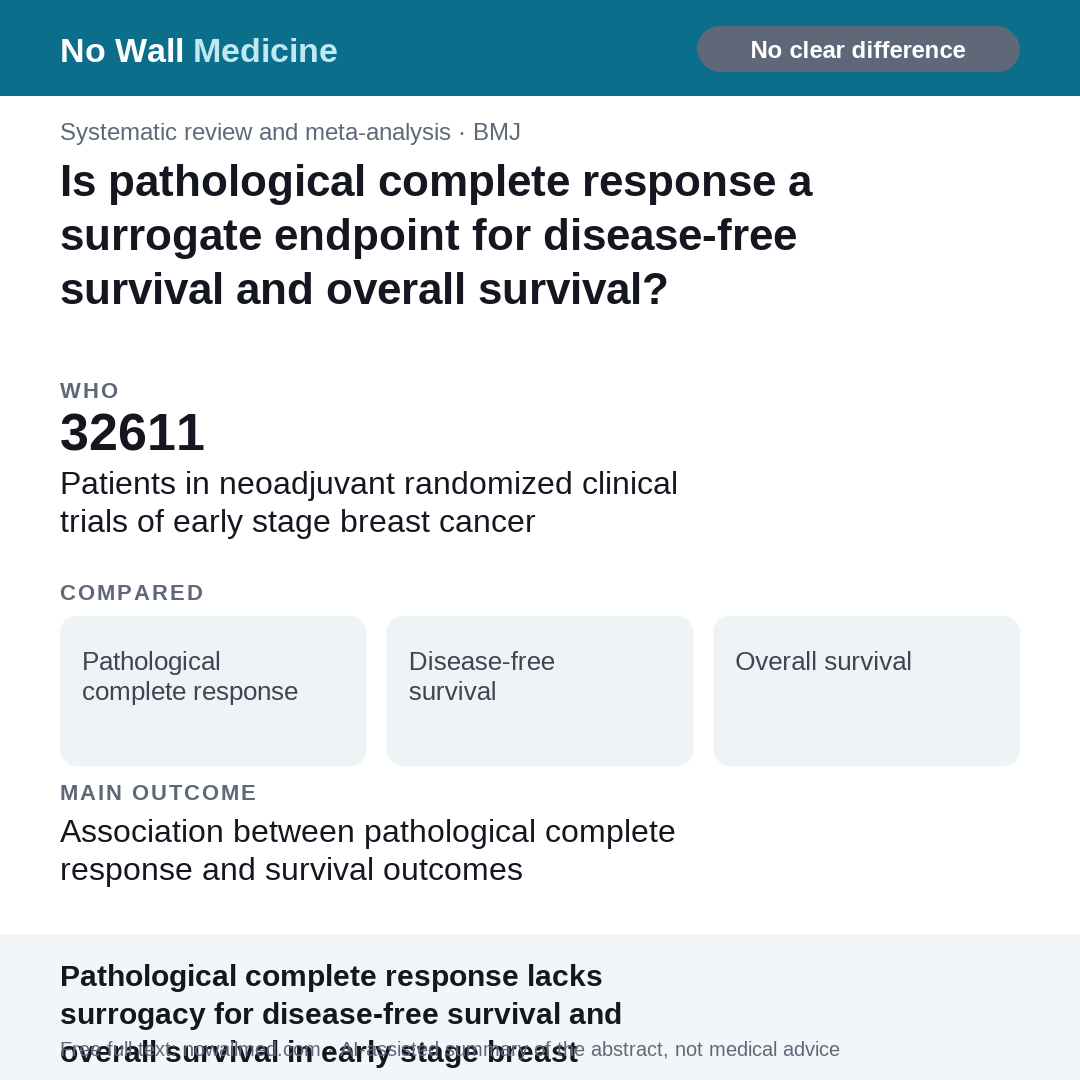
Is pathological complete response a surrogate endpoint for disease-free survival and overall survival?
Who
32611
Patients in neoadjuvant randomized clinical trials of early stage breast cancer
Compared
Pathological complete response
Disease-free survival
Overall survival
Main outcome
Association between pathological complete response and survival outcomes
Result: R2=0.14 (95% CI 0.00 to 0.29) for disease-free survival; R2=0.08 (95% CI 0.00 to 0.22) for overall survival
Bottom line: Pathological complete response lacks surrogacy for disease-free survival and overall survival in early stage breast cancer trials.
BMJ · 2021-12-21Download image
Clinical question: Is pathological complete response a surrogate endpoint for disease-free survival and overall survival?
Abstract
Objective
To evaluate pathological complete response as a surrogate endpoint for disease-free survival and overall survival in regulatory neoadjuvant trials of early stage breast cancer. Design
Systematic review and meta-analysis. Data sources
Medline, Embase, and Scopus to 1 December 2020. Eligibility criteria for study selection
Randomised clinical trials that tested neoadjuvant chemotherapy given alone or combined with other treatments, including anti-human epidermal growth factor 2 (anti-HER2) drugs, targeted treatments, antivascular agents, bisphosphonates, and immune checkpoint inhibitors. Data extraction and synthesis
Trial level associations between the surrogate endpoint pathological complete response and disease-free survival and overall survival. Methods
A weighted regression analysis was performed on log transformed treatment effect estimates (hazard ratio for disease-free survival and overall survival and relative risk for pathological complete response), and the coefficient of determination (R2) was used to quantify the association. The secondary objective was to explore heterogeneity of results in preplanned subgroups analysis, stratifying trials according treatment type in the experimental arm, definition used for pathological complete response (breast and lymph nodes v breast only), and biological features of the disease (HER2 positive or triple negative breast cancer). The surrogate threshold effect was also evaluated, indicating the minimum value of the relative risk for pathological complete response necessary to confidently predict a non-null effect on hazard ratio for disease-free survival or overall survival. Results
54 randomised clinical trials comprising a total of 32 611 patients were included in the analysis. A weak association was observed between the log(relative risk) for pathological complete response and log(hazard ratio) for both disease-free survival (R2=0.14, 95% confidence interval 0.00 to 0.29) and overall survival (R2 =0.08, 0.00 to 0.22). Similar results were found across all subgroups evaluated, independently of the definition used for pathological complete response, treatment type in the experimental arm, and biological features of the disease. The surrogate threshold effect was 5.19 for disease-free survival but was not estimable for overall survival. Consistent results were confirmed in three sensitivity analyses: excluding small trials (<200 patients enrolled), excluding trials with short median follow-up (<24 months), and replacing the relative risk for pathological complete response with the absolute difference of pathological complete response rates between treatment arms. Conclusion
A lack of surrogacy of pathological complete response was identified at trial level for both disease-free survival and overall survival. The findings suggest that pathological complete response should not be used as primary endpoint in regulatory neoadjuvant trials of early stage breast cancer.
Abstract reproduced under the article’s CC BY NC licence.
Subject terms
Cite this article
Conforti F, Pala L, Sala I, Oriecuia C, De Pas T, Specchia C. Evaluation of pathological complete response as surrogate endpoint in neoadjuvant randomised clinical trials of early stage breast cancer: systematic review and meta-analysis. BMJ. 2021. doi:10.1136/bmj-2021-066381
Spotted a mistake? Suggest a correction
Top studies every Monday
The week’s key trials and guidelines in your specialties, plus any topics you follow. By email, free.
Get the weekly digest