Digital adherence technology improved treatment success rates for patients with drug susceptible tuberculosis
Evaluation of patient centred digital adherence technology for tuberculosis treatment outcomes: pragmatic randomised controlled trial
Pragmatic, two arm, parallel randomised controlled trialBenefit found
Does digital adherence technology improve tuberculosis treatment outcomes in Argentina?
Who
555
Patients aged 16 years or older with newly diagnosed drug susceptible tuberculosis · Four public reference hospitals in Buenos Aires, Argentina
Compared
Standard of care: 201/270; 74%
Standard of care plus Tuberculosis Treatment Support Tools: 208/255; 82%
Main outcome
Treatment success (cure or treatment completion)
Result: risk ratio 1.10 (1.00 to 1.20; P=0.04)
Bottom line: A digital adherence tool improved tuberculosis treatment success rates in a pragmatic trial in Argentina.
BMJ · 2026-08-06Download image
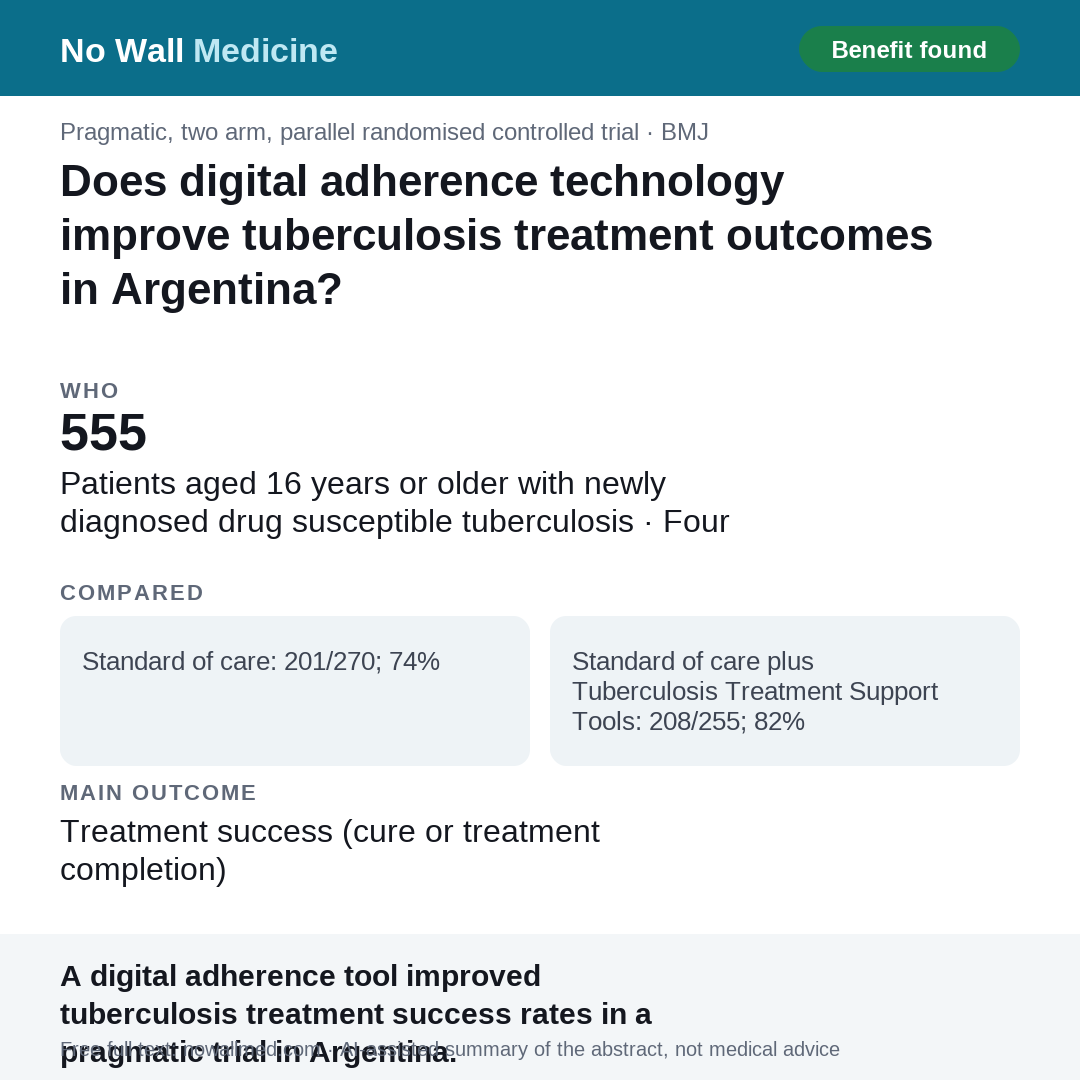
Clinical question: Does digital adherence technology improve tuberculosis treatment outcomes in Argentina?
Why it matters: There is a need to evaluate if patient-centered digital tools can improve treatment outcomes for individuals with drug susceptible tuberculosis.
Key points
- Researchers studied 555 patients in Argentina, comparing standard care to standard care plus a mobile application for tuberculosis treatment support.
- The digital tool group had a treatment success rate of 82% compared to 74% in the standard care group.
- Loss to follow-up, or patients dropping out of care, was lower in the digital tool group at 17% versus 24%.
Headline and key points written with AI from the paper’s abstract, with every number checked against it. Read the paper before relying on them.
Abstract
Objective
To evaluate the effectiveness of Tuberculosis Treatment Support Tools (TB-TST), a patient centred digital adherence technology, in improving treatment outcomes among individuals with drug susceptible tuberculosis in Argentina. Design
Pragmatic, two arm, parallel randomised controlled trial. Setting
Four public reference hospitals in Buenos Aires, Argentina. Participants
555 patients aged ≥16 years with newly diagnosed drug susceptible tuberculosis, recruited between November 2020 and July 2023, randomised to standard of care (n=278) or standard of care plus TB-TST (n=277). Intervention
A mobile application that enabled daily adherence reporting, bidirectional messaging with treatment supporters, educational content, and a weekly urine based isoniazid test for verification of adherence. Participants and care givers were aware of their group assignment, but data collectors and data analysts were masked. Main outcome measures
The primary outcome was treatment success (cure or treatment completion). Secondary outcomes included loss to follow-up. Analyses used intention-to-treat and per protocol approaches. Results
525 participants (94.6% of the enrolled population) were included in the analysis after exclusion of 30 individuals who deviated from the protocol. In the intention-to-treat analysis, treatment success was higher in the intervention group (208/255; 82%) than in the control group (201/270; 74%). The risk difference was 7.1% (95% confidence interval 1.1% to 14.1%), and the risk ratio was 1.10 (1.00 to 1.20; P=0.04). Loss to follow-up was lower in the intervention group (17% v 24%; risk ratio 0.70, 0.50 to 0.98; P=0.04). Greater benefit was observed among female participants and those aged under 35 years. Conclusions
A multifaceted, interactive digital adherence tool improved tuberculosis treatment outcomes, particularly among younger participants and women, showing feasibility and effectiveness in supporting adherence to tuberculosis treatment in low resource settings. Future research should evaluate the impact of app engagement, context factors such as the covid-19 pandemic, cost effectiveness, and use of the tool beyond tuberculosis in the management of chronic diseases. AI powered features and integrated mental health support may enhance the scalability and personalisation of care. Trial registration
ClinicalTrials.gov NCT04221789; International Registered Report Identifier DERR1-10.2196/28094.
Abstract reproduced under the article’s CC BY NC licence.
Topics
Spotted a mistake? Suggest a correction