Evidence is insufficient to determine if processed nerve allografts are effective for nerve reconstruction
Evaluation of Processed Nerve Allograft in Peripheral Nerve Surgery: A Systematic Review and Critical Appraisal
Systematic reviewUnclear result
Is processed nerve allograft justified in reconstruction of peripheral nerve defects?
Who
Patients with posttraumatic or iatrogenic peripheral nerve injury
Compared
Processed nerve allograft
Nerve autograft or conduits
Main outcome
Nerve reconstruction outcomes and postoperative complications
Bottom line: No conclusions could be drawn regarding processed nerve allograft compared to established methods due to low certainty evidence.
Limitation: Low certainty evidence, lack of control groups, small patient numbers, and high risk of bias.
Plast Reconstr Surg Glob Open · 2023-06-27Download image
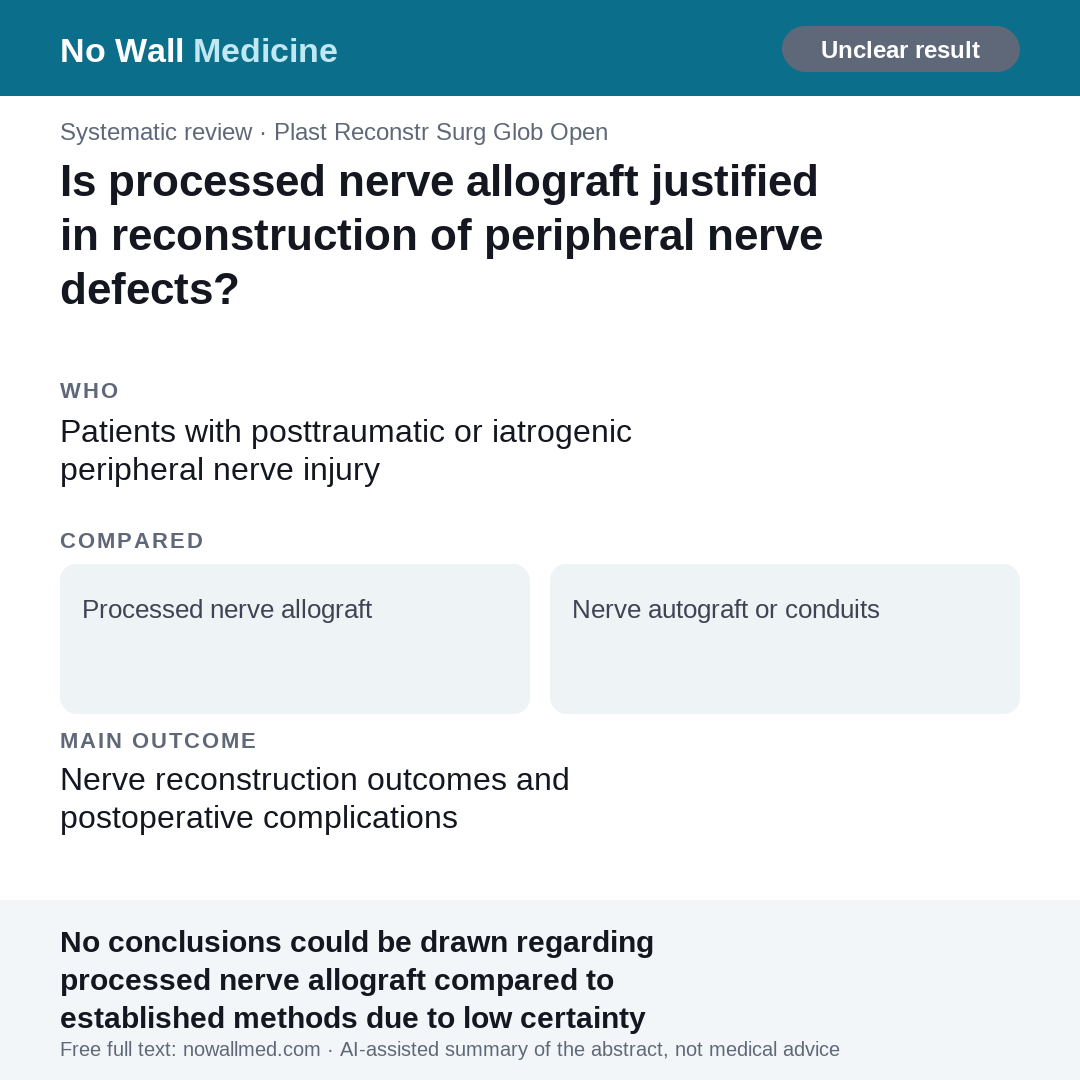
Clinical question: Is processed nerve allograft justified in reconstruction of peripheral nerve defects?
Why it matters: It is unknown whether processed nerve allografts are justified for reconstructing nerve defects compared to established methods like nerve autografts or conduits.
Key points
- Researchers performed a systematic review to compare processed nerve allograft, which is donor nerve tissue, against nerve autografts or conduits for repairing nerve defects.
- The review found no conclusions regarding differences in outcomes between processed nerve allografts and other established methods for nerve reconstruction.
- The certainty of evidence for all evaluated outcomes was classified as very low.
Limitation the authors note: Most published studies lacked a control group, had a low number of patients, or had a large, undefined loss of patients during follow-up.
Headline and key points written with AI from the paper’s abstract, with every number checked against it. Read the paper before relying on them.
Was this summary helpful?
Cite this article
Frostadottir D, Chemnitz A, Johansson Ot LJ, Holst J, Dahlin LB. Evaluation of Processed Nerve Allograft in Peripheral Nerve Surgery: A Systematic Review and Critical Appraisal. Plast Reconstr Surg Glob Open. 2023. doi:10.1097/GOX.0000000000005088
Spotted a mistake? Suggest a correction
Top studies every Monday
The week’s key trials and guidelines in your specialties, plus any topics you follow. By email, free.
Get the weekly digest