High risk of bias and poor reporting quality found in neuroimaging artificial intelligence psychiatric models
Evaluation of Risk of Bias in Neuroimaging-Based Artificial Intelligence Models for Psychiatric Diagnosis: A Systematic Review
Systematic reviewHarm found
What is the risk of bias and reporting quality of neuroimaging-based artificial intelligence models?
Who
555
Neuroimaging-based artificial intelligence models for psychiatric diagnosis
Compared
461Models with high risk of bias (83.1%; 95% CI, 80.0%-86.2%)
61.2%Overall reporting completeness (95% CI, 60.6%-61.8%)
Main outcome
Risk of bias and reporting quality
Bottom line: Neuroimaging-based artificial intelligence models for psychiatric diagnosis have high risk of bias and poor reporting quality.
JAMA Netw Open · 2023-03-01 · Save PNG
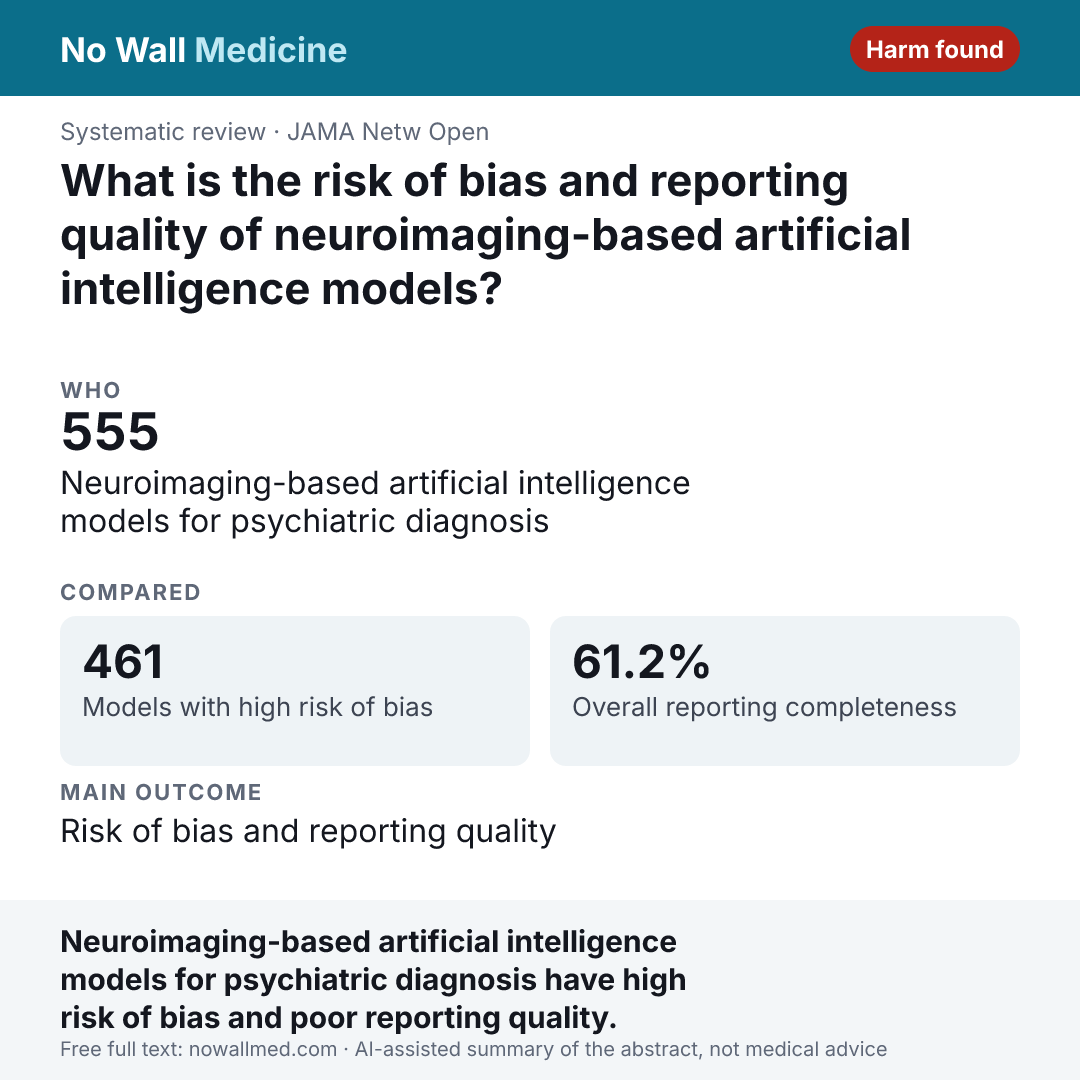
Clinical question: What is the risk of bias and reporting quality of neuroimaging-based artificial intelligence models?
Why it matters: The clinical applicability and reporting quality of artificial intelligence models using brain imaging for psychiatric diagnosis have not been systematically evaluated.
Key points
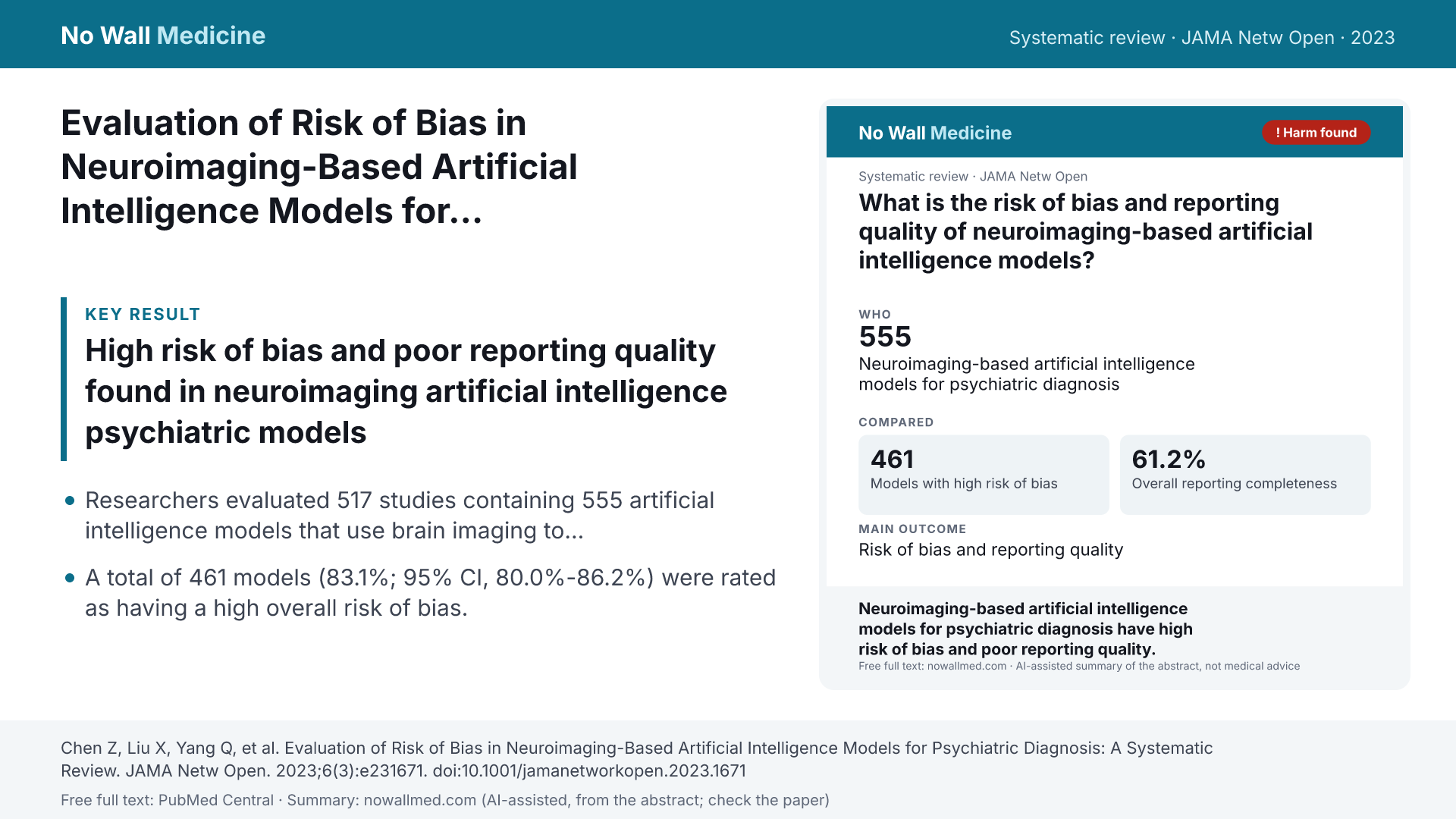
- Researchers evaluated 517 studies containing 555 artificial intelligence models that use brain imaging to diagnose psychiatric disorders.
- A total of 461 models (83.1%; 95% CI, 80.0%-86.2%) were rated as having a high overall risk of bias.
- The models showed poor reporting completeness at 61.2% (95% CI, 60.6%-61.8%), with the lowest completeness in technical assessment at 39.9% (95% CI, 38.8%-41.1%).
Headline and key points written with AI from the paper’s abstract, with every number checked against it. Read the paper before relying on them.
Was this summary helpful?
Subject terms
Headline, design, result, key points, caveat and citation as plain text.
Cite this article
Chen Z, Liu X, Yang Q, et al. Evaluation of Risk of Bias in Neuroimaging-Based Artificial Intelligence Models for Psychiatric Diagnosis: A Systematic Review. JAMA Netw Open. 2023;6(3):e231671. doi:10.1001/jamanetworkopen.2023.1671
Spotted a mistake? Suggest a correction