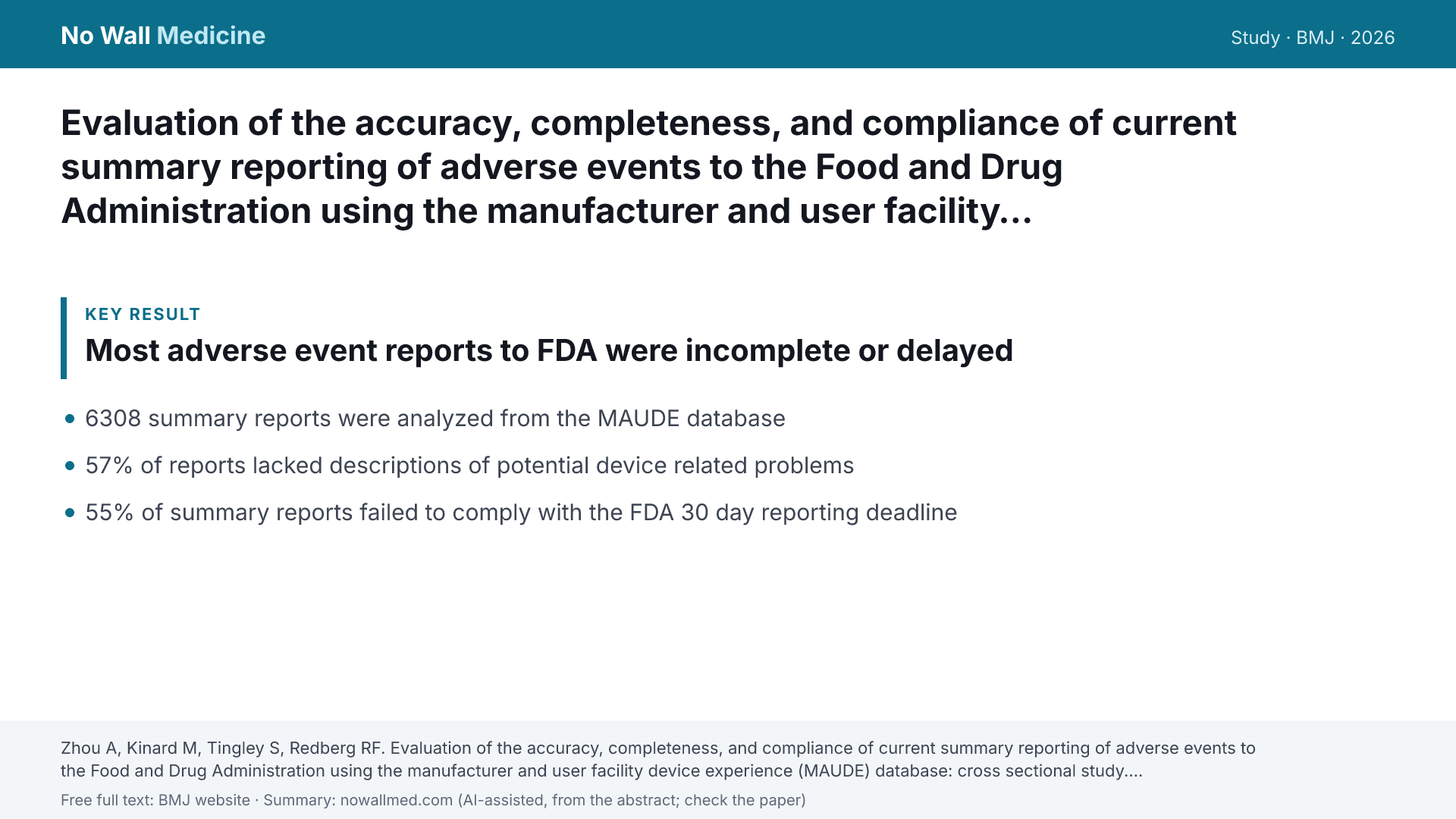
Most adverse event reports to FDA were incomplete or delayed
Evaluation of the accuracy, completeness, and compliance of current summary reporting of adverse events to the Food and Drug Administration using the manufacturer and user facility device experience (MAUDE) database: cross sectional study
Key points
- 6308 summary reports were analyzed from the MAUDE database.
- 57% of reports lacked descriptions of potential device related problems.
- 55% of summary reports failed to comply with the FDA 30 day reporting deadline.
Headline and key points written with AI from the paper’s abstract, with every number checked against it. Read the paper before relying on them.
Was this summary helpful?
Abstract
Objectives
To evaluate the accuracy and completeness of adverse event summary reports for medical devices and compliance of the reports with the Food and Drug Administration (FDA) requirements. Design
Cross sectional study. Setting
The FDA manufacturer and user facility device experience (MAUDE) database. Participants
All adverse event summary reports filed in MAUDE from July 2019 to June 2025. Main outcome measures
Identification of device problem codes, appropriate identification as summary reports in the submission form, concordance between the number of events data field and the report narrative, and compliance with FDA reporting deadlines. Results
6308 summary reports were submitted to MAUDE containing 159 503 adverse events. Use of summary reports increased from 808 to 1757 between 2020 and 2024, a factor of 1.21 per year (P<0.001). Most (91%) adverse events in summary reports were for class 3 high risk devices. Summary reports lacked descriptions of potential device related problems: 57% of reports denoted an "adverse event without identified device or use problem" and 38% of reports selected "insufficient information" in the device problem code data field. Manufacturers incorrectly checked "N" (no) in the summary report (Y/N, reporting yes/no) field for 694 summary reports (11%) and erroneously listed "n=1" under the number of events field for 423 summary reports (7%), causing an undercount of 11 902 adverse events. The majority (55%) of summary reports failed to comply with the FDA reporting deadline of 30 days after the manufacturer became aware of the adverse event. Conclusions
Adverse event summary reports in MAUDE are frequently incomplete, inaccurate, and delayed. Improvements are needed to ensure timely identification of device safety signals and uphold FDA transparency standards.
Abstract reproduced under the article’s CC BY NC licence.
Subject terms
Headline, design, result, key points, caveat and citation as plain text.
Cite this article
Zhou A, Kinard M, Tingley S, Redberg RF. Evaluation of the accuracy, completeness, and compliance of current summary reporting of adverse events to the Food and Drug Administration using the manufacturer and user facility device experience (MAUDE) database: cross sectional study. BMJ. 2026;395:e100812. doi:10.1136/bmj-2026-100812
Spotted a mistake? Suggest a correction