Growth assessment protocol did not increase antenatal detection of small for gestational age
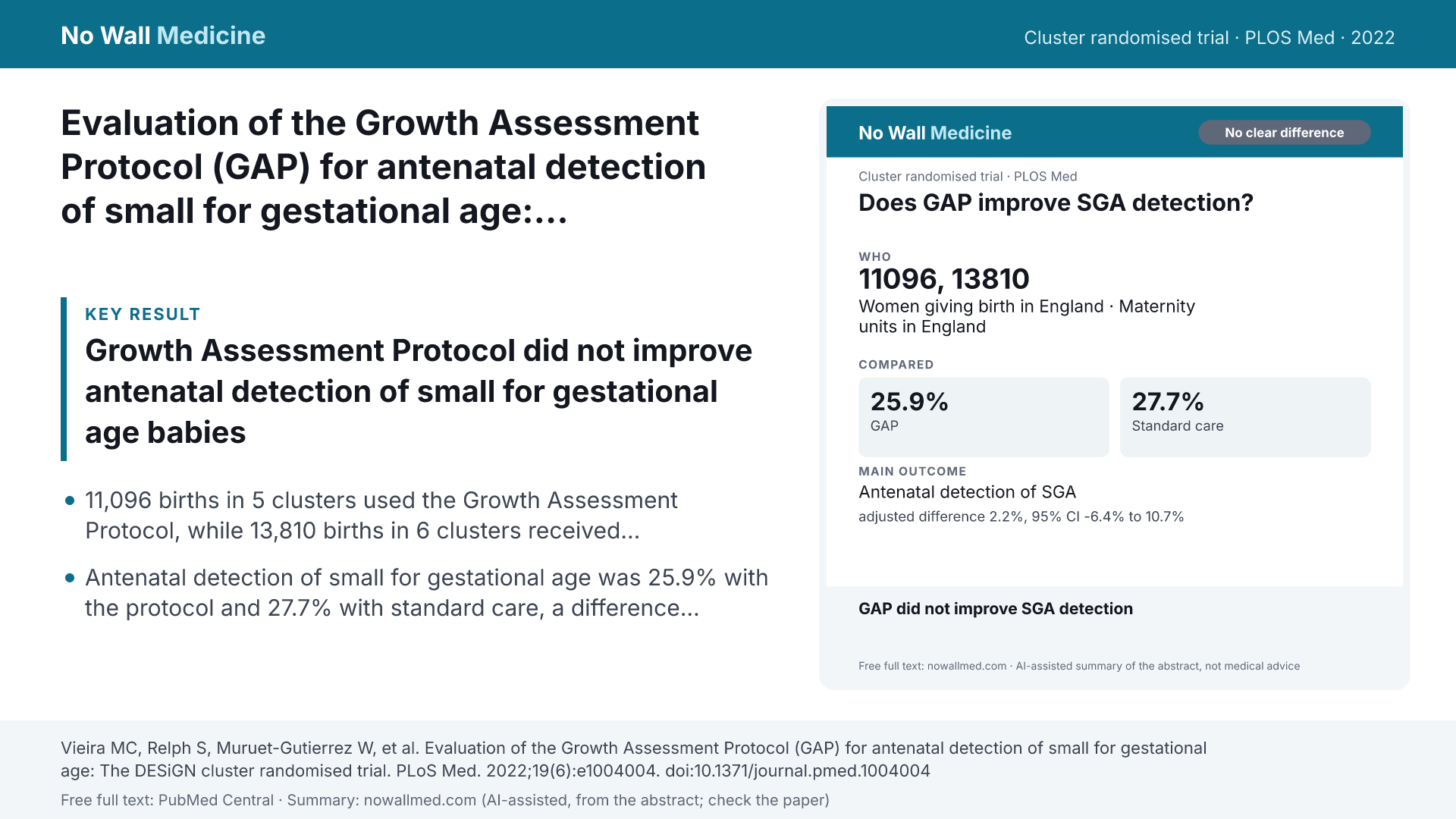
Evaluation of the Growth Assessment Protocol (GAP) for antenatal detection of small for gestational age: The DESiGN cluster randomised trial
Cluster randomised trialNo clear difference
Does GAP improve SGA detection?
Who
11096, 13810
Women giving birth in England · Maternity units in England
Compared
25.9%GAP
27.7%Standard care
Main outcome
Antenatal detection of SGA
Result: adjusted difference 2.2%, 95% CI -6.4% to 10.7%
Bottom line: GAP did not improve SGA detection
Limitation: modest number of clusters and missing data
PLOS Med · 2022-06-21Download image
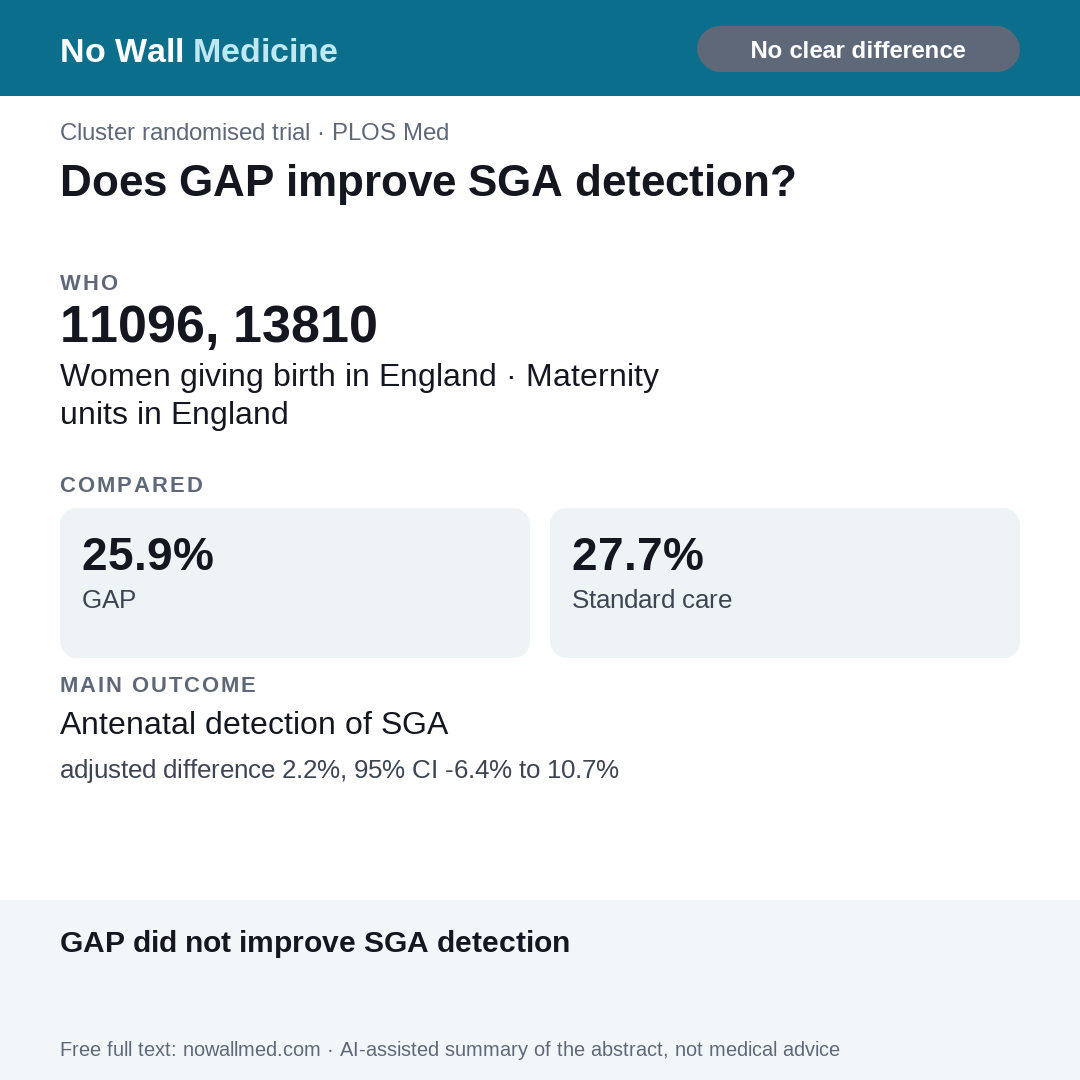
Clinical question: Does GAP improve SGA detection?
Why it matters: Observational studies have provided conflicting results regarding whether the Growth Assessment Protocol improves the detection of small for gestational age and reduces stillbirth.
Key points
- Researchers conducted a cluster randomized trial involving 11,096 births in the intervention group and 13,810 births in the standard care group.
- Antenatal detection of small for gestational age, defined as a baby being smaller than expected for their pregnancy age, was 25.9% in the intervention group and 27.7% in the standard care group.
- The difference in detection rates between the two groups was not statistically significant, with an adjusted difference of 2.2% (95% CI -6.4% to 10.7%; p = 0.62).
Limitation the authors note: The authors state that the modest number of clusters limits the ability to study small effect sizes and that the use of routinely collected data may result in missing data.
Headline and key points written with AI from the paper’s abstract, with every number checked against it. Read the paper before relying on them.
Was this summary helpful?
Subject terms
Cite this article
Vieira MC, Relph S, Muruet-Gutierrez W, Elstad M, Coker B, Moitt N. Evaluation of the Growth Assessment Protocol (GAP) for antenatal detection of small for gestational age: The DESiGN cluster randomised trial. PLOS Med. 2022. doi:10.1371/journal.pmed.1004004
Spotted a mistake? Suggest a correction