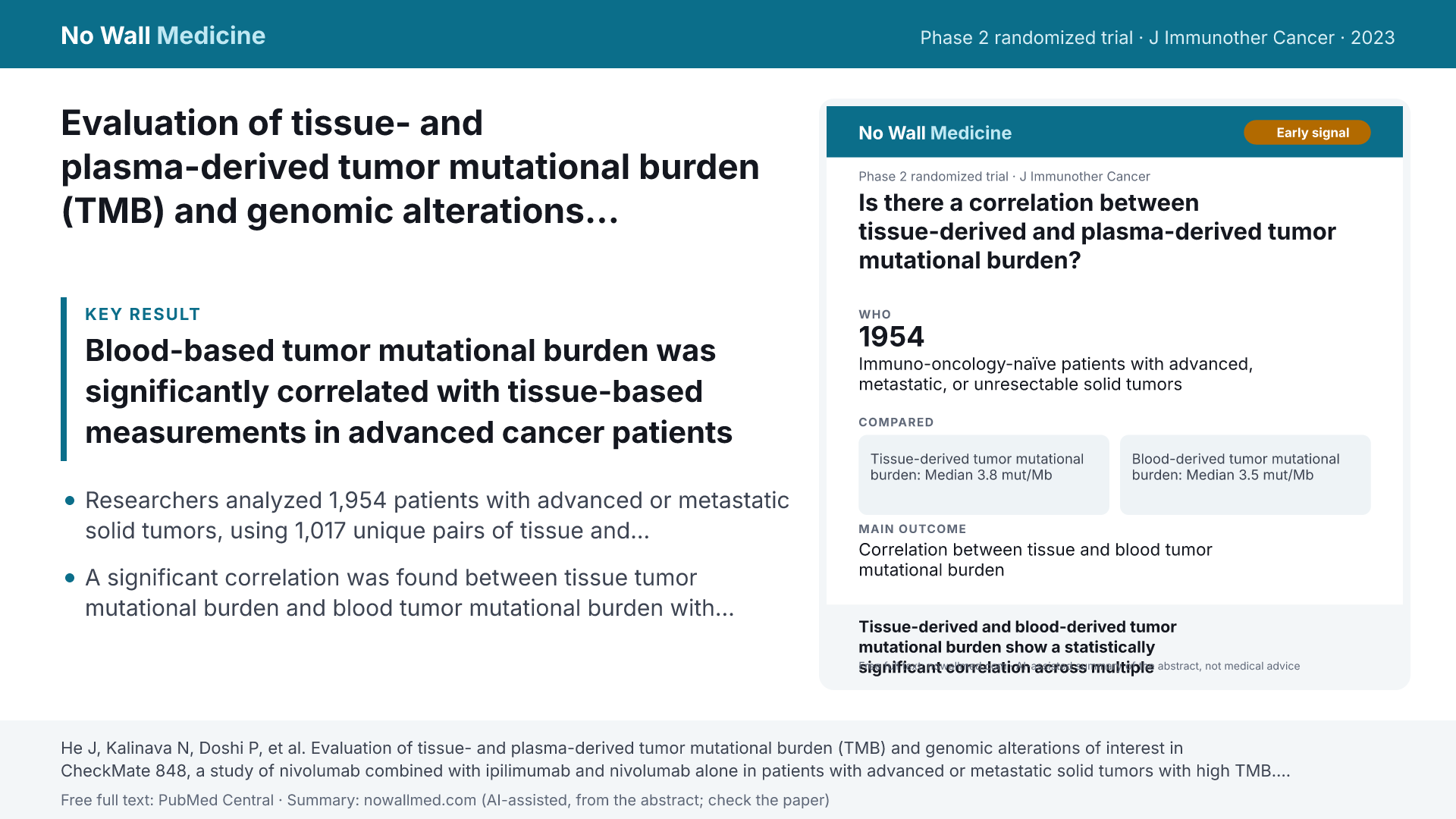
Blood-based tumor mutational burden was significantly correlated with tissue-based measurements in advanced cancer patients
Evaluation of tissue- and plasma-derived tumor mutational burden (TMB) and genomic alterations of interest in CheckMate 848, a study of nivolumab combined with ipilimumab and nivolumab alone in patients with advanced or metastatic solid tumors with high TMB
Phase 2 randomized trialEarly signal
Is there a correlation between tissue-derived and plasma-derived tumor mutational burden?
Who
1954
Immuno-oncology-naïve patients with advanced, metastatic, or unresectable solid tumors
Compared
Tissue-derived tumor mutational burden: Median 3.8 mut/Mb
Blood-derived tumor mutational burden: Median 3.5 mut/Mb
Main outcome
Correlation between tissue and blood tumor mutational burden
Result: r=0.48, p<0.0001
Bottom line: Tissue-derived and blood-derived tumor mutational burden show a statistically significant correlation across multiple disease ontologies.
J Immunother Cancer · 2023-11-30Download image
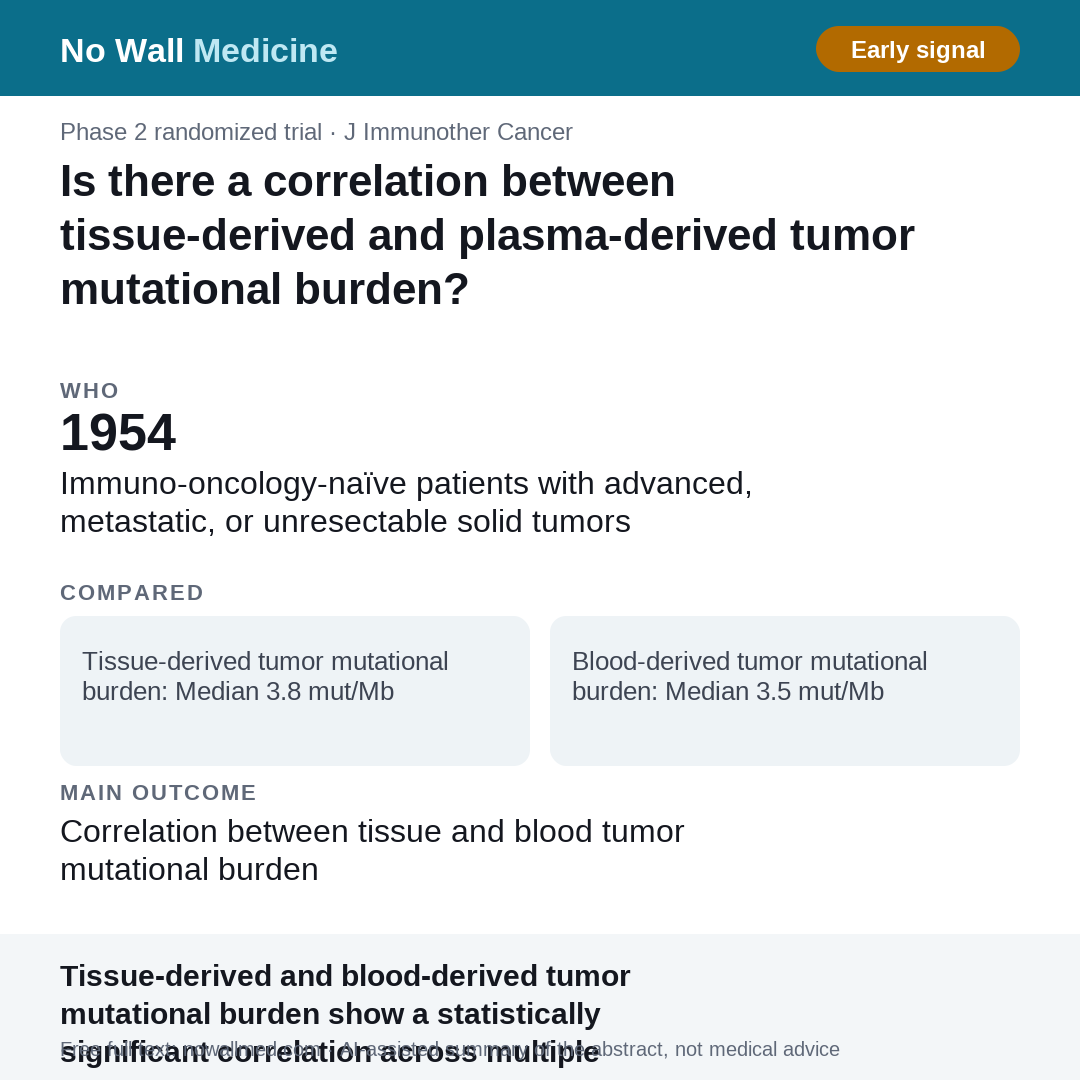
Clinical question: Is there a correlation between tissue-derived and plasma-derived tumor mutational burden?
Why it matters: It is unknown if blood-based tumor mutational burden, a less invasive measurement, can serve as a substitute for tissue-based measurements.
Key points
- Researchers analyzed 1,954 patients with advanced or metastatic solid tumors, using 1,017 unique pairs of tissue and blood measurements.
- A significant correlation was found between tissue tumor mutational burden and blood tumor mutational burden with r=0.48 (p<0.0001).
- The correlation increased to r=0.54 (p<0.0001) for samples with a maximum somatic allele frequency of ≥1%.
Headline and key points written with AI from the paper’s abstract, with every number checked against it. Read the paper before relying on them.
Was this summary helpful?
Abstract
Background
An accumulation of somatic mutations in tumors leads to increased neoantigen levels and antitumor immune response. Tumor mutational burden (TMB) reflects the rate of somatic mutations in the tumor genome, as determined from tumor tissue (tTMB) or blood (bTMB). While high tTMB is a biomarker of immune checkpoint inhibitor (ICI) treatment efficacy, few studies have explored the clinical utility of bTMB, a less invasive alternative for TMB assessment. Establishing the correlation between tTMB and bTMB would provide insight into whether bTMB is a potential substitute for tTMB. We explored the tumor genomes of patients enrolled in CheckMate 848 with measurable TMB. The correlation between tTMB and bTMB, and the factors affecting it, were evaluated. Methods
In the phase 2 CheckMate 848 (NCT03668119) study, immuno-oncology-naïve patients with advanced, metastatic, or unresectable solid tumors and tTMB-high or bTMB-high (≥10 mut/Mb) were prospectively randomized 2:1 to receive nivolumab plus ipilimumab or nivolumab monotherapy. Tissue and plasma DNA sequencing was performed using the Foundation Medicine FoundationOne CDx and bTMB Clinical Trial Assays, respectively. tTMB was quantified from coding variants, insertions, and deletions, and bTMB from somatic base substitutions. Correlations between tTMB and bTMB were determined across samples and with respect to maximum somatic allele frequency (MSAF). Assay agreement and variant composition were also evaluated. Results
A total of 1,438 and 1,720 unique tissue and blood samples, respectively, were obtained from 1,954 patients and included >100 screened disease ontologies, with 1,017 unique pairs of tTMB and bTMB measurements available for assessment. Median tTMB and bTMB were 3.8 and 3.5 mut/Mb, respectively. A significant correlation between tTMB and bTMB (r=0.48, p<0.0001) was observed across all sample pairs, which increased to r=0.54 (p<0.0001) for samples with MSAF≥1%. Assay concordance was highest for samples with MSAF≥10% across multiple disease ontologies and observed for both responders and non-responders to ICI therapy. The variants contributing to tTMB and bTMB were similar. Conclusions
We observed that tTMB and bTMB had a statistically significant correlation, particularly for samples with high MSAF, and that this correlation applied across disease ontologies. Further investigation into the clinical utility of bTMB is warranted.
Abstract reproduced under the article’s CC BY NC licence.
Subject terms
Cite this article
He J, Kalinava N, Doshi P, et al. Evaluation of tissue- and plasma-derived tumor mutational burden (TMB) and genomic alterations of interest in CheckMate 848, a study of nivolumab combined with ipilimumab and nivolumab alone in patients with advanced or metastatic solid tumors with high TMB. J Immunother Cancer. 2023. doi:10.1136/jitc-2023-007339
Spotted a mistake? Suggest a correction