A goal-directed checklist did not significantly reduce cardiac arrest in brain-dead potential organ donors
Evidence-Based Checklist to Delay Cardiac Arrest in Brain-Dead Potential Organ Donors: The DONORS Cluster Randomized Clinical Trial
Open-label, parallel-group cluster randomized clinical trialUnclear result
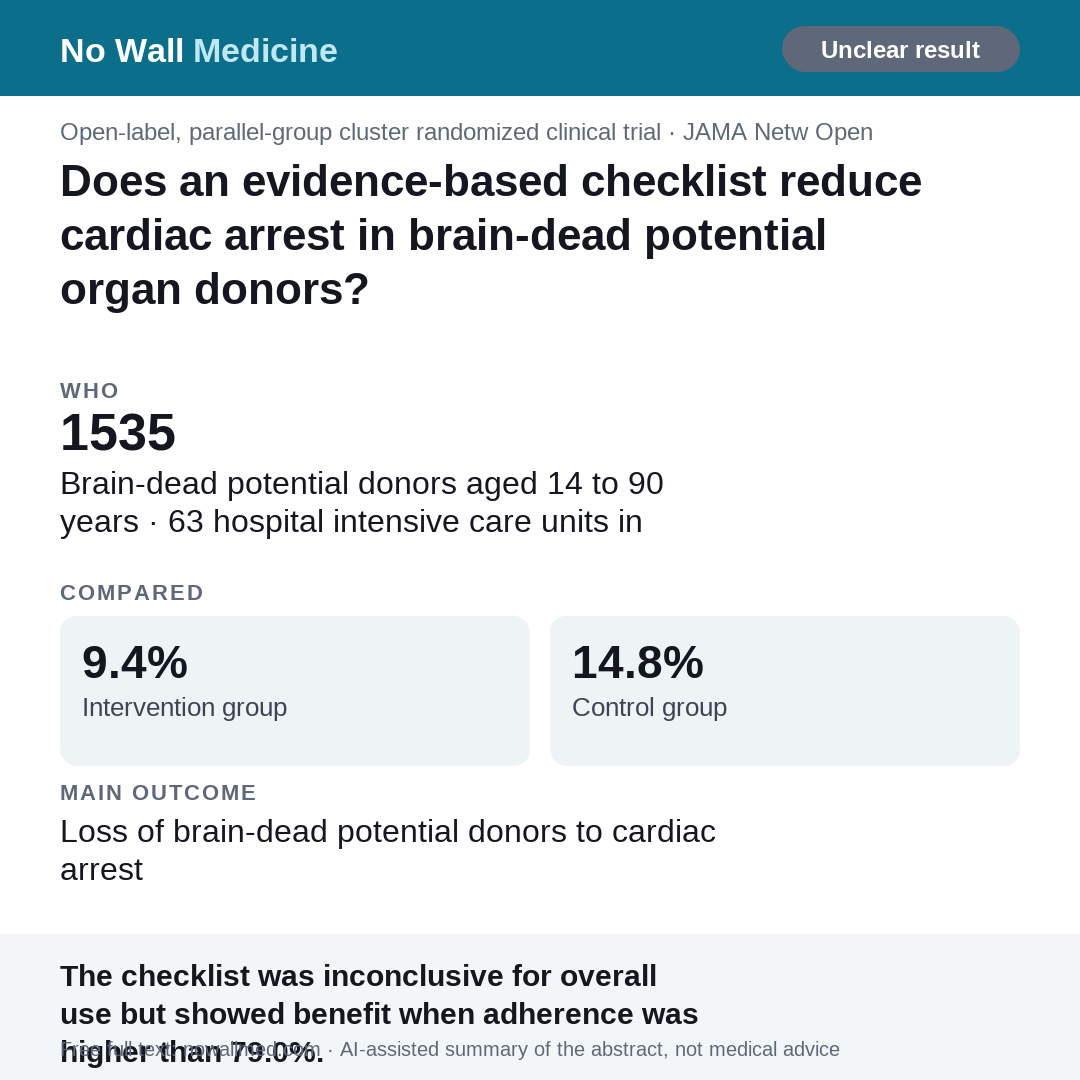
Does an evidence-based checklist reduce cardiac arrest in brain-dead potential organ donors?
Who
1535
Brain-dead potential donors aged 14 to 90 years · 63 hospital intensive care units in Brazil
Compared
9.4%Intervention group
14.8%Control group
Main outcome
Loss of brain-dead potential donors to cardiac arrest
Result: risk ratio 0.70 (95% CI, 0.46-1.08)
Bottom line: The checklist was inconclusive for overall use but showed benefit when adherence was higher than 79.0%.
Limitation: The trial was inconclusive in determining whether overall checklist use reduced cardiac arrest.
JAMA Netw Open · 2023-12-01Download image
Clinical question: Does an evidence-based checklist reduce cardiac arrest in brain-dead potential organ donors?
Why it matters: It is unclear if goal-directed care using a clinical checklist can reduce the loss of brain-dead potential organ donors to cardiac arrest.
Key points
- Researchers studied 1535 brain-dead potential organ donors across 63 hospitals to see if a 13-goal clinical checklist could prevent cardiac arrest.
- The primary outcome of cardiac arrest occurred in 9.4% of the intervention group and 14.8% of the control group, which was not statistically significant.
- In a sensitivity analysis, patients where staff followed the checklist more than 79.0% of the time had lower cardiac arrest rates than the control group (5.3% vs 14.8%).
Headline and key points written with AI from the paper’s abstract, with every number checked against it. Read the paper before relying on them.
Was this summary helpful?
Subject terms
Cite this article
Westphal GA, Robinson CC, Giordani NE, Teixeira C, Rohden AI, Dos Passos Gimenes B. Evidence-Based Checklist to Delay Cardiac Arrest in Brain-Dead Potential Organ Donors: The DONORS Cluster Randomized Clinical Trial. JAMA Netw Open. 2023. doi:10.1001/jamanetworkopen.2023.46901
Spotted a mistake? Suggest a correction
Top studies every Monday
The week’s key trials and guidelines in your specialties, plus any topics you follow. By email, free.
Get the weekly digest