Clinical practice guidelines developed for safe and effective laser-assisted drug delivery use
Evidence-Based Clinical Practice Guidelines for Laser-Assisted Drug Delivery
Systematic review and Delphi consensusBenefit found
What are the recommendations for safe and effective laser-assisted drug delivery use?
Who
Adults and adolescents aged 12 years or older
Compared
Ablative fractional laser-assisted drug delivery: safe in all Fitzpatrick skin types
Nonablative fractional laser-assisted drug delivery
Main outcome
Safe and effective use of laser-assisted drug delivery
Bottom line: Guidelines recommend laser-assisted drug delivery is safe and effective for various medical and cosmetic applications.
Limitation: Future research will further improve understanding of this novel treatment technique.
JAMA Dermatol · 2022-08-18Download image
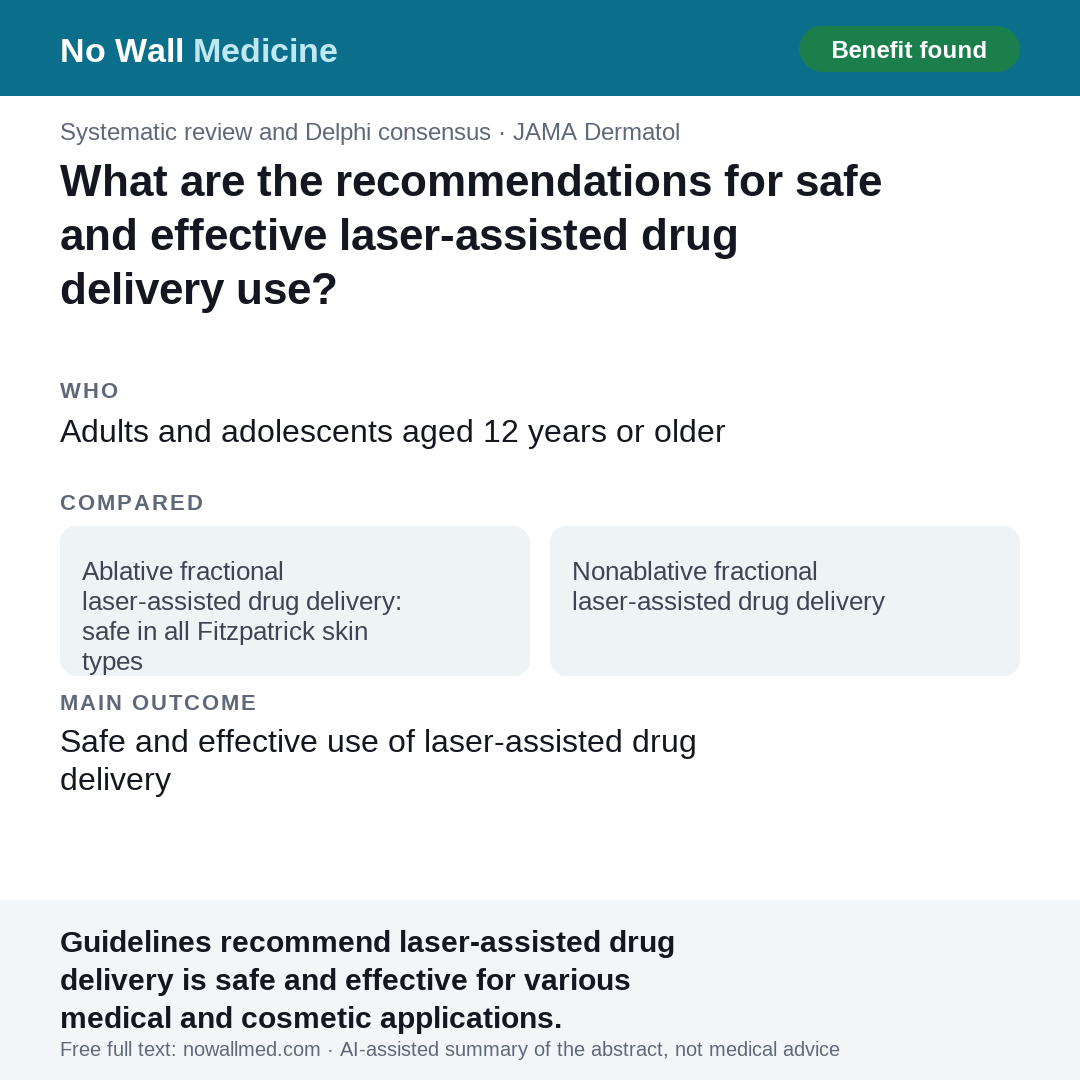
Clinical question: What are the recommendations for safe and effective laser-assisted drug delivery use?
Why it matters: Clinicians lack sufficient evidence-based guidance to assist with the safe and effective use of laser-assisted drug delivery in medical and cosmetic applications.
Key points
- A multidisciplinary panel reviewed 54 studies to create recommendations for laser-assisted drug delivery, a technique using lasers to help transport medication into the skin.
- The panel found the procedure is safe for adults and adolescents aged 12 years or older across all Fitzpatrick skin types and in immunosuppressed patients.
- The guidelines recommend antiviral prophylaxis for treating the face and genitalia but do not recommend antibiotic or antifungal prophylaxis unless wound healing is impaired.
Headline and key points written with AI from the paper’s abstract, with every number checked against it. Read the paper before relying on them.
Was this summary helpful?
Subject terms
Cite this article
Labadie JG, Ibrahim SA, Worley B, Kang BY, Rakita U, Rigali S. Evidence-Based Clinical Practice Guidelines for Laser-Assisted Drug Delivery. JAMA Dermatol. 2022. doi:10.1001/jamadermatol.2022.3234
Spotted a mistake? Suggest a correction
Top studies every Monday
The week’s key trials and guidelines in your specialties, plus any topics you follow. By email, free.
Get the weekly digest