Evidence on Digital HIV Self-Testing From Accuracy to Impact: Updated Systematic Review
Systematic reviewBenefit found
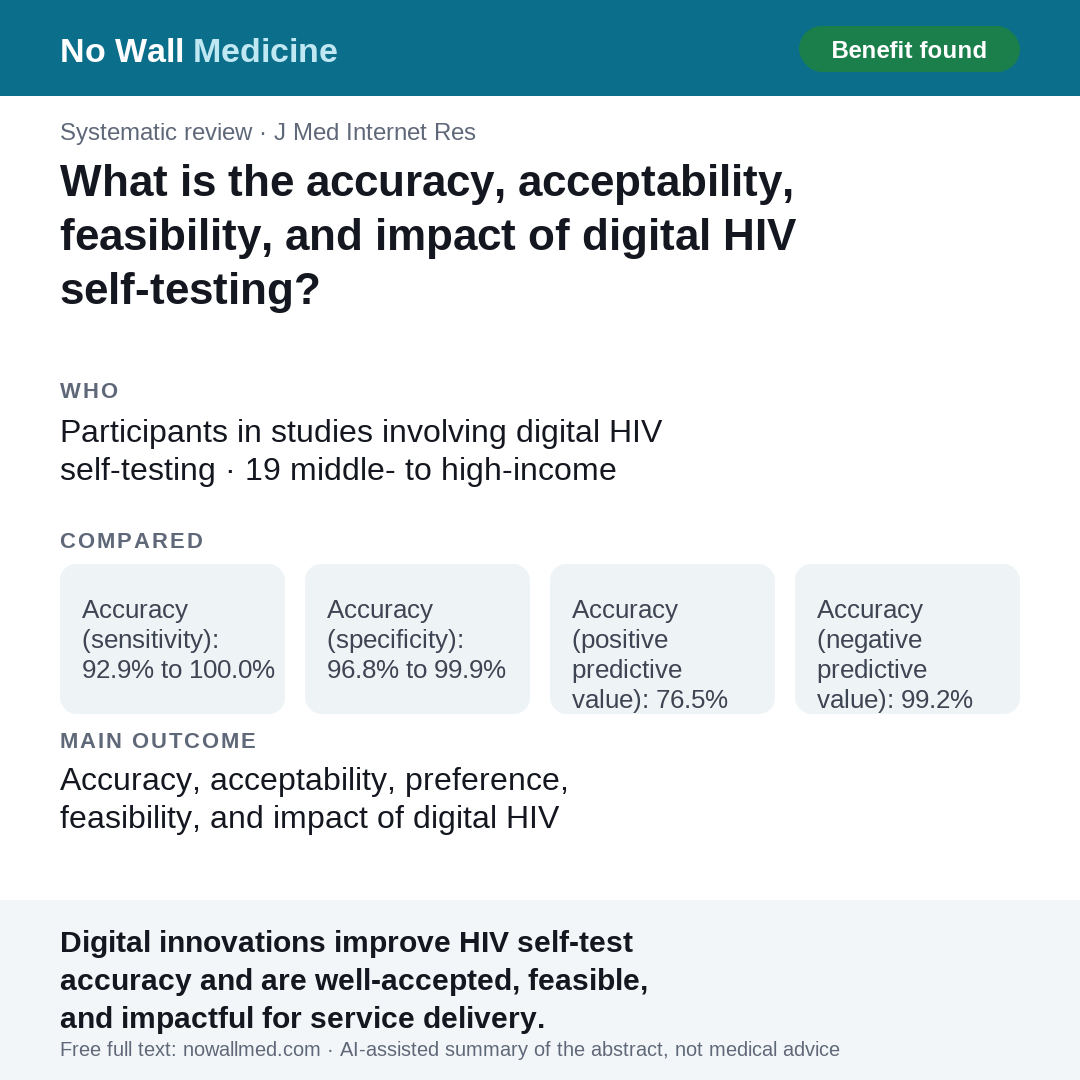
What is the accuracy, acceptability, feasibility, and impact of digital HIV self-testing?
Who
Participants in studies involving digital HIV self-testing · 19 middle- to high-income countries
Compared
Accuracy (sensitivity): 92.9% to 100.0%
Accuracy (specificity): 96.8% to 99.9%
Accuracy (positive predictive value): 76.5% to 99.2%
Accuracy (negative predictive value): 99.2% to 100.0%
Main outcome
Accuracy, acceptability, preference, feasibility, and impact of digital HIV self-testing
Bottom line: Digital innovations improve HIV self-test accuracy and are well-accepted, feasible, and impactful for service delivery.
Limitation: The quality of studies varied, though they generally demonstrated low risk of bias.
J Med Internet Res · 2025-03-04Download image
Clinical question: What is the accuracy, acceptability, feasibility, and impact of digital HIV self-testing?
Abstract
Background
HIV self-testing has gained momentum following the approval of self-testing methods and novel technological advancements. Digital HIV self-testing involves completing an oral or blood-based HIV self-test with support from a digital innovation. Objective
We conducted a systematic review on the existing data analyzing digital HIV self-testing accuracy while updating research on digital HIV self-test acceptability, preference, feasibility, and impact. Methods
We searched Embase and PubMed for records on HIV self-testing with digital support. Included studies significantly incorporated a form of digital innovation throughout the HIV self-test process and reported quantitative data. For accuracy measures, the search spanned January 1, 2013, to October 15, 2024; for patient-centered and impact outcomes, we updated existing literature (June 16, 2021, to October 15, 2024) reported in a previous systematic review. Studies' quality was assessed using the QUADAS 2 Tool, Newcastle-Ottawa Scale, and Cochrane Risk of Bias Tool 2. Results
Fifty-five studies (samples ranging 120-21,035, median 1267 participants) were summarized from 19 middle- to high-income countries. Seven studies reported on the accuracy of HIV self-testing with innovations from >5000 participants. Diagnostic performance metrics, including point estimates of specificity, sensitivity, positive predictive value, and negative predictive value were measured (n=3), and ranged from: 96.8% to 99.9%, 92.9% to 100.0%, 76.5% to 99.2%, and 99.2% to 100.0%, respectively. The percentage of invalid test results for oral and blood-based self-tests ranged from 0.2% to 12.7% (n=4). Fifty-one studies reported data on metrics beyond accuracy, including acceptability, preference, feasibility, and impact outcomes from >30,000 participants. Majority (38/51, 74.5%) were observational studies, while 25.5% (13/51) reported data from randomized controlled trials. Acceptability and preference outcomes varied from 64.5% to 99.0% (14/51) and 4.6% to 99.3% (8/51), respectively. Feasibility outcomes included test uptake (30.9% to 98.2%; 28/51), response rate (26.0% to 94.8%; 7/51), and visits to web-based providers (43.0% to 70.7%; n=4). Impact outcomes assessed new infections (0.0% to 25.8%; 31/51), first-time testers (2.0% to 53.0%; 26/51), result return proportions (22.1% to 100.0%; 24/51), linkage to care as both connections to confirmatory testing and counseling (53.0% to 100.0%; 16/51), and referrals for treatment initiation (44.4% to 98.1%; 8/51). The quality of studies varied, though they generally demonstrated low risk of bias. Conclusions
Digital innovations improved the accuracy of HIV self-test results, and were well-accepted and preferred by participants. Operationally, they were found to be feasible and reported impacting the HIV self-testing process. These findings are in favor of the use of digital HIV self-test innovations as a promising support tool and suggest that digital HIV self-tests' service delivery models hold promise in not only facilitating HIV testing but also impacting operational outcomes that are crucial to reaching Joint United Nations Program on HIV/AIDS targets in middle- to high-income countries. Trial registration
PROSPERO CRD42020205025; https://www.crd.york.ac.uk/prospero/CRD42020205025.
Subject terms
Cite this article
Beecroft A, Vaikla O, Engel N, Duchaine T, Liang C, Pant Pai N. Evidence on Digital HIV Self-Testing From Accuracy to Impact: Updated Systematic Review. J Med Internet Res. 2025. doi:10.2196/63110
Spotted a mistake? Suggest a correction
Top studies every Monday
The week’s key trials and guidelines in your specialties, plus any topics you follow. By email, free.
Get the weekly digest