Health funding for non-communicable diseases and health systems decreased or remained low from 1990 to 2022
Evolution and effectiveness of bilateral and multilateral development assistance for health: a mixed-methods review of trends and strategic shifts (1990-2022)
Mixed-methods reviewMixed results
How has development assistance for health evolved and shifted from 1990 to 2022?
Who
Development assistance for health data from 1990 to 2022 · Low- and middle-income countries
Compared
1%Non-communicable diseases funding in 1990
2%Non-communicable diseases funding in 2022
19%Health system strengthening funding in 1990
7%Health system strengthening funding in 2022
Main outcome
Trends in development assistance for health allocation and strategic shifts
Bottom line: Development assistance remains focused on infectious diseases, with insufficient shifts toward non-communicable diseases and health system strengthening.
Limitation: Establishing causality is challenging due to multiple influencing factors.
BMJ Glob Health · 2025-01-11Download image
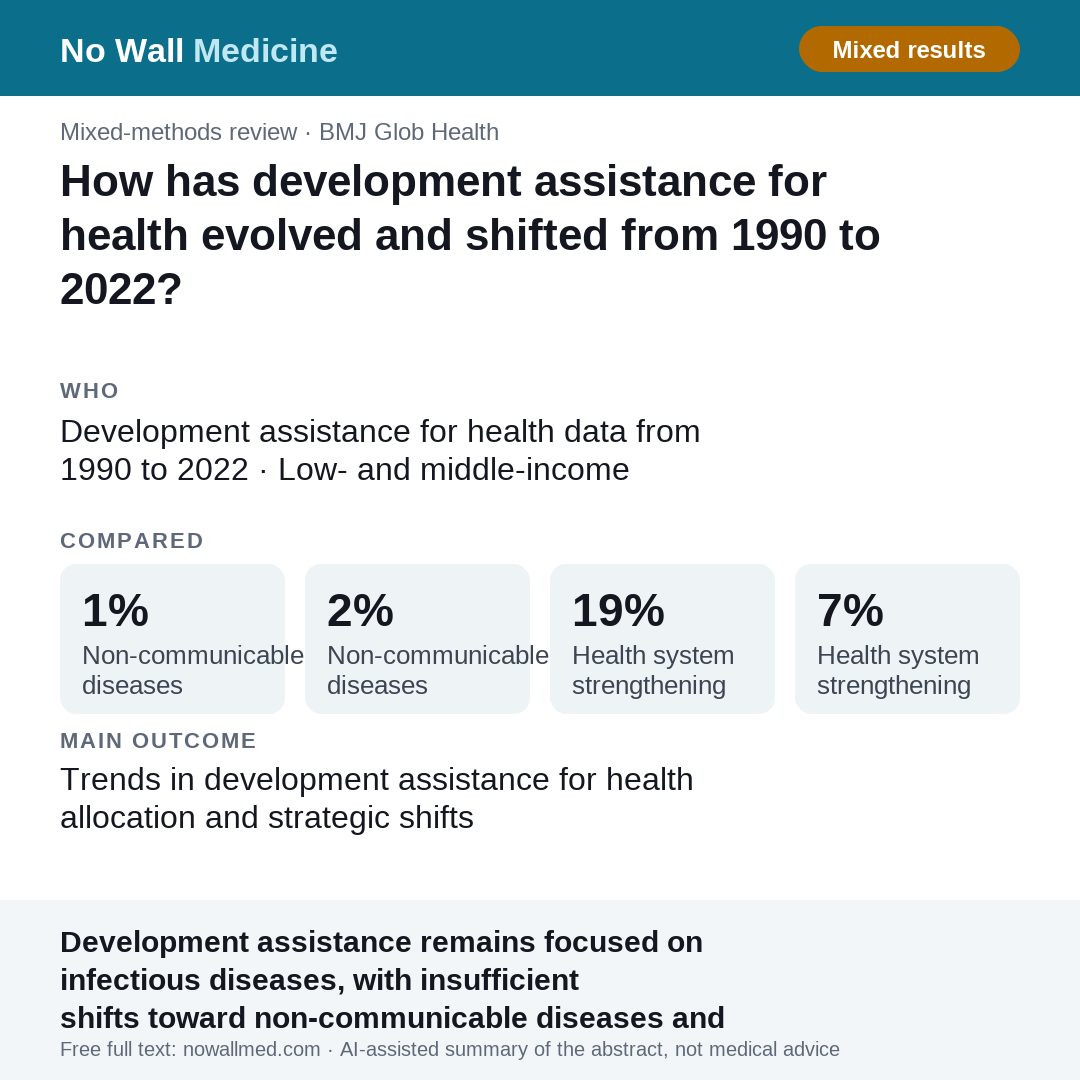
Clinical question: How has development assistance for health evolved and shifted from 1990 to 2022?
Why it matters: The trends, strategic shifts, and impact of international health funding on health systems and outcomes were not comprehensively analyzed.
Key points
- Researchers reviewed 102 studies and data from 1990 to 2022 regarding development assistance for health, which is international funding for health programs in low- and middle-income countries.
- Funding for non-communicable diseases increased only from 1% in 1990 to 2% in 2022, while funding for health system strengthening decreased from 19% in 1990 to 7% in 2022.
- While development assistance for health was associated with improvements in certain health outcomes, establishing direct cause and effect is difficult due to multiple influencing factors.
Headline and key points written with AI from the paper’s abstract, with every number checked against it. Read the paper before relying on them.
Abstract
Background
Development assistance for health (DAH) plays a vital role in supporting health programmes in low- and middle-income countries. While DAH has historically focused on infectious diseases and maternal and child health, there is a lack of comprehensive analysis of DAH trends, strategic shifts and their impact on health systems and outcomes. This study aims to provide a comprehensive review of DAH from 1990 to 2022, examining its evolution and funding allocation shifts. Methods
We conducted a mixed-methods review, adhering to the Preferred Reporting Items for Systematic Reviews and Meta-Analyses guidelines. A systematic literature search was performed across PubMed, Embase, Web of Science and the Cochrane databases, yielding 102 eligible studies. Quantitative data were obtained from the Institute for Health Metrics and Evaluation database, covering DAH data from 1990 to 2022. Qualitative data were analysed through thematic synthesis based on the WHO's six health system building blocks. Results
The DAH has predominantly focused on HIV/AIDS and maternal and child health. Despite the increasing global burden of non-communicable diseases (NCDs), the proportion of DAH allocated to NCDs remained low, increasing only from 1% in 1990 to 2% in 2022. Similarly, the overall funding for health system strengthening decreased from 19% in 1990 to 7% in 2022. Major contributors to DAH included the USA, the UK and the Bill & Melinda Gates Foundation. While associations between DAH and improvements in certain health outcomes were observed, establishing causality is challenging due to multiple influencing factors. The COVID-19 pandemic underscored the importance of robust health systems. However, DAH allocation did not show any substantial shift towards health system strengthening during this period. Economic evaluations calculated the median incremental cost-effectiveness ratio of DAH interventions, CONCLUSIONS: This study reviews DAH trends from 1990 to 2022, showing a predominant focus on HIV/AIDS and maternal and child health, with insufficient attention to NCDs and health system strengthening. Despite the increasing burden of NCDs and the impact of COVID-19, DAH priorities have not significantly shifted, highlighting the need for ongoing evaluation and strategic adjustments. To enhance DAH effectiveness, it is crucial to adopt a more balanced approach and also align interventions with needs from recipient countries and implement evidence-based strategies with continuous monitoring and evaluation.
Abstract reproduced under the article’s CC BY NC licence.
Topics
Cite this article
Xie S, Du S, Huang Y, Luo Y, Chen Y, Zheng Z. Evolution and effectiveness of bilateral and multilateral development assistance for health: a mixed-methods review of trends and strategic shifts (1990-2022). BMJ Glob Health. 2025. doi:10.1136/bmjgh-2024-017818
Spotted a mistake? Suggest a correction