Macrolide and fluoroquinolone resistance in Mycoplasma genitalium showed specific prevalence rates between 2018 and 2021
Evolving patterns of macrolide and fluoroquinolone resistance in Mycoplasma genitalium: an updated systematic review and meta-analysis
Systematic review and meta-analysisMixed results
What are the contemporary prevalence estimates of macrolide and fluoroquinolone resistance in Mycoplasma genitalium?
Who
Mycoplasma genitalium samples · 41 countries
Compared
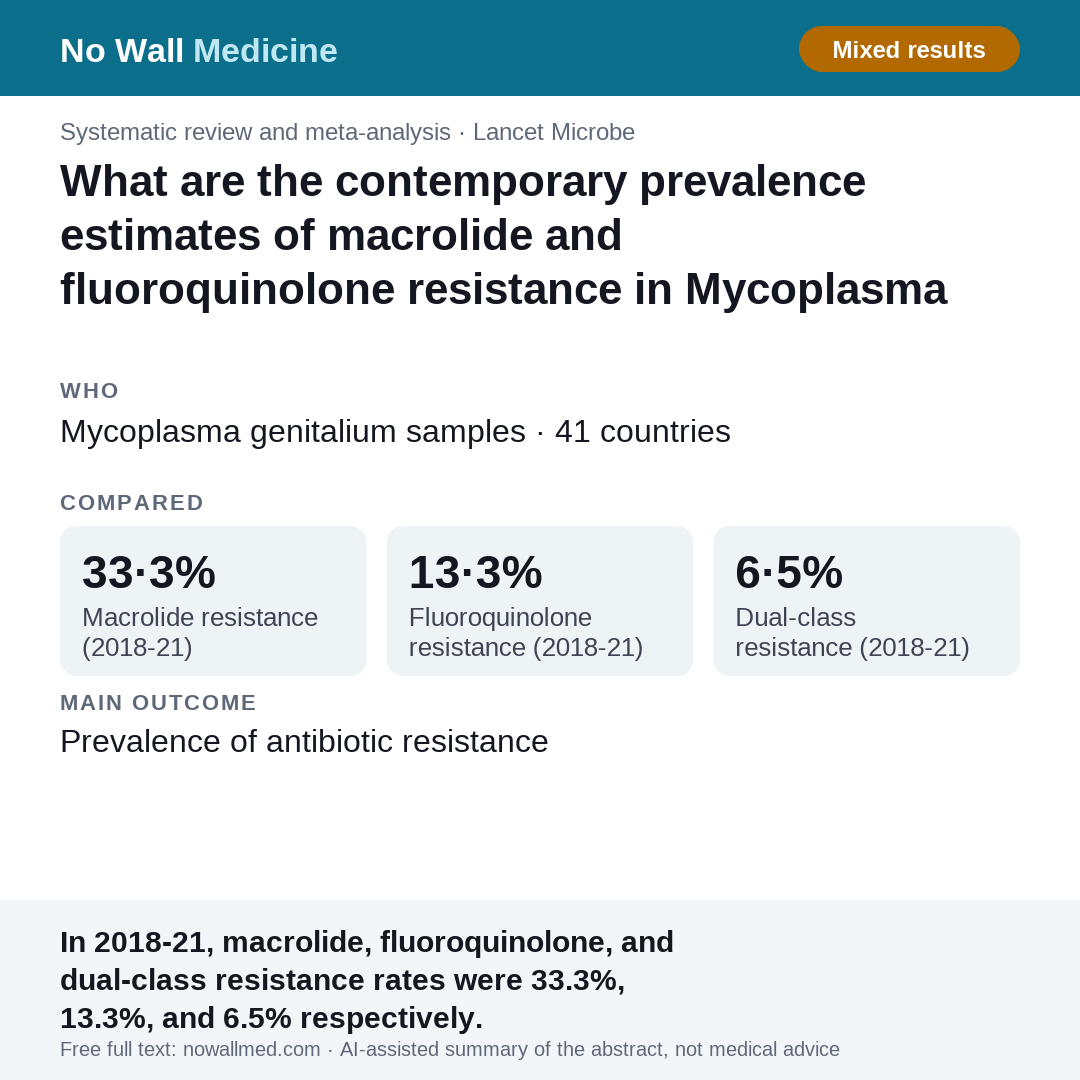
33·3%Macrolide resistance (2018-21) (95% CI 27·2-39·7)
13·3%Fluoroquinolone resistance (2018-21) (10·0-17·0)
6·5%Dual-class resistance (2018-21) (4·0-9·4)
Main outcome
Prevalence of antibiotic resistance
Bottom line: In 2018-21, macrolide, fluoroquinolone, and dual-class resistance rates were 33.3%, 13.3%, and 6.5% respectively.
Funded by: Australian Research Council
Lancet Microbe · 2025-03-24Download image
Clinical question: What are the contemporary prevalence estimates of macrolide and fluoroquinolone resistance in Mycoplasma genitalium?
Why it matters: Contemporary estimates of macrolide and fluoroquinolone resistance in Mycoplasma genitalium are needed to inform national, regional, and global treatment guidelines.
Key points
- Researchers analyzed 166 studies involving 22,974 samples to assess antibiotic resistance in Mycoplasma genitalium.
- In 2018-21, macrolide resistance was 33.3%, fluoroquinolone resistance was 13.3%, and dual-class resistance was 6.5%.
- The ParC S83I genetic variant associated with fluoroquinolone resistance increased from 0% before 2012 to 7.3% in 2018-21.
Headline and key points written with AI from the paper’s abstract, with every number checked against it. Read the paper before relying on them.
Was this summary helpful?
Subject terms
Cite this article
Chua TP, Vodstrcil LA, Murray GL, Plummer EL, Jensen JS, Unemo M. Evolving patterns of macrolide and fluoroquinolone resistance in Mycoplasma genitalium: an updated systematic review and meta-analysis. Lancet Microbe. 2025. doi:10.1016/j.lanmic.2024.101047
Spotted a mistake? Suggest a correction
Top studies every Monday
The week’s key trials and guidelines in your specialties, plus any topics you follow. By email, free.
Get the weekly digest