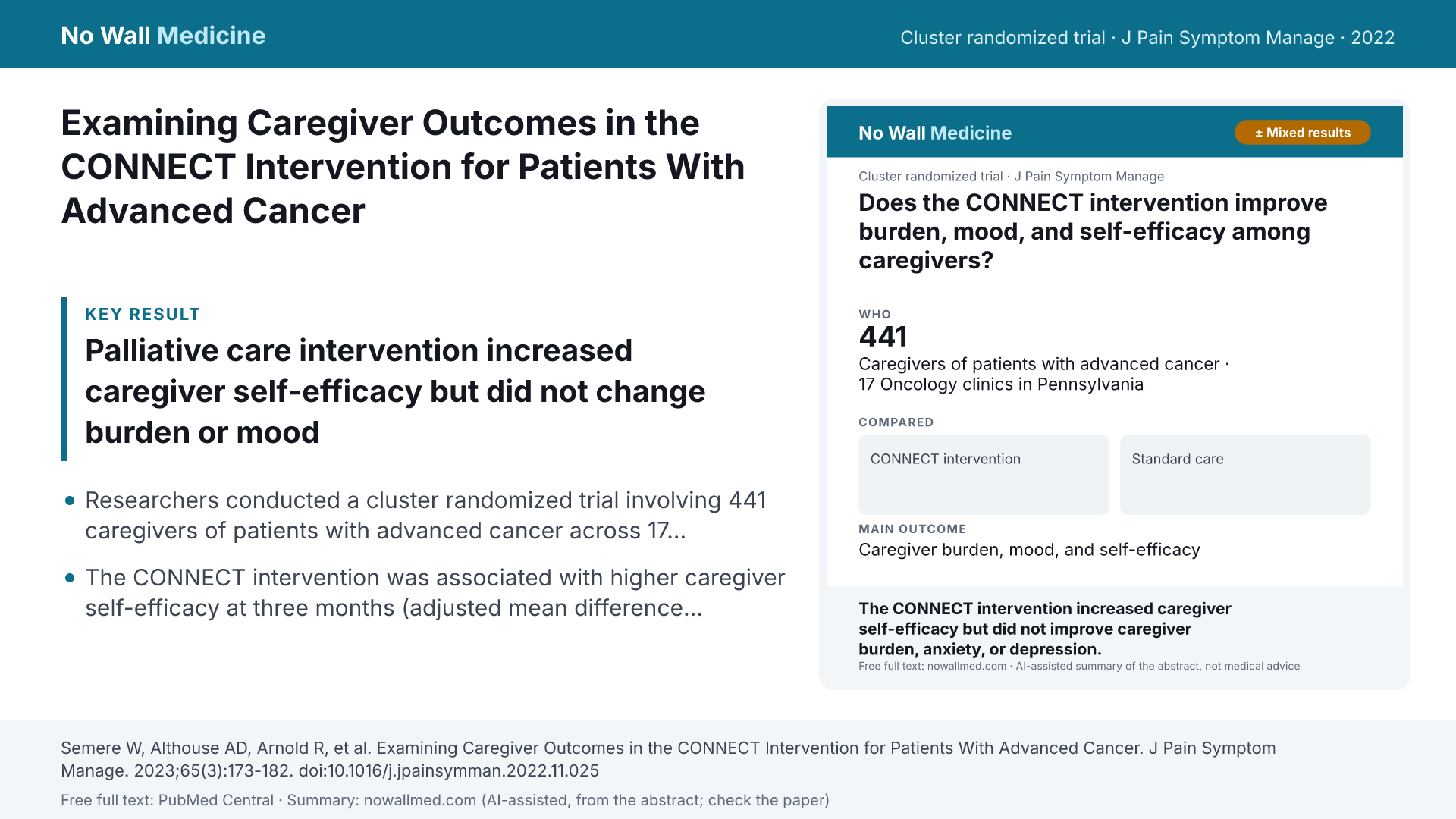
Palliative care intervention increased caregiver self-efficacy but did not change burden or mood
Examining Caregiver Outcomes in the CONNECT Intervention for Patients With Advanced Cancer
Cluster randomized trialMixed results
Does the CONNECT intervention improve burden, mood, and self-efficacy among caregivers?
Who
441
Caregivers of patients with advanced cancer · 17 Oncology clinics in Pennsylvania
Compared
CONNECT intervention
Standard care
Main outcome
Caregiver burden, mood, and self-efficacy
Result: adjusted mean difference 9.36 (95% CI 0.95-17.77) for self-efficacy
Bottom line: The CONNECT intervention increased caregiver self-efficacy but did not improve caregiver burden, anxiety, or depression.
J Pain Symptom Manage · 2022-12-09 · Save PNG
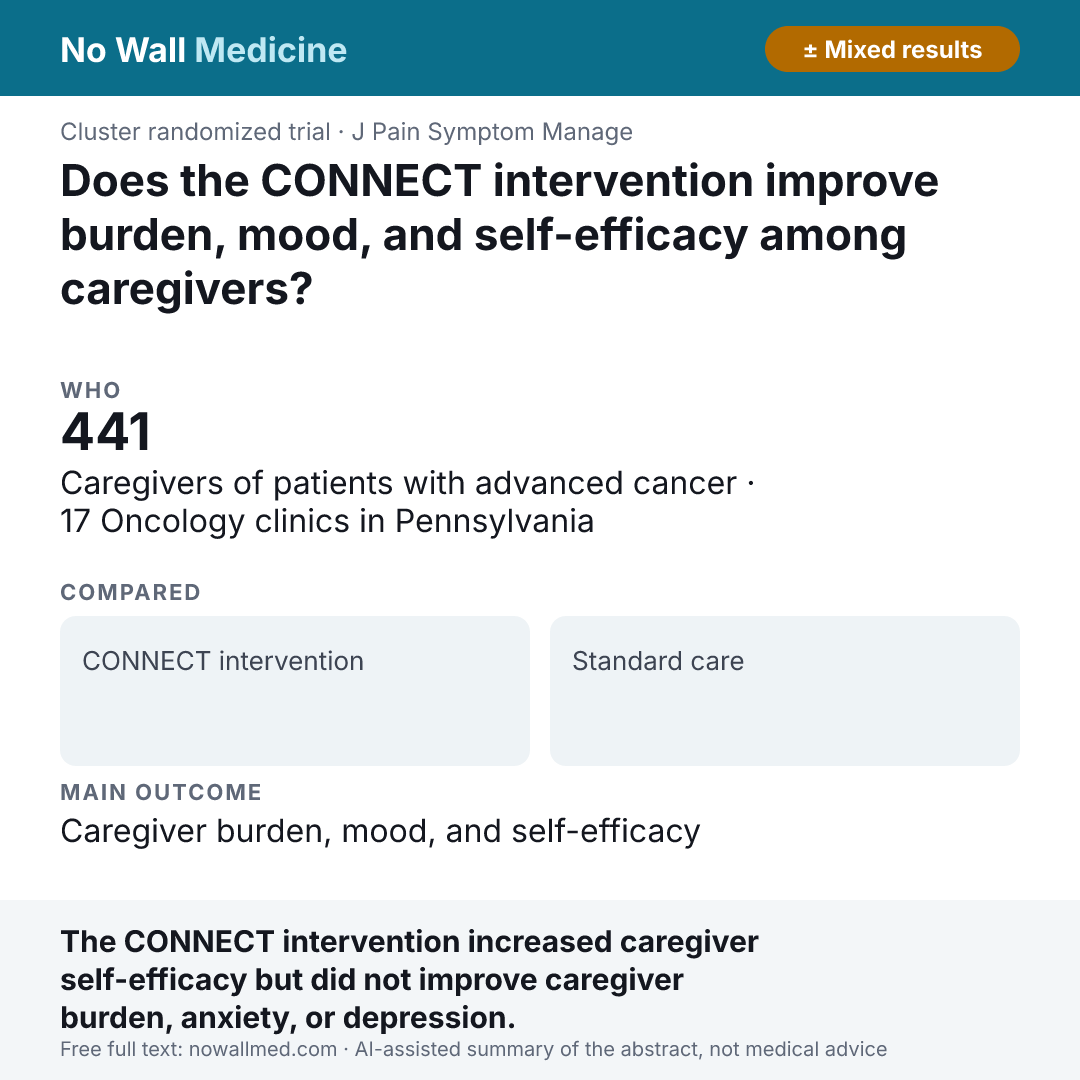
Clinical question: Does the CONNECT intervention improve burden, mood, and self-efficacy among caregivers?
Key points
- Researchers conducted a cluster randomized trial involving 441 caregivers of patients with advanced cancer across 17 oncology clinics.
- The CONNECT intervention was associated with higher caregiver self-efficacy at three months (adjusted mean difference 9.36; 95% CI 0.95-17.77, P = 0.030).
- No significant differences were found between the intervention and standard care for caregiver burden (P = 0.90), depression (P = 0.26), or anxiety (P = 0.58).
Headline and key points written with AI from the paper’s abstract, with every number checked against it. Read the paper before relying on them.
Was this summary helpful?
Subject terms
Headline, design, result, key points, caveat and citation as plain text.
Cite this article
Semere W, Althouse AD, Arnold R, et al. Examining Caregiver Outcomes in the CONNECT Intervention for Patients With Advanced Cancer. J Pain Symptom Manage. 2023;65(3):173-182. doi:10.1016/j.jpainsymman.2022.11.025
Spotted a mistake? Suggest a correction