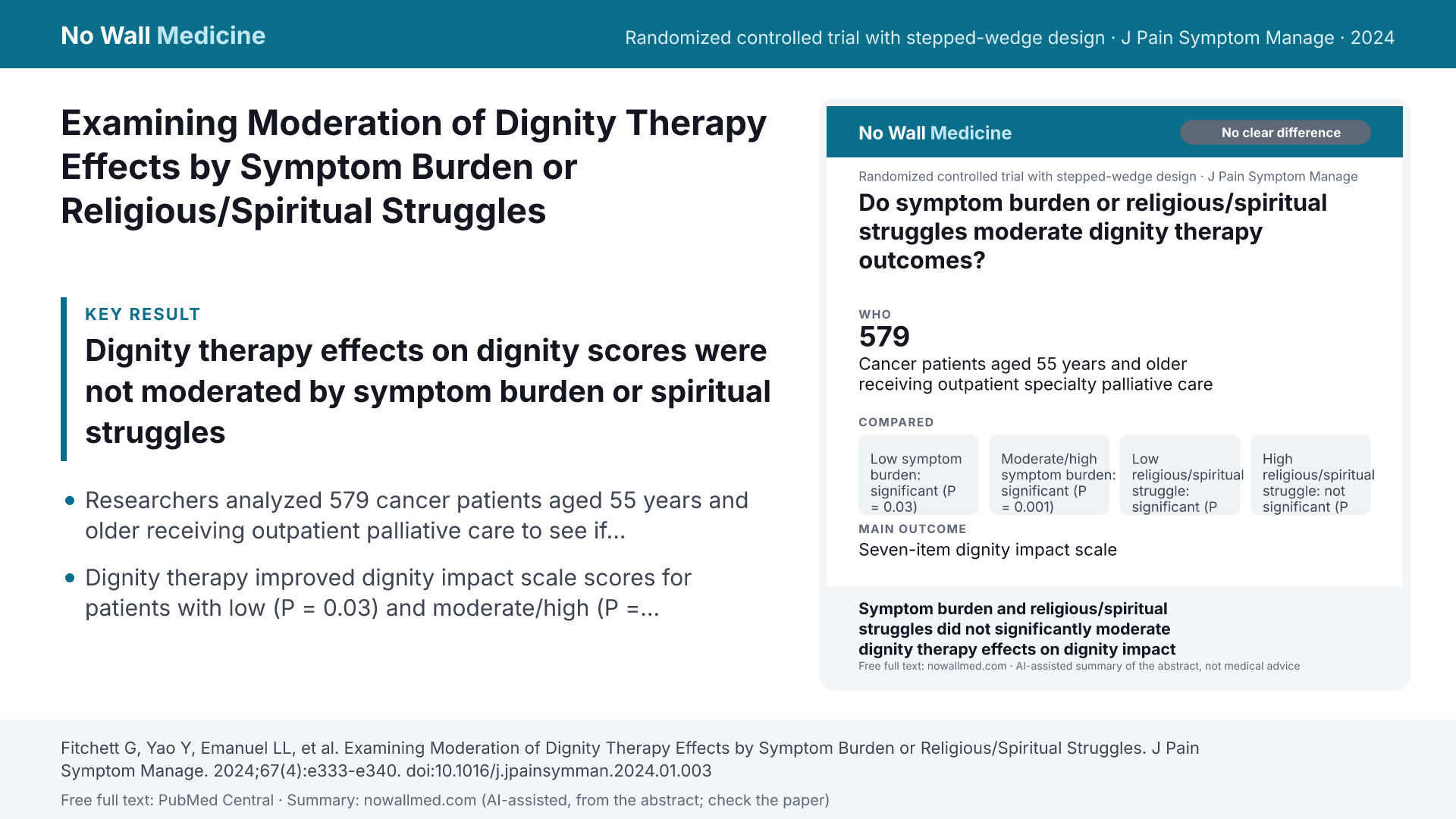
Dignity therapy effects on dignity scores were not moderated by symptom burden or spiritual struggles
Examining Moderation of Dignity Therapy Effects by Symptom Burden or Religious/Spiritual Struggles
Randomized controlled trial with stepped-wedge designNo clear difference
Do symptom burden or religious/spiritual struggles moderate dignity therapy outcomes?
Who
579
Cancer patients aged 55 years and older receiving outpatient specialty palliative care · Six sites across the United States
Compared
Low symptom burden: significant (P = 0.03)
Moderate/high symptom burden: significant (P = 0.001)
Low religious/spiritual struggle: significant (P = 0.004)
High religious/spiritual struggle: not significant (P = 0.10)
Main outcome
Seven-item dignity impact scale
Bottom line: Symptom burden and religious/spiritual struggles did not significantly moderate dignity therapy effects on dignity impact scale.
J Pain Symptom Manage · 2024-01-11Download image
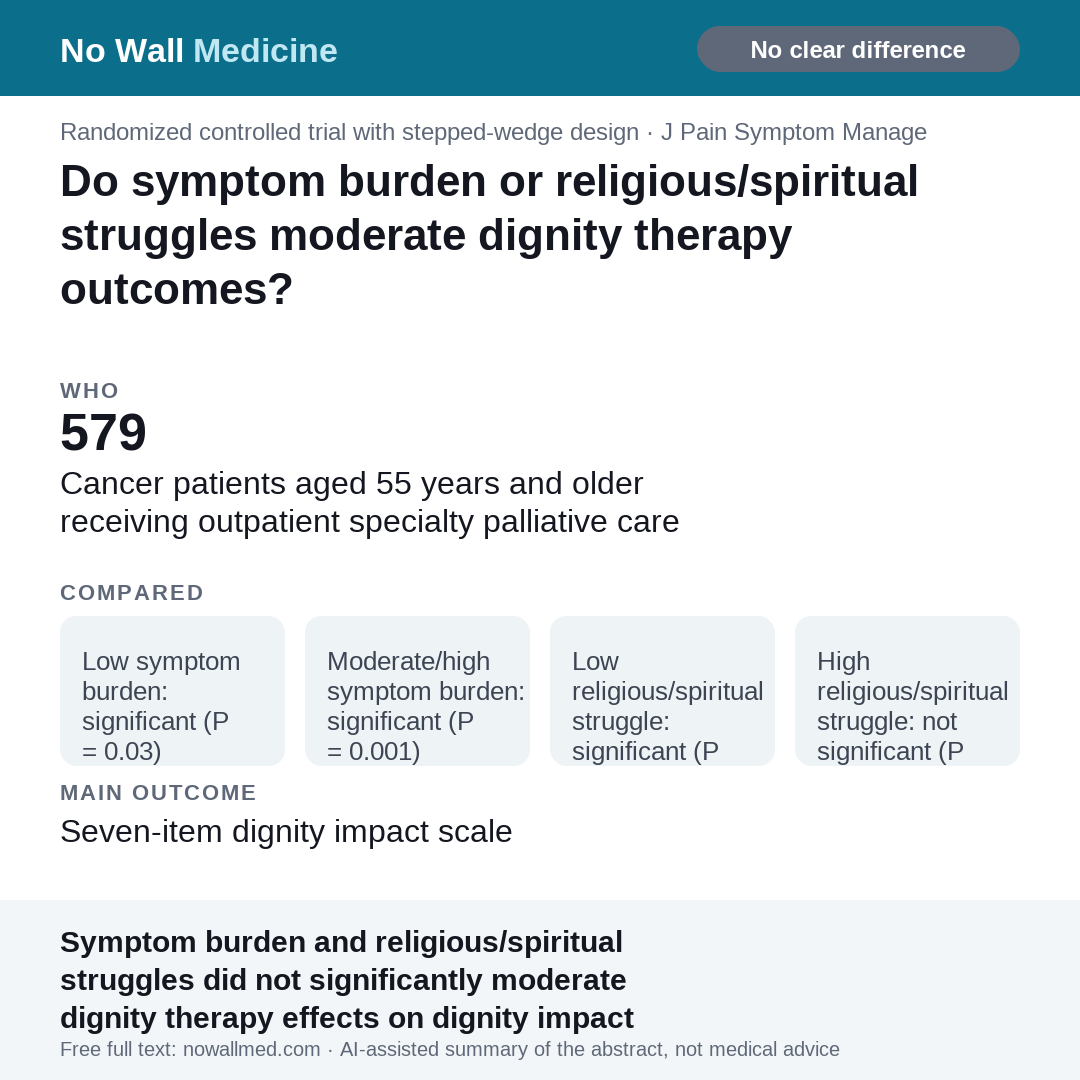
Clinical question: Do symptom burden or religious/spiritual struggles moderate dignity therapy outcomes?
Why it matters: It is unclear whether the effectiveness of dignity therapy, a psychotherapeutic intervention, depends on a patient's level of physical symptoms or religious and spiritual struggles.
Key points
- Researchers analyzed 579 cancer patients aged 55 years and older receiving outpatient palliative care to see if symptom burden or religious/spiritual struggles changed the effects of dignity therapy.
- Dignity therapy improved dignity impact scale scores for patients with low (P = 0.03) and moderate/high (P = 0.001) symptom burden, but not for those with high religious/spiritual struggle (P = 0.10).
- The moderation effects of symptom burden (P = 0.054) and religious/spiritual struggle (P = 0.52) on dignity scores were not significant, and no significant effects were found for death preparation or life completion.
Headline and key points written with AI from the paper’s abstract, with every number checked against it. Read the paper before relying on them.
Was this summary helpful?
Subject terms
Cite this article
Fitchett G, Yao Y, Emanuel LL, et al. Examining Moderation of Dignity Therapy Effects by Symptom Burden or Religious/Spiritual Struggles. J Pain Symptom Manage. 2024. doi:10.1016/j.jpainsymman.2024.01.003
Spotted a mistake? Suggest a correction