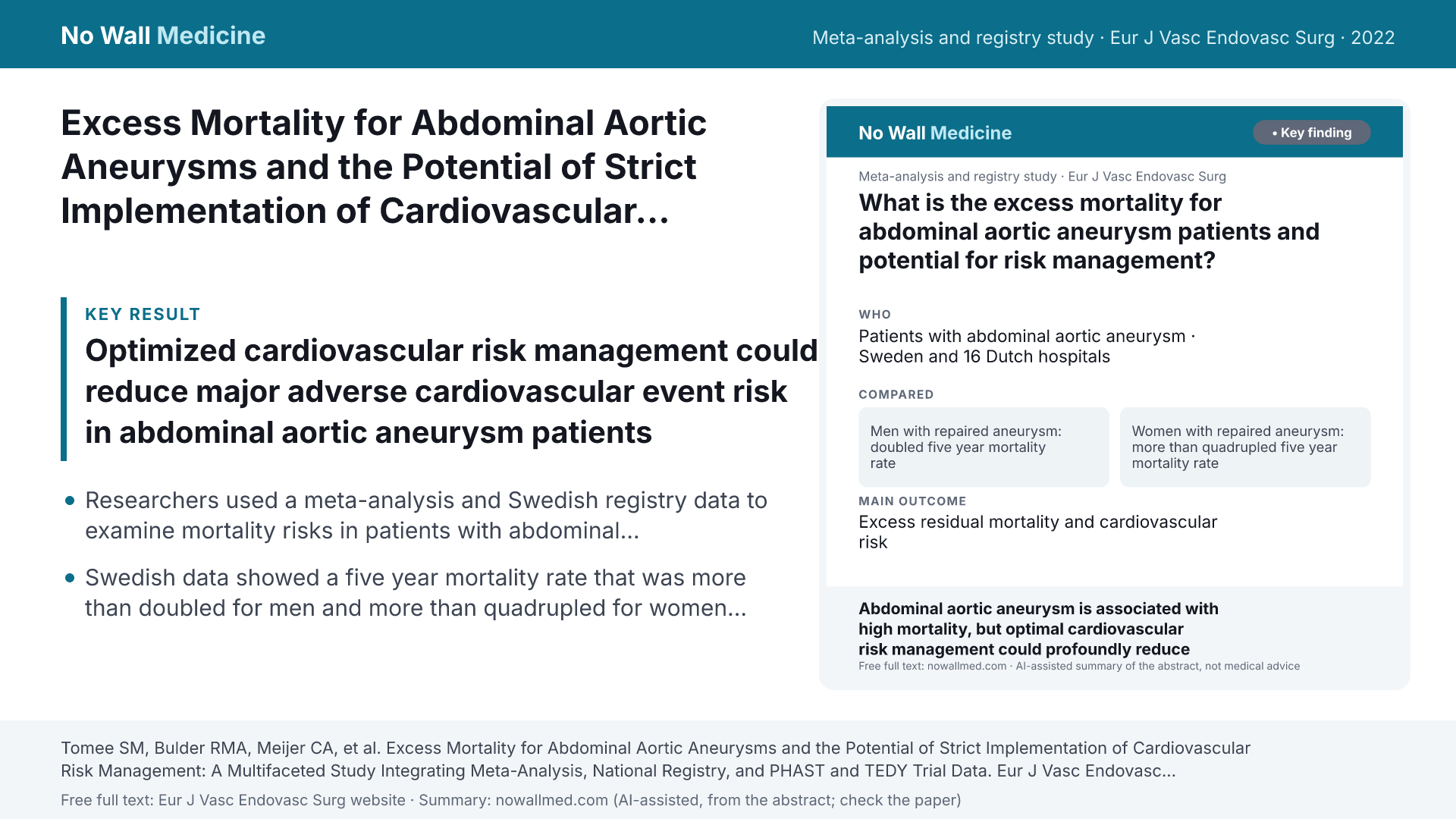
Optimized cardiovascular risk management could reduce major adverse cardiovascular event risk in abdominal aortic aneurysm patients
Excess Mortality for Abdominal Aortic Aneurysms and the Potential of Strict Implementation of Cardiovascular Risk Management: A Multifaceted Study Integrating Meta-Analysis, National Registry, and PHAST and TEDY Trial Data
Meta-analysis and registry studyKey finding
What is the excess mortality for abdominal aortic aneurysm patients and potential for risk management?
Who
Patients with abdominal aortic aneurysm · Sweden and 16 Dutch hospitals
Compared
Men with repaired aneurysm: doubled five year mortality rate
Women with repaired aneurysm: more than quadrupled five year mortality rate
Main outcome
Excess residual mortality and cardiovascular risk
Result: 10 year risk of major adverse cardiovascular events 43% to 14%
Bottom line: Abdominal aortic aneurysm is associated with high mortality, but optimal cardiovascular risk management could profoundly reduce major adverse cardiovascular events.
Eur J Vasc Endovasc Surg · 2022-11-29Download image
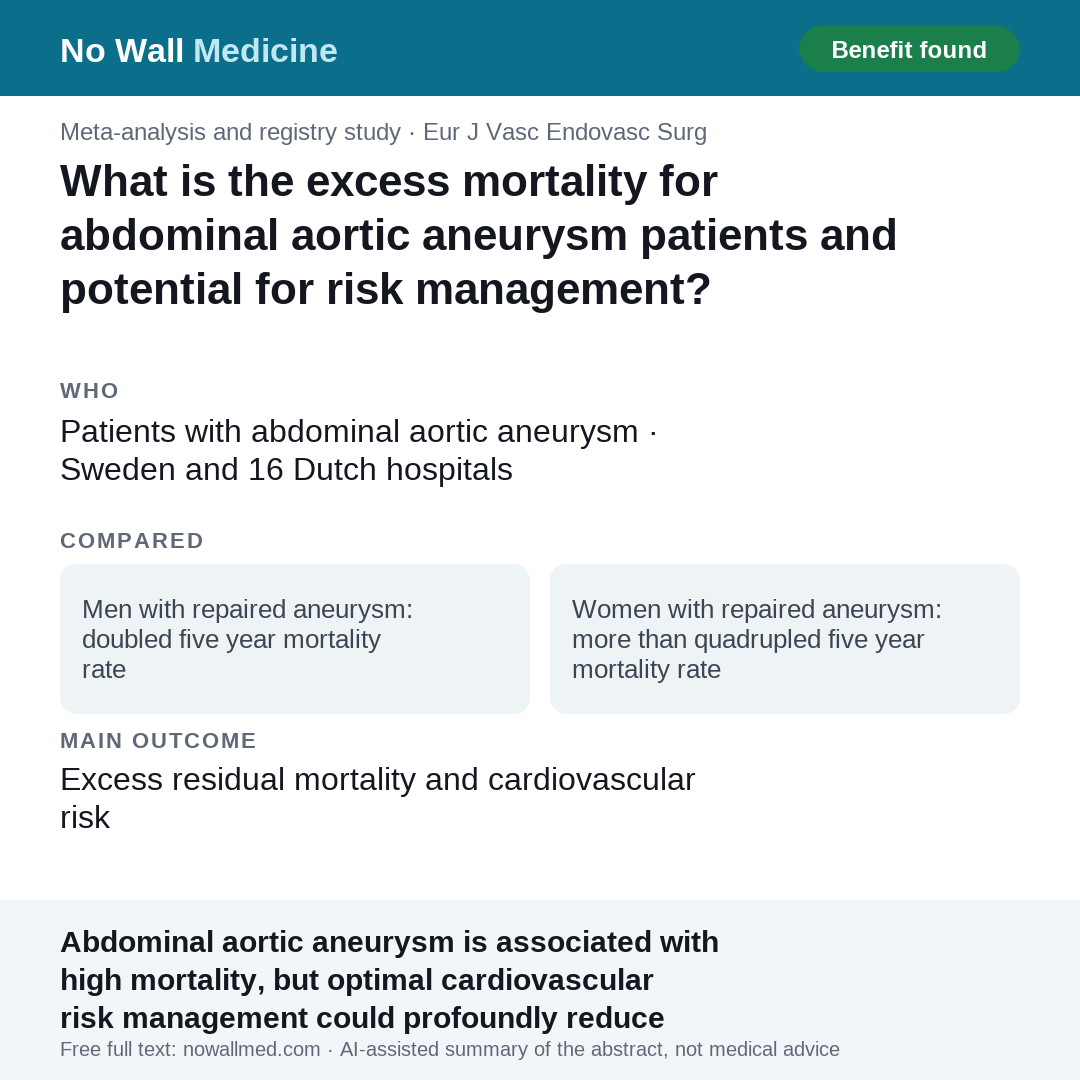
Clinical question: What is the excess mortality for abdominal aortic aneurysm patients and potential for risk management?
Key points
- Researchers used a meta-analysis and Swedish registry data to examine mortality risks in patients with abdominal aortic aneurysms, which are bulges in the main artery of the body.
- Swedish data showed a five year mortality rate that was more than doubled for men and more than quadrupled for women after aneurysm repair.
- Using a risk score algorithm, optimal implementation of cardiovascular management guidelines was predicted to reduce the 10 year risk of major adverse cardiovascular events from 43% to 14%.
Headline and key points written with AI from the paper’s abstract, with every number checked against it. Read the paper before relying on them.
Was this summary helpful?
Subject terms
Headline, design, result, key points, caveat and citation as plain text.
Cite this article
Tomee SM, Bulder RMA, Meijer CA, et al. Excess Mortality for Abdominal Aortic Aneurysms and the Potential of Strict Implementation of Cardiovascular Risk Management: A Multifaceted Study Integrating Meta-Analysis, National Registry, and PHAST and TEDY Trial Data. Eur J Vasc Endovasc Surg. 2022. doi:10.1016/j.ejvs.2022.11.019
Spotted a mistake? Suggest a correction